Showing posts with label Central America. Show all posts

Monday, October 10, 2011

Inside Mexico’s Peace Movement

by Kristin Bricker, The Indypendent


Photo by Santiago Navarro F.
On Sept. 10, thousands of people marched through the besieged resort town of Acapulco to greet the Caravan for Peace with Dignity and Justice led by Javier Sicilia, a poet who ignited a nationwide movement against drug war violence this spring after his son was murdered.


In recent years, Acapulco has endured a plague of violence — beheadings, massacres of tourists, kidnapping of schoolchildren and demands from criminal gangs that teachers pay 50 percent of their salaries as protection money. In the vast majority of the cases, no one has been charged with these crimes.

Armed with signs and T-shirts that said “No more violence,” “Stop kidnappings and crime,” and “No more militarization, we want education,” locals faced down their fear of being identified by halcones or cartel spies, and marched for peace.
“They asked me if I was afraid to participate,” said Yuridia Betancourt, whose son Christian Obeth was kidnapped on March 19. “I’m panicked. But I’m more afraid to stay at home with my arms crossed.”

However, moments after the peace march swept by Zaragoza Street, several blocks from the central plaza where the marchers rallied, unidentified gunmen shot and killed Antelmo Petatan Vasquez in his taxi in broad daylight, a fate shared by a growing number of cabbies who are often suspected of working as informants for the cartels or are forced to pay them “quotas” in exchange for the right to work. Petatan Vasquez was one of eight people murdered that day in Acapulco; three were killed during the march.

Petatan Vasquez’s killing marked another in the more than 40,000 deaths that have occurred in Mexico since conservative President Felipe Calderón escalated the government’s war on drug cartels in January 2007. It also underscored the challenges faced by Sicilia and the antiwar movement as it ventured into southern Mexico for the first time, hoping to build on earlier momentum.

Breaking the Fear

Rural and mountainous, southern Mexico is more impoverished and has a much greater percentage of indigenous peoples than the northern part of the country. And while southern Mexico generally has less violent crime than northern states, organized crime and government security forces are victimizing certain sectors of the population at alarming rates.
Located several hundred miles southwest of Mexico City, the state of Guerrero bore the brunt of a government counter-insurgency campaign against leftist guerrillas from the 1960s to 1980s. The Guerra Sucia (or, “Dirty War”) carried out by the army and its paramilitary allies officially ended almost three decades ago. Nowadays, Guerrero residents are suffering some of the worst abuses of the drug war, as, the military remained in Guerrero and a climate of government corruption has assured that crimes committed against locals are almost never punished.

“The Dirty War never ended in Guerrero,” argues Rosario Cabañas, the niece of Guerrero school teacher and guerrilla leader Lucio Cabañas who was killed in 1974. “Unfortunately, thanks to [the Dirty War], peace and justice were lost. For 40 years, there has been impunity and injustice.”

Calderón’s militarized response disrupted drug trafficking routes and the cartels began to battle for control of Guerrero, which includes the coastal enclave of Acapulco. Residents found themselves caught in the middle. Unsurprisingly, the conflation of political and criminal violence gave birth in Guerrero to Mexico’s first narco-paramilitary organization, the “Liberator of the People Army” led by local political boss Rogaciano Alba.

Sharing Stories

Composed of 15 buses carrying more than 700 activists, journalists and family members of victims, the caravan rolled through 19 towns and cities in seven states over 10 days in mid-September. At every stop, caravaneros and locals marched for peace. The marches always ended in rallies where drug war victims from the north shared the stage with local victims to tell the world about how they have suffered in the so-called “war on organized crime.” At each stop, Sicilia’s Movement for Peace with Justice and Dignity collected complaints about violence and human rights abuses, just as they had done in the north.

Mexico’s drug cartels were significantly strengthened in the early 1990s as junior partners to their counterparts in Colombia who were finding it increasingly difficult to ship cocaine to the United States through the Caribbean. In recent years, thanks in large part to the Colombian cartels’ decreased control over shipping routes, the Mexican cartels have become fully diversified organized crime syndicates and have expanded into new areas such as kidnapping, extortion, prostitution and human trafficking.

Approximately 40 Central American migrants traveled with the Peace Caravan, calling attention to how the cartels frequently prey on immigrants.

Mexico’s harsh U.S.-backed immigration laws force the hundreds of thousands of Central American migrants who enter Mexico each year to travel clandestinely, which puts them at great risk of being kidnapped by organized crime, caravan participants explained. When migrants are detained by authorities, they are sometimes handed over to criminal groups for a bribe.

During the caravan, the Central American migrants described how the gangs take people like themselves to safe houses where they are forced to call their families or friends in the United States and hold the telephone in their hands while the criminals torture them into begging their families for ransom money: “I saw them cut off a 14-year-old boy’s finger while his father was listening on the phone,” said one Salvadoran immigrant who says that he, too, was tortured.

Female immigrants are sometimes forced into prostitution or made to perform in pornographic movies. German Guillermo Ramirez Garduaza of the “Santa Faustina Kowalska” migrant shelter in Veracruz estimates that 80 percent of female Central American migrants are raped in Mexico.

Danira Meléndez, a Honduran migrant, recalled how her coyote (paid guide) demanded that she have sex with him. “He told me, ‘Here, I’m just one man. But I work with the Zetas, and if I turn you over to them, it’ll be 15 or 20 men raping you,’” Meléndez recounted. “We know that female migrants are easy sexual merchandise for organized crime.”

A Militant Tradition

Before the Movement for Peace with Justice and Dignity emerged, drug war victims were terrified, isolated and silent. On the two caravans, victims learned public speaking skills and how to organize protests and press conferences and hold more effective meetings with public officials. Now that the caravans are over, the victims will return to their communities, most of which now have local antiwar committees. Whereas before drug war victims were shunned, now they are in a position to become community leaders.

Citing lower turnouts at Peace Caravan events in the south, the Mexican media have portrayed the antiwar movement as losing support. However, this does not take into account the fact that the south has experienced less drug war violence than the north and in places that have been hard hit — like Guerrero and Veracruz — thousands of people turned out to protest the war. Moreover, the south has a long tradition of militant grassroots organizing (see sidebar) and resistance to military occupation that most of the north lacks. Whereas most northern drug war victims are just beginning to organize and define their politics, southern drug war victims are joining experienced organizations and hitting the ground running.
If southern organizations continue to collaborate with Sicilia’s national movement, they will likely provide a counterweight to Sicilia’s strong focus on engagement with authorities, which has included meeting with leaders of all three branches of a government that is widely seen as being complicit in the drug trade it claims to be fighting.

“We still don’t understand why they dedicate so much energy and effort to dialogue with a political class that long ago lost all will to govern and is nothing more than a gang of criminals,” the Zapatistas’ Subcomandante Marcos recently wrote, reflecting the sentiment of many groups in the south.

Mexico holds presidential and congressional elections next year. It remains to be seen how the budding anti-war movement will affect the electoral process. Ultimately, the country’s future depends on whether Mexico’s civil society can be mobilized to cleanse the state of a culture of corruption and impunity that exists at all levels of government.


Kristin Bricker is a Mexico-based freelance journalist covering militarization, social movements and the drug war in Latin America. She blogs at mywordismyweapon.blogspot.com.

Friday, September 16, 2011

On the Mexico-Guatemala Border, Migrants Demand End to the Violence


By Kristin Bricker, Americas Program
The caravan of drug war victims led by Mexican poet Javier Sicilia arrived at the Mexico-Guatemala border in Ciudad Hidalgo, Chiapas, on Sept. 14, where they asked for forgiveness from the migrants who risk their lives to cross Mexico to reach the United States.
Simultaneous marches from the Mexican and Guatemalan sides of the border met on the international bridge that connects the two countries.  The Guatemalan marchers greeted Sicilia and the marchers from Mexico with cries of “Long Live Mexico! Long Live Guatemala!”
Standing on the imaginary line that divides the two countries, Sicilia said, “We came to ask our Central American brothers and sisters to forgive us for having not spoken up before, for not having the consciousness and the strength necessary to prevent the kidnapping and murder that has affected thousands of migrants and Mexican citizens and has torn apart their families.”
When the Caravan for Peace set out from Mexico City on Sept. 9, some thirty Central American migrants accompanied it south towards the border.  Just before dawn on Sept. 14, about ten more migrants from a migrant shelter in Ixtepec, Oaxaca, joined the trek south. In Ciudad Hidalgo, the migrants told of how both organized crime and Mexican authorities abuse them as they cross the country precariously perched on the top of cargo trains.
One young Salvadoran migrant said organized crime members kidnapped him last December in Reynosa, Tamaulipas. The kidnappers called his family in El Salvador to demand ransom money.  His family couldn’t come up with the money, so, on Christmas Eve, the kidnappers called his family so that they could hear him being tortured.
The kidnappers beat him has he held the phone in his hands; they told him that they would kill him if he didn’t cry and beg his family for the money.  He refused to cry, so they beat him harder.  The young man was also forced to witness the torture of other migrants who were being held in the same house.  He saw them cut off a 14-year-old’s finger as the boy’s father listened on the telephone, and he was present when the kidnappers raped a woman in front of the rest of the kidnapped migrants.
“I saw with my own eyes that the police came to the place where we were [being held hostage],” he said. “The police are the most corrupt ones here.”  Four migrants managed to escape and went for help, which is how the young Salvadoran lived to tell his story even though his family couldn’t pay his ransom.
“[Mexican] authorities have robbed me; they’ve beaten me in my travels,” recalled a middle-aged Salvadoran migrant.  “Four months ago, I was violently robbed by [Chiapas] State Police as I crossed the border right here.”  His misfortune didn’t end there.  “My wife was kidnapped in Mexico State. She’s still kidnapped, and because we’re migrants in this country, the authorities don’t want to listen to us.  It’s really difficult to get the authorities to listen to us when we want to report a crime.”
Honduran migrant Daniela Melendez, mother of five, recounted how her coyote, the man she paid to help her cross Mexico and enter the United States, tried to rape her as she traveled through Chiapas.  In an attempt to pressure her to have sex with him, he told her, “Here, I’m just one man.  But I work with the Zetas, and if I turn you over to them, it’ll be fifteen or twenty men raping you.”  Melendez managed to reach the migrant shelter in Ixtepec, Oaxaca, run by Father Alejandro Solalinde. “Father Solalinde’s team in the shelter rescued me,” she recounts.
Melendez was spared, but too many undocumented migrant women aren’t.  Drug trafficking organizations—particularly the Zetas—have branched out into the sex trafficking industry.  The problem is becoming so severe that Fermina Rodriguez of the Fray Matias de Cordova Human Rights Center  said, “When you talk to women, they consider rape to be part of the price they pay to migrate.” Germán Guillermo Ramírez Garduaza of the “Santa Faustina Kowalska” migrant shelter in Veracruz estimates that 80% of female Central American migrants are rapedas they transit Mexico.
As Mexicos’ drug war rages and more and more migrants fall victim to the cartels that have taken over the migrant routes, many Central Americans are still willing to risk traveling through Mexico to reach the United States because they feel as though they have no other choice.
Unemployment or underemployment are the reasons most Central American migrants give for why they decided to travel to the United States.  Two young Guatemalans staying in Father Solalinde’s shelter in Ixtepec, for example, are from sharecropper families who don’t make enough money to survive.  Even though they finished high school, the boys haven’t been able to find work.  So the boys, who are neighbors, made their first attempt to reach the United States.  They want to make enough money to help their families get ahead, and then they plan to return to Guatemala.
Twenty-one-year-old Francisco Rivera* first migrated to the United States from his native Honduras when he was twelve years old.  A gang was threatening to harm his family if he didn’t join, and his older brother’s job sewing American Eagle clothing in Honduras’ “free trade zone” wasn’t enough to pay his family’s bills.  After several attempts, he managed to reach the United States, but was deported back to Honduras.
In 2008, his father, the leader of an organization that helped landless peasants occupy government land to obtain deeds, was assassinated.  Rivera’s family believes a mayor who lost land to his father’s organization ordered the execution.  Days after the Honduran coup occurred in 2009, Rivera was nearly shot as a coup supporter opened fire on his neighborhood.  As more and more bodies were dumped in his neighborhood in the weeks following the coup, Rivera’s mother told him, “I’d rather you be far away than dead,” so Rivera migrated again.  This time, he sought political asylum in the United States.  After spending a year in jail in general population as he fought for asylum, his petition was denied and he was deported.  Rivera is now on his way back to the United States.
In crafting its immigration policy, the Mexican government is taking a cue from the United States.  Whereas migrants cross Guatemala fairly easily and inexpensively by bus, Mexico’s strict immigration enforcement means migrants must take extra precautions.  “You can cross Guatemala in a bus, and if the authorities catch you they might make you pay a bribe of 100 quetzales (about $12 dollars),” says Rivera. “In Mexico they have so many immigration checkpoints along the highways.  And if they catch you at one checkpoint, they’ll make you pay a $500 peso ($38 dollar) bribe, but then they’ll radio ahead to the next checkpoint to advise them that you’re coming so that they make you pay the bribe at that checkpoint, too.  When you get to the last checkpoint they’ll detain and deport you even though you already paid all those bribes.”
Mexico’s immigration checkpoints mean that many migrants prefer to brave the elements while perched on top of cargo trains.  Some fall off and are maimed or killed by the train, and others are pushed off by organized crime members looking to extort money from the migrants. Still, every day thousands of migrants ride Mexico’s rails.
Rivera calls Mexico’s immigration policies hypocritical: “Mexico demands respect from the United States for Mexican citizens, but they treat us so terribly, and they accept money from the United States through the Merida Initiative.”  The Merida Initiative, an aid package designed to support Mexico’s war on drugs, provides funds to expand immigration databases and monitoring, and equip and train border personnel. It includes support to implement biometric tracking of immigrants and build up security measures on both Mexican borders.
But some studies show that U.S. and Mexico’s tough immigration policies are actually driving migrants into the hands of organized crime.  According to a 2003 brief by the American Immigration Law Foundation:
“A July 2002 study by the Public Policy Institute of California concluded that there is no ‘statistically significant relationship between the build-up and the probability of migration. Economic opportunities in the United States and Mexico have a stronger effect on migration than does the number of agents at the border.’ The study found that ‘the number of unauthorized immigrants in the United States has increased’ since the strategy was first implemented, due in part to the fact that ‘migrants who successfully cross the border stay longer in the United States than they did in the past.’ The study also notes that the more dangerous border crossings have led to the ‘increased use of hired guides, or coyotes,’ which ‘may have expanded the very profitable human smuggling industry.’”

Migrants Targetted
Increasingly dangerous conditions for migrants in Mexico have led them to support the nascent Movement for Peace with Justice and Dignity, which seeks to end violence and impunity in Mexico. While the migrants aren’t the only drug-war victims in the Movement, they are the only ones who have consistently been attacked while participating in Movement-related caravans.
When Sicilia called for a four-day march from Cuernavaca, Morelos, to Mexico City this past May, Central American migrants organized a trek from southern Mexico to meet the march in Mexico City.  The plan was to walk along the railroad tracks that lead to Mexico City.  The migrants never made it to the march in Mexico City because on May 6 in the state of Veracruz, gunmen attempted to kidnap women from the group.  The presence of media that was covering the migrants’ march apparently scared away the gunmen, but they told the terrified migrants that they would return.  The migrants called Mexican authorities for help, but for hours no law enforcement agency showed up to protect them.  The migrants were left stranded by the tracks for the rest of the day, terrified that their attackers would return.
In June, migrants organized a second protest, this time a five-day caravan that would travel on top of the trains from Ixtepec, Oaxaca, to Veracruz. On June 24, gunmen armed with assault rifles stopped the train and kidnapped 40 to 60 of the 250 migrants who were onboard.  Those migrants are still missing.
Migrants organized yet another caravan, the “Step by Step Toward Peace” Caravan from July 25-August 2, to protest violence against migrants.  This time, they travelled with family members of Central American migrants who went missing in Mexico.  After the second caravan, one of the participants, 19-year-old Guatemalan migrant Julio Fernando Cardona was detained by municipal police in Tultitlán, Mexico State, according to witnesses.  Later that day, Cardona’s body was found dumped along the railroad tracks in Tultitlán.  He had been stoned to death.  Cardona’s participation in the second caravan led to an unusually high amount of media attention to his case.  Under pressure, the government investigated the police that witnesses identified, and it found blood in the bed of the officers’ pickup truck, according to a source close to the case.
The brazen violence against migrants participating in the protest caravans has underlined the need for Mexico to make immediate changes to how it treats immigrants. Migrants and human rights defenders demand that Mexican authorities investigate crimes against migrants and punish the perpetrators. Migrants are also demanding that Mexico allow them to legally pass through the country on their way to the United States by cancelling the requirement that Central Americans hold visas in Mexico. North American and European travellers, for example, are automatically given tourist cards when they arrive at any Mexican port-of-entry, making the visa application process unnecessary for them.  The migrants say that if they were permitted to legally travel through Mexico, they would stop using the dangerous trains and would start using buses to cross the country.
The migrants on the peace caravan say that despite their fear that their participation in the protests will make them targets, the caravans are working.  They note that due to pressure from the caravans, the Mexican government has awarded 300 visas to migrants so that they can safely travel through Mexico. Moreover, two Central American mothers who participated in the “Step by Step Toward Peace” Caravan found their missing sons alive and well in Mexico, thanks to the caravan. Also, the police officers who allegedly killed Julio Fernando Cardona have been arrested, although it remains to be seen if they will do time for the brutal murder.
Many Central American migrants say they are glad to march side-by-side with Mexicans against the drug war, because migrants have to endure the same violence that terrorizes Mexicans on a daily basis.
“We’re here to support Mexico,” says Angie, a 21-year-old migrant who participated in the second caravan and is on the Caravan for Peace with Sicilia now.  “There are a lot of people from other countries who migrate through Mexico every day, and we know about the kidnappings and the extortion all too well.”
* This name has been changed.
Kristin Bricker is a reporter in Mexico. She is a contributor to the CIP Americas Program www.cipamericas.org and is currently covering the 10-day Caravan of the Movement for Peace with Justice and Dignity for the Americas Updater.

Wednesday, October 13, 2010

Coup in Ecuador?

by Kristin Bricker, NACLA

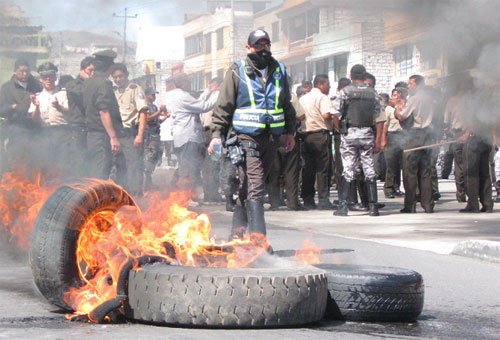
On September 30, about 1,000 Ecuadoran national police officers took to the streets, blocking key intersections and taking over public space, in protest of a new law that eliminated their bonuses and other benefits.
Even though the protesting police represented a small fraction of the 42,000-member force, things quickly spun out of control. The police occupied Congress, helped shut down airports, and held Correa hostage in a hospital for more than 10 hours until an army Special Operations team rescued him. The unrest left 10 dead and 274 injured.
The police rebellion began after Correa used line-item vetoes to change certain parts of the Public Services Law, which reportedly aimed to streamline Ecuador’s public sector by doing away with certain bonuses and forcing many public servants into early retirement. The president’s line-item veto power is provided for under the country’s 2008 constitution, and the president has often used it to overrule Congress.
According to Edwin Bedoya, vice president of the Ecuadoran Federation of Unitarian Working Class Organizations (CEDOCUT), the version of the Public Services Law that Congress originally passed was crafted in negotiations between Correa’s Alianza PAIS party and public servants. “But we saw in the second round of voting that the president had vetoed the agreements and had gotten rid of certain workers’ rights,” Bedoya said. When Congress, including some members of Alianza PAIS, balked at Correa’s changes to the legislation, the president threatened to use his right to dissolve Congress to pass his version of the Public Services law.
But the ensuing rebellion, Correa and others have emphasized, was not a spontaneous uprising. While still being held hostage, Correa declared: “It is a coup attempt led by the opposition and certain sections of the armed forces and the police.” Many Latin Americans, still rattled by the successful coup against leftist President Manuel Zelaya in Honduras last year, feared Correa would be next. Others argued that calling the unrest a “coup” is an exaggeration, or even that Correa kidnapped himself in order to increase his popularity and political power.
Yet the protests took place in at least four provinces in Ecuador, casting doubt on their spontaneity. And as Correapointed out, the protests were “coordinated with the closure . . . of the airport, coordinated with the attacks on the [state television’s] relay antennas, with the invasion of [government-owned] Ecuador TV’s studios,” and the police takeover of Congress.
Moreover, video footage of the striking police during the operation that freed Correa clearly demonstrates that the police were shooting to kill. Correa told the press that the armored vehicle that drove him away from the hospital wasshot multiple times.
While police held Correa hostage, former Ecuadoran president Lucio Gutiérrez—an outspoken critic of Correa—gave interviews from Brazil, hailing the police rebellion as a coup. “The end of Correa’s tyranny is at hand,” he said, and called for the “dissolution of parliament” and “early presidential elections.” Former president of Congress Alberto Acosta, a Correa supporter turned critic, reported that “ex-soldiers and ex-police, the very people that make up the fat of the Lucio’s party,” were seen in barracks in multiple cities. When police briefly occupied Congress, Acosta added, the representatives who are members of Gutiérrez’s Patriotic Society Party entered and exited freely, while members of other parties “had trouble entering.”
Both Correa and former National Police commander Freddy Martínez, who resigned after his failure to control his troops, argue that outside instigators infiltrated the police, misled police about his austerity measures in the Public Service Law, and provoked the uprising. Labor and indigenous organizations in Ecuador, however, have taken a more nuanced line. The police rebellion occurred, they argue, because Ecuador’s right wing is taking advantage of weaknesses created by Correa’s alienating governing style. Although they opposed any coup attempt and demanded that constitutional order be respected, they also criticized Correa for marginalizing his natural allies in the social movements and leaving himself vulnerable to attacks from the right.
A joint statement from four of Ecuador’s largest indigenous organizations rejected the “right-wing’s actions that in an undercover way form part of the attempted coup” and called upon its members to “be on alert and ready to mobilize.” However, the statement criticizes the Correa administration for violently repressing mobilizations against transnational mining, oil, and agro-industrial companies. The organizations argued, “The social crisis that was let loose today was also provoked by the authoritarian character and the unwillingness to dialogue in the lawmaking process. We have seen how laws that were negotiated [with social sectors] were vetoed by the President of the Republic. . . . This scenario nurtures the conservative sectors.”
Labor leader Bedoya says that on September 30, the CEDOCUT called on all sectors to hit the streets to restore constitutional order. However, like his country’s indigenous organizations, he qualified his organization’s defense of Correa: “We do believe that part of the blame for what is happening lies with not accepting dialogue with social sectors.”
Acosta, who co-founded the Alianza PAIS with Correa, echoed this. “The president and his government don’t know how to dialogue,” he said. “They impose their laws, without even respecting the criteria of the assembly members of their own block.”
Even worse, argued indigenous organizations on the day of the coup, the Correa administration has repressed them just as right-wing governments have. “Faced with the criticism and mobilization of communities against transnational mining, oil, and agro-industrial companies,” wrote the CONAIE, the ECUARUNARI, the CONFENIAE, and CONAICE, “the government, instead of creating a dialogue, responds with violence and repression. . . . The only thing this type of politics provokes is to open spaces to the Right and create spaces of destabilization.”
Bedoya shares this analysis: “Of course the right takes advantage of this, and takes advantage of the most powerful sector, which is the national police and the military, and it begins to sow discontent . . . but the government’s behavior is making that possible.”
Acosta hopes that his former ally will learn from the police rebellion. “History has given to President Correa, once again, the opportunity to reacquaint himself with the origins of the revolutionary process, to rectify. Hopefully he understands it that way.”
“A Citizens’ Revolution,” argued Bedoya, “implies a respect for the rights of all people, of the workers, of organizations’ collective rights, and to establish a dialogue to reach a minimum consensus with the social sectors.”

Thursday, September 30, 2010

"Attempted Coup" in Ecuador

Update, 9:30pm Mexico time (10:30pm EST): The military rescued President Rafael Correa from the hospital where police where holding him hostage. There was heavy gunfire, and multiple people are reported injured, including at least one soldier.

The government of Ecuador has announced that an attempted coup against President Rafael Correa is underway.  Correa brought Ecuador into the Bolivarian Alliance for the Americas, of which overthrown Honduran president Manuel Zelaya was also a member.

The unrest in Ecuador stems from a police protest over bonuses that they allege were taken away from them.  The Ecuadoran government claims the police were compensated for this loss of bonuses in other ways.

Correa reports that police are holding him hostage in a hospital where he was being treated after police attacked him with teargas. 

Correa enjoys the continued support of civilians, Congress, the Joint Chiefs of Staff, and the international community.

I am posting updates to Twitter with photos and translations of breaking news as the situation develops in Ecuador.  Follow me here: http://www.twitter.com/kristinbricker


Friday, September 3, 2010

The Truth About the Immigrant Massacre in Tamaulipas

by Gennaro Carotenuto
translated from Italian to Spanish by S. Seguí for Rebelión
translated from Spanish to English by Kristin Bricker

Coffins containing the remains of 72 immigrants massacred
in Tamaulipas. (AP)
Regarding the massacre of 72 immigrants in the [Mexican state of] Tamaulipas, where the judge in charge of the investigation and the mayor of the town of Hidalgo were also murdered shortly thereafter, the global disinformation complex has wanted to have us believe that the victims were being recruited by drug traffickers or that they were trying to sell themselves to the cartels, or that maybe they had refused to be hired as hit-men.

This interpretation lacks basis.  It is slanderous and racist, and it seeks to hide the truth about the exploitation--down to the last cent their lives are worth--of the 600,000 Central and South American immigrants who attempt to cross Mexico every year.  The reality is that these immigrants are the constant victims of extortion, harassment, rape, and threats even before they begin to cross the desert--the wall constructed by George Bush--to be victims of the Minutemen patrols--those armed "anglo" patrols in the US--, of racist state laws such as Arizona's, and of so many other vicissitudes in their quest for work in the United States.  According to Catholic priest Alejandro Solalinde, from the moment the "cachucos" (a slur that means "dirty Central Americans") leave their country, "they stop being people and they turn into merchandise, into a gold mine for both the mafias and the authorities."

Mainstream media portrays them as low-cost criminal labor for drug traffickers, society's trash, undesirables, accomplices or even members of the mafia, and therefore without rights nor human dignity.  Now pilot-less aircraft or "drones" will be used against them.  Those drones won't manage to stop the entrance of even one gram of cocaine, but they will help to throw the immigrants into organized crime's open arms.  In reality, these immigrants are victims of a true humanitarian emergency that the Obama and Calderón administrations should deal with.

Immigrants are a business worth $3 billion dollars per year, which is divided up amongst the criminal cartels and corrupt police forces, both in the US and in Mexico.  To cross to the other side they pay between $4,000 and $15,000 dollars.  Often, it is only the principle of martyrdom that drives the "American dream," which has already been achieved by (in addition to tens of millions of Mexicans) a million Hondurans, two million Salvadorans, and three million Guatemalans who send about $10 billion dollars in cash remittances to their families in their countries of origin every year.

According to Felipe Arizmendi Esquivel, the bishop of San Cristóbal de las Casas, Chiapas, at least two-thirds of immigrants suffer extortion or robbery once they are in Mexico, and one out of every ten is raped during the trip. About one-fifth is detained and sent home.  This is a shrinking number, because [the authorities] who intercept the immigrants prefer to get money out of them rather than send them home.  The situation has gotten much worse over the past decade with the violent campaign against immigrants that George Bush led when he constructed the wall between the US and Mexico, which will soon be complemented by a double wall on the border between Mexico and Guatemala.  The measures that have been adopted to detain immigration, just like those along other borders between the South and the North, do not impede human trafficking; they do no more than raise the price, making the business more lucrative and putting immigrants lives even more at risk.

Every year, according to official statistics, at least 20,000 immigrants are kidnapped by criminal cartels and forced to pay, in addition to the cost of their passage across the border, ransoms of between $1,000 and $5,000 dollars each.  They become trade items between the cartels, as if they were packages, or they are murdered has hostages in order to convince others to pay.

According to Jorge Bustamante, the United Nations Special Rapporteur on Immigration, Mexico is undoubtedly the country where the worst human rights abuses on the continent are committed, enabled by the media's shameful silence.  The media is always ready to write pages of condemnation about integrationist governments, but they are always silent about the Mexican hell. 

In 2009, Mexico's National Human Rights Commission (CNDH) published a volume entitled "Welcome to the Kidnappers' Hell," in which it denounced the mistreatment of Central American immigrants and collected numerous testimonies regarding the involvement of Mexican authorities in the kidnappings.

The report describes kidnapping's characteristics.  The immigrant is usually detained by the police and sold to criminal organizations, who sent him to isolated places like the San Fernando ranch where the Tamaulipas massacre occurred.  There, the beatings, the harassment, the rapes, and the torture begin.  The goal is to obtain family members' telephone numbers so that [the criminals] can obtain exorbitant ransoms from the immigrants, almost all of them very poor.  In general, those who cannot pay are murdered.

The Tamaulipas massacre fits within this atrocious context of 20,000 kidnappings per year.  Seventy-two immigrants who probably couldn't pay were shot just like in the Nazi massacres.  We know about it only because Freddy Lala, an 18-year-old Ecuadoran, managed to survive and alert others after walking over 20 kilometers with a bullet in his neck.  Or maybe it was that, just like in the times of Plan Condor or the genocide in Guatemala, they allowed him to survive so that he  would tell the story and cause more terror.

Immigrants are victims, not accomplices.


Gennaro Carotenuto, a lawyer with a doctorate in History, teaches the History of Journalism in the University of Macerata (Italy).  Scholar of international politics, dictatorial regimes, and the Contemporary History of Latin America, he also teachers Geopolitics and Oral History at the same university, and has been a visiting professor in the University of Montevideo (Uruguay).  In 2005 he published Franco e Mussolini, la guerra vista dal Mediterraneo (Milan) and in 2007 he edited the fourth volume of "Storia e Comunicazione. Un Rapporto in Evoluzione" (EUM).

S. Seguí is a member of the Rebelión collective and Tlaxcala, a network of translators for linguistic diversity.  The [Spanish] translation can be freely reproduced under the condition that its integrity is respected and that it mentions the names of the author, the translator, and the source.

Sunday, June 28, 2009

COUP IN HONDURAS

The following is an article I wrote for Narco News. I will not be actively updating this blog today as I focus all of my energies on covering the coup for Narco News. For up-to-the-minute information on the coup in Honduras, go to narconews.com

School of the Americas-Trained Military Detains and Expels Democratically-Elected President Zelaya

Early this morning approximately 200 Honduran soldiers arrived at President Manuel "Mel" Zelaya's residence, reportedly fired four shots, and detained the President. Zelaya told TeleSUR that the soldiers took him to an air force base and put him on a plane to Costa Rica.

Zelaya told TeleSUR from San Jose, Costa Rica, "They threatened to shoot me." Honduras' ambassador to the Organization of American States, Carlos Sosa Coello, reports that the president has been beaten up.

Zelaya told TeleSUR that he doesn't believe it was regular soldiers who kidnapped him. "I have been the victim of a kidnapping carried out by a group of Honduran soldiers. I don't think the Army is supporting this sort of action. I think this is a vicious plot planned by elites. Elite who only want to keep the country isolated and in extreme poverty."

Zelaya fears for the safety of his family, who remains in Honduras. He pleaded with TeleSUR viewers to seek a way to "have a dialogue with these soldiers so that they don't harm my family, so that they don't shoot anybody. We can settle our differences through dialogue."

The anti-Zelaya President of Congress, Roberto Micheletti, has declared himself interim president of Honduras. On the Friday before the coup, Zelaya called Micheletti "a pathetic, second-class congressman who got that job because of me, because I gave you space within my political current."

Zelaya informed TeleSUR that he has not requested asylum in Costa Rica, and that he will return to Honduras as its president to complete his term, which expires in 2010.

Honduran Media Shut Down

Radio Es Lo De Menos, an independent radio station reporting from Honduras, issued a press release before its power was cut. The press release states that several cabinet members have been detained, and there are arrest warrants out for other cabinet members as well as leaders of social organizations. It calls on the international community to hold protests outside Honduran embassies and consulates.

TeleSUR reports that the soldiers have also arrested the Cuban, Venezuelan, and Nicaraguan ambassadors to Honduras, as well as Chancellor Patricia Rodas. The Venezuelan ambassador told TeleSUR that the soldiers beat him during the kidnapping. La Prena reports that soldiers have detained at least one pro-Zelaya mayor, San Pedro Sula's Rodolfo Padilla Sunseri.

Cell phones are reportedly no longer working in Honduras. The power has been cut in at least some parts of the country, disabling independent media and state television stations for the time being. Before the state televisions went off the air, Channel 8 managed to communicate to its viewers, "It appears as though the soldiers are coming here." Seconds before it went off the air, Channel 8 told citizens to gather in the Plaza de la Libertad. Channel 8 appears to have been taken over by the military, but it is still not transmitting.

Honduras' privately owned Channel 12 and Channel 11 are showing classic soccer clips.

Soldiers Block Opinion Poll

Soldiers have also moved to block the opinion poll that sparked the coup. Today Hondurans were supposed to register their opinion in a non-binding poll that asked them, "Do you think that the November 2009 general elections should include a fourth ballot box in order to make a decision about the creation of a National Constitutional Assembly that would approve a new Constitution?" The poll would have had no legal weight.

In the town of Trujillo, soldiers have taken the streets and are not allowing citizens to vote in the opinion poll.

In Santa Rosa, soldiers reportedly under the orders of the Federal Prosecutors Office have seized ballot boxes from schools and public places.

Soldiers seized ballot boxes in Dulce Nombre Copan as well, but citizens have gone to the military base to take them back again.

In Santa Barbara, La Prensa reports that the opinion poll is going on as planned, with no interference thus far from the military.

Soldiers are also carrying out operations on the country's major highways, according to La Prensa. The situation could get ugly on the highways, as La Prensa reports that peasants from the Guadalupe Carney community have taken over some highways.

School of the Americas Connection

The crisis in Honduras began when the military refused to distribute ballot boxes for the opinion poll in a new Constitution. President Zelaya fired the head of the Joint Chiefs of Staff, Romeo Orlando Vasquez Velasquez, who refused to step down. The heads of all branches of the Honduran armed forces quit in solidarity with Vasquez. Vasquez, however, refused to step down, bolstered by support in Congress and a Supreme Court ruling that reinstated him. Vasquez remains in control of the armed forces.

Vasquez, along with other military leaders, graduated from the United States' infamous School of the Americas (SOA). According to a School of the Americas Watch database compiled from information obtained from the US government, Vasquez studied in the SOA at least twice: once in 1976 and again in 1984.

The head of the Air Force, Gen. Luis Javier Prince Suazo, studied in the School of the Americas in 1996. The Air Force has been a central protagonist in the Honduran crisis. When the military refused to distribute the ballot boxes for the opinion poll, the ballot boxes were stored on an Air Force base until citizens accompanied by Zelaya rescued them. Zelaya reports that after soldiers kidnapped him, they took him to an Air Force base, where he was put on a plane and sent to Costa Rica.

Congressman Joseph Kennedy has stated, "The U.S. Army School of the Americas...is a school that has run more dictators than any other school in the history of the world."

The School of the Americas has a long, tortured history in Honduras. According to School of the Americas Watch, "In 1975, SOA Graduate General Juan Melgar Castro became the military dictator of Honduras. From 1980-1982 the dictatorial Honduran regime was headed by yet another SOA graduate, Policarpo Paz Garcia, who intensified repression and murder by Battalion 3-16, one of the most feared death squads in all of Latin America (founded by Honduran SOA graduates with the help of Argentine SOA graduates)."

Honduran Gen. Humberto Regalado Hernandez was inducted into the SOA's Hall of Fame. School of the Americas Watch notes that he was a four-time graduate. As head of the armed forces, he refused to take action against soldiers invovled in the Battalion 3-16 death squad.

School of the Americas Watch points out that this is not the first time the SOA has been involved in Latin American coups. "In April 2002, the democratically elected Chavez government of Venezuela was briefly overthrown, and the School of the Americas-trained [soldiers] Efrain Vasquez Velasco, ex-army commander, and Gen. Ramirez Poveda, were key players in the coup attempt."

According to School of the Americas Watch, "Over its 58 years, the SOA has trained over 60,000 Latin American soldiers in counter-insurgency techniques, sniper skills, commando and psychological warfare, military intelligence and interrogation tactics. Colombia, with over 10,000 troops trained at the school, is the SOA's largest customer. Colombia currently has the worst human rights record in Latin America."

Thursday, June 25, 2009

Coup Fears in Honduras

Civil society organizations and UN General Assembly President Miguel D’Escoto have warned of a possible coup attempt by the Honduran military. D'Escoto's spokesperson said that the Assembly President “clearly and strongly condemns the attempted coup d’etat that is currently unfolding against the democratically elected Government of President Manuel Zelaya of Honduras.” Fears of a coup stem from a military deploymentaround the Presidential Palace and the Toncontín airport on Thursday.

The military and President Zelaya have been at odds over the President's initiative to hold a popular consultation on June 28 to decide if November's presidential elections should include a referendum where citizens would vote on whether or not Honduras should write a new constitution.

Mexico's El Financiero claims that President Zelaya's problems stem from his decision to join the Bolivarian Alternative for the Americas, Venezuelan President Hugo Chavez's alternative to the US-supported Free Trade Area of the Americas.

However, Venezuela's TeleSUR reports that Honduras' current problems stem from that country's free trade agreement with the United States:

Carlos Reyes, an independent Honduran presidential candidate, reported on Thursday that s ince 2005, when the Free Trade Agreement (FTA) with the United States was approved, popular movements "said that that was the final blow to the Constitution, and therefore a new Constitutional Assembly was necessary."

For that reason, President Manuel Zelaya has taken up the cause and has rallied Hondurans around the necessity of holding a referendum during the upcoming elections, explained Reyes in a telephone interview with TeleSUR.

"This has unleashed the wrath of powerful groups, of the dominant classes that have been waging a terrible campaign.  Yesterday they were even talking about a coup," he noted.

Honduras' Supreme Court ruled the June 28 consultation illegal.  Following the Supreme Court's decision, Honduras' Congress unanimously voted to ask the Organization of American States (OAS) to withdraw the three observers it had sent to observe the consultation.  Congress argued that the OAS observers' presence legitimated a process that had been declared illegal by the Supreme Court.

Honduras' La Tribuna reports that following the Supreme Court decision, the military refused to distribute the ballot boxes as originally planned.

High-ranking military officials have refused to distribute the ballot boxes and the rest of the materials necessary for carrying out the consultation.

In retaliation, Zelaya fired the head of the military's Joint Chiefs of Staff, Gen. Romeo Vásquez, and accepted the resignation of Minister of Defense Edmundo Orellana.

Likewise, the commanders of the other branches of the Armed Forces, Military, Navy, and Air Force, quit in solidarity.

La Tribuna reported that the military deployment around the Presidential Palace and the airport immediately followed the firing and resignations.

President Zelaya has called for mass mobilizations in the Honduran capital of Tegucigalpa "to make decisions in favor of Honduran democracy and development."  Peasant leader Rafael Alegría told TeleSUR that peasants, indigenous people, and workers from around the country have set out from around the country towards the capital to support the president, and that some have already arrived.

Today President Zelaya and a caravan of supporters entered the Hernán Acosta Mejía air force base to recover the ballot boxes for the June 28 consultation that the military had refused to distribute.  The president and his supporters loaded the ballot boxes into trucks and removed them from the base so that they can be used for the Sunday consultation.

A correspondent from Radio Es Lo De Menos who travelled with the caravan to the air force base reports that 25,000-30,000 people participated.  The Associated Press, on the other hand, reports that only "dozens" of people entered the base to recover the ballot boxes.  

One caravan participant, interviewed by Radio Es Lo De Menos on a bus on his way to the military base, called for international solidarity in the form of actions at Honduran consulates and embassies: "This is a call to the people and unions of the world to plan actions in solidarity with the Honduran people at consulates and embassies so that this coup doesn't happen."

Meanwhile, the Honduran Congress has convened an investigation into the president's "mental health" to determine if he is still capable of governing the country.


Reposted from Narco News.  More updates will be posted at Narco News.

Wednesday, December 24, 2008

“Wall of Violence” on Mexico’s Southern Border

Calderon’s “two-faced” policy combines police, the military, gangs, and Los Zetas to fulfill US mandate to deter Central American migration


by Kristin Bricker

“Humberto” is a Honduran subsistence farmer. He grows his beans and vegetables without pesticides and herbicides. “The chemicals they put in food these days ruin the taste,” he says. Humberto has a patch of land, a house, a wife, and five children—three of whom still live at home.

Like many small farmers, Humberto has a lot of debt. The bank is going to take his home if he doesn’t come up with the approximately USD$17,000 he owes. So Humberto packed some clothes, kissed the wife and kids goodbye, and headed north to the United States. He told them he’d be back as soon as he’d paid off the debt; it wouldn’t take long.

Humberto had planned to take the route most undocumented Central Americans take north: he took busses, combis (vans), and hitched rides towards Mexico’s southern border. He crossed the Suchiate River that divides Guatemala’s Tecún Umán from Ciudad Hidalgo in Chiapas, Mexico. He took the combis north to Arriaga, Chiapas, where he planned to hop on a freight train, perched precariously on its roof as it headed towards Oaxaca. In Oaxaca he’d hop a different train to Veracruz; from Veracruz he’d hop a train to Mexico state, and from there he’d get on a train headed to one of five crossing areas on the Mexico-US border. He’d figure out how to cross into the US when he got there.

But Humberto’s plans were put on hold in Arriaga. As Humberto waited for the train in Arriaga—it leaves every three days—he made friends with some fellow train-hoppers who said they were Guatemalan. They chatted, shared a couple of kilos of tortillas and a can of sardines that Humberto had scared up (“Woo! We ate rich that day,” he remembers), and dozed on the train tracks. At some point—Humberto doesn’t remember exactly when—the Guatemalans disappeared. He looked around, wondering where they went, and saw why they’d fled so fast: a police patrol was headed his way. An unidentified man dressed in plainclothes accompanied them.

Humberto ran. The police and the man ran faster. The man in plainclothes caught Humberto first. He hit Humberto in the ankle with a club. Humberto’s ankle shattered and he crumpled to the ground. Their job done, police and the man started to leave. They had no interest in arresting Humberto.

“Hey!” Humberto shouted. “You guys can’t just break my foot and leave me here! Take me to a hospital!”

The police and the mysterious man heeded Humberto’s cries. They radioed for an ambulance. The plainclothes man—Humberto doesn’t know if he was police or paramilitary—supported Humberto on his right side. A police officer put Humberto’s left arm around his shoulder and together they helped him to the road and waited until the ambulance came to pick him up.

When the hospital discharged Humberto, he went to the Catholic Church’s Casa del Migrante “El Hogar de la Misericordia” (“House of Mercy”), a shelter for migrants that provides them with food and a roof over their heads. Even though migrants are only allowed to stay for three days while they wait for the train to leave, Father Heyman Vazquez and his humanitarian team let migrants stay longer if the need arises. With his leg in a cast and multiple pins in his ankle, Humberto will be incapacitated for months. The Casa del Migrante will let Humberto stay until he recovers. The shelter has an agreement with the local hospital, which treats shelter residents for free.

Humberto says he’ll continue north when he recovers. He has to pay off that debt or he won’t have a house to go home to.

I ponder Humberto’s bravery in the face of such brutality, more of which is certainly awaiting him further north.

“Did you pay a coyote?” I ask him. Coyotes charge a high price for trafficking migrants through Mexico and across the US border. Their financial agreements with government agents (both US and Mexican) provide their clients with a certain degree of security.

“No, I didn’t,” Humberto replies. “I’m on my own.”

Part of the Price

Humberto’s story is repeated throughout El Hogar de la Misericordia and its sister Casas del Migrante in Oaxaca and Veracruz. The actors often change—sometimes the attackers are gang members, or police, or soldiers, or drug cartel members, or immigration agents. Too often, as in Humberto’s case, they seem to be a combination of several of the above. Together they take advantage of the impunity provided by the government to rob and abuse migrants, forming what several immigration activists have referred to as a “Wall of Violence” that discourages migrants from ever wanting to set foot on Mexican soil.

The “Wall of Violence” is fierce: El Hogar de la Misericordia estimates that 80% of all migrants who pass through Chiapas have been assaulted during their travels. Approximately 30% of the women who come to El Hogar de la Misericordia report being sexually assaulted in la Arrocera, Chiapas, which is only one of many stops along the migrants’ route. Fermina Rodriguez of the Fray Matias de Cordova Human Rights Center, which monitors human rights on Mexico’s southern border, says, “When you talk to women, they consider rape to be part of the price they pay to migrate.”

“Two-faced”

The “Wall of Violence” shouldn’t exist in Mexico. In mid-2007, Mexico decriminalized undocumented migrants. It did away with the ten-year prison sentences the law used to allow and now refers to foreigners who enter the country illegally as “administrative irregularities.” Police and soldiers shouldn’t be carrying out operations—be they official or clandestine—against undocumented migrants. But they do.

On October 15, 2008, Mexico’s President Felipe Calderon met with Salvadoran President Elías Antonio Saca to call on the United States government to decriminalize immigrants in the US. Calderon also agreed to reform regulations that apply to undocumented Salvadorans in Mexico. One promised reform will allow undocumented Salvadorans to enter a Mexican program to earn a bachelor’s degree in English. In announcing the pact between the two nations, Calderon stated that it was necessary to “protect the dignity of people who are in Mexican territory, regardless of their migration situation.”
In August 2008, Calderon had a similar meeting with Honduran President Manuel Zelaya. There, the two leaders called immigration “a human right.” Calderon promised his Honduran counterpart that his country would respect migrants’ human rights in Mexico, and he “reiterated our readiness to prevent cases of abuse and human rights violations that can happen on our southern border.”

However, Central American presidents aren’t the only leaders with a vested interest in how Mexico treats migrants passing through its territory.

Mexico is a participant in the Security and Prosperity Partnership (SPP), a North American initiative that aims to pick up where the North American Free Trade Agreement (NAFTA) left off. It aims to “harmonize” laws, regulations, and procedures related to migration, security, energy, health, trade, the environment, and agriculture. Thomas Shannon, Sub-Secretary of Western Hemisphere Affairs for the US State Department, summed up the SPP in one simple sentence: “To a certain extent, we’re armoring NAFTA.”

The SPP is able to succeed where NAFTA fell short because, unlike NAFTA, SPP initiatives do not need to be ratified by Congress. The North American Competitiveness Council (NACC), a group of thirty business leaders from Mexico, Canada, and the US, issues recommendations under the SPP, and the three countries’ executive branches commit to carry out the recommendations. In this sense, while NAFTA is a treaty, the SPP is more of a handshake agreement.

The SPP specifically deals with the nations’ borders. It aims to facilitate the flow of cargo, money, and “legitimate” people across borders. In its “Prosperity Agenda,” the SPP vows to “identify measures to facilitate further the movement of business persons within North America” [emphasis added] by developing a “trusted traveler program.” At the same time, the NACC recommends that leaders “enhance the use of biometrics in screening travelers destined to North America with a view to developing compatible biometric border and immigration systems.” Biometrics utilize unique biological identifiers such as fingerprints and DNA. The NACC also promised the presidents and prime minister, “We will develop standards for lower-cost secure proof of status and nationality documents.”

Globalization’s double standard under the SPP and free trade agreements such as NAFTA isn’t lost on Father Alejandro Solalinde Guerra, the southern coordinator of the Catholic Church’s Human Mobility Mission Migrants program: “The globalized economy has been, above all, machiavellian and immoral. The markets cross borders freely. Money crosses freely. The volatile speculative market, financial capital, even poultry magnates cross freely. But the migrant population isn’t given the same treatment.” While the SPP opens North American borders to capital and capitalists, it’s closing them to capitalism’s victims.

The SPP’s border recommendations are already being implemented through one of the SPP’s hundreds of programs and agreements: the Merida Initiative, aka Plan Mexico. While Plan Mexico’s aim is to combat organized crime, the US government snuck the SPP’s biometric equipment into the aid package for Mexico’s military and police. This past November 17, US Ambassador to Mexico Antonio Garza helped the Mexican government inaugurate the first of its sixty Plan Mexico-funded laboratories designed to determine the authenticity of immigration documents. While the head of Mexico’s National Migration Institute, Cecilia Romero, says the labs will combat human, drug, and arms trafficking, it’s unclear how they will fulfill all but the first goal. After all, illegal drugs and guns don’t carry immigration papers, and, as the Burro Hall blog points out, “On the list of antisocial activities committed by the cartels, sneaking into the country on false papers is pretty far down the list.”

Calderon’s desire to pander to both his Central American counterparts and the US government leaves Mexico with what a Contralinea editorial cartoon referred to as a “two-faced” immigration policy on the southern border: one on paper and another completely different one in reality. Solalinde argues, “If the Mexican government really wants to demonstrate that it respects human rights, it can’t just sign documents. It has to be consistent in all of its actions through all of its institutions and personnel in order to respect human rights. If it doesn’t do that, it leaves the impression that everything that’s happening on the southern border is state policy. The Mexican government doesn’t have the guts to put up a wall on the southern border. But in a lot of ways it’s putting up a de facto wall, because it’s causing a lot of people to die; it’s making a lot of people turn around and go back. There’s the suspicion that this is a state policy that’s coordinated with and financed by the United States so that migrants aren’t allowed to cross.”

Wall of Violence

“Migrants don’t have rights in Mexico,” says Father Heyman Vazquez Medina, founder of El Hogar de la Misericordia. “It’s ok to beat them, extort money from them, rob them, sexually abuse them, murder them, and nothing happens. Central American migrants’ legal security guarantees appear to be repeatedly and permanently violated by individuals and groups of people who rely on the protection, consent, tolerance, or acquiescence of the State and who have the power of weapons, money, police protection, corruption, and impunity. They have put a price on the head of each migrant.”

Migrant shelter staffers say those who abuse migrants operate with absolute impunity. Most migrants don’t report crimes because they don’t have the time or resources to stay in the town where the crime occurred in order to work on their cases. Others are so traumatized by their experiences that they just want to leave Mexico as soon as possible. Solalinde recalls one case where a woman was kidnapped from one of the shelters he oversees. Solalinde remained in contact with her family throughout the ordeal. When she finally turned up in the United States, she said that the group that kidnapped her forced her to make several pornographies. When they finally brought her to the US-Mexico border, they made her family pay thousands of dollars in ransom. Solalinde offered to fly her back south and pay all of her expenses if she filed a complaint with the government. The woman refused, saying she never wanted to set foot in Mexico ever again.

Even when migrants or human rights organizations do file complaints, they almost never result in arrests or convictions. Solalinde says that almost every time he calls the police because migrants have identified and located their attackers, he can’t find a police force that will arrest the suspects. They all say they don’t have jurisdiction in immigration affairs.

Vazquez says El Hogar de la Misericordia no longer bothers to file complains with Mexico’s official National Human Rights Commission (CNDH in its Spanish initials) when Mexican security forces abuse migrants. Even though he has provided the CNDH with photographic evidence and eyewitness testimony to police and military abuses, the CNDH generally says there is not enough evidence to issue a non-binding recommendation (the only “power” it has).

Migrants’ exploitation in Mexico begins the moment they attempt to cross the Guatemala-Mexico border. Mercedes Osuna of La Semilla del Sur, a Chiapas-based organization that works primarily on indigenous issues, recently followed the migration route from Guatemala to southern Mexico. She explains that a Guatemalan-Mexican “union” of raft owners traffics people and goods across the Suchiate River between Tecún Umán, Guatemala, and Ciudad Hidalgo, Chiapas, in full view of an immigration office located next to the river. The rafts that ferry cheaper Mexican goods to Guatemala cost MX$10 (about 75 cents) per ride. Slightly further down the river, the same “union” uses the same rafts to ferry migrants from Guatemala to Mexico. Migrants pay USD$300. Faced with this steep price and barred from the 10-peso rafts, many migrants choose to wade or swim across. “The river is filthy and it stinks,” Osuna says.
After crossing the river into Ciudad Hidalgo, migrants walk or catch combis north to Arriaga. However, on the route between Ciudad Hidalgo and Arriaga, there is a Mexican immigration office. Osuna explains that to avoid passing this office, undocumented migrants must walk a roundabout route through an area called la Arrocera. La Arrocera is teeming with violent criminals who mug migrants as they pass through. Osuna spoke with some migrants who recently passed through la Arrocera. They told her that in la Arrocera they saw uniformed Chiapas state police in marked vehicles pick up and drop off people who mugged migrants. In la Arrocera, the muggers are painfully thorough: migrants complained to Osuna of being stripped searched. The assailants even checked their victims’ anuses and vaginas for hidden valuables.

Police don’t just offer rides to assailants; they often are the assailants. While immigration violations do not fall within the jurisdiction of the state police, police use migrants’ fear to their own advantage. Osuna explains that while police can’t legally ask migrants for identification (only immigration police can), they do so anyway in order to extort money from them.

Bricks in the Wall

There is, of course, a slightly safer way to migrate: pay a coyote, also known as a pollero. Coyotes charge migrants a hefty fee to shuttle them through unknown lands. Carlos Solis, coordinator of Arriaga’s El Hogar de la Misericordia, says that the coyotes’ price for passage between Arriaga and Ixtepec, Oaxaca, is a thousand pesos (about USD$75).

In Chiapas, the coyotes pay the train machinists to guarantee their clients’ passage. Osuna says that at some popular hop-on points, machinists will slow down the train if coyotes pay them to. On the other hand, if the train is approaching a group of migrants waiting to hop on, but a coyote hasn’t paid, the machinist will speed up the train, increasing the likeliness of injury as desperate immigrants attempt to jump on.

Coyotes also pay machinists for information on when the next train will leave. Osuna witnessed obvious machinist-coyote complicity in Arriaga during her visit there. On the day a freight train was rumored to leave, about 150-200 migrants waited by the train tracks. A train with only four cars began to move, but most of the migrants believed that the train wouldn’t leave with so few cars—engines move around the train yard to pick up cargo and cars, but the trains don’t leave the yard for good until dozens of cars are attached to the engine.

That day, however, the train left the Arriaga station with only four cars. Ten migrants who were accompanied by their pollero knew that the train was leaving and were able to get on. When other migrants saw the pollero’s clients get on, they realized what was happening and chased the train. About thirty of them managed to get on, but over 100 would have to wait three more days for the next train.
Gangs and Los Zetas also enforce the coyote system. Father Solalinde says that a few months ago in Veracruz, a group of people allegedly working for Los Zetas boarded a train full of migrants. The men had lists of the names of migrants who had paid coyotes. They asked each migrant for his or her name and checked the name against the list. If the migrant’s name did not appear on the list, the man with the list told him or her, “You haven’t paid your pollero.” Solalinde recounts, “And if the migrant refused to pay, he was thrown from the train. Several migrants lost limbs that way. And the pollero who doesn’t pay Los Zetas gets it even worse.”

The gangs and Los Zetas have financial incentive to make sure the migrants pay their polleros: Los Zetas, former Mexican soldiers from an elite US-trained Special Forces team who deserted to work in the more lucrative drug trade, charge coyotes a fee to operate in their territory.

Los Zetas don’t stop at taking money from migrants through their coyotes; they also rob and kidnap migrants. This past October, 32 Central American migrants escaped from Los Zetas’ custody in the Mexican state of Puebla. Los Zetas and municipal police had kidnapped the Central Americans and demanded USD$2,500 from each migrant’s family in the United States. Father Vazquez says mass kidnappings of migrants, even women and children, are common.

Solis says that a Chiapas state police commander told him that Los Zetas are also infiltrating El Hogar de la Misericordia. About five or six months ago, Los Zetas were first detected in and around Arriaga. They pose as migrants and enter El Hogar de la Misericordia to gather intelligence on the residents. The Zetas find out who doesn’t have a coyote, which migrants have money, and who is planning to receive wire transfers. They report this information to their colleagues, who later rob the migrants.

Zetas have also been seen photographing migrants on trains. Solis says they even take his picture sometimes.

Criminal Organizations Unite Across Borders

While Los Zetas started out as the Gulf cartel’s private army, they appear to be diversifying their operations. The DEA reported this year that it believes Los Zetas are attempting to break free from the Gulf cartel to form their own cartel. Furthermore, Los Zetas are reportedly purchasing land along the Guatemala-Mexico border to store and traffic drugs. The News’ Malcolm Beith reports that Zetas kill bus drivers and business owners in Tecún Umán if they don’t pay the fees the criminal organization demands.

Los Zetas have entered the immigration industry in southern Mexico with relative ease and little resistance from other more established Mexican cartels. Solis says this is due to their links with other southern criminal organizations.

This month FBI director Robert Mueller reported that Los Zetas have “periodic contact” with the notorious M-18 and MS-13 (Mara Salvatrucha) gangs in El Salvador, the birthplace and stronghold of Central American gangs. Solis says these gangs work together with Los Zetas in Honduras, as well.
Further north, Los Zetas have found natural allies in a Guatemalan group called kaibiles. Kaibiles, much like Los Zetas, were Guatemalan Special Forces soldiers trained by the US during Guatemala’s dirty war. They committed some of the worst atrocities during that country’s brutal civil war, and then they deserted to work in drug trafficking. The working relationship between Los Zetas and the kaibiles dates back to at least 2005, when the US Department of Homeland Security notified the Border Patrol that kaibiles were training Los Zetas in a McAllen, Texas, ranch.

“Did you pay your coyote?”

Carlos is on his twelfth attempt to reach the United States. He says there’s just too much poverty in his native Honduras.

Carlos arranged for his sister to wire him money along the way so that he didn’t have to travel with a lot of cash. When he reached Arriaga, she wired him USD$300. On his way back to El Hogar de la Misericordia, a group of men jumped him. Some of them were Mexican, and some were Central American. They stole his $300 and everything else he was carrying. Then they brutally beat him. Carlos has a concussion, lost hearing in his left ear, and has bruises and wounds all over his body. He can barely walk and suffers excruciating headaches. Even though the attack happened days ago, Carlos still has blood all over his shirt.

“Are you going to file a complaint?” I ask.

“No, they don’t do anything,” Carlos replies.

“Did you pay a coyote?”

“No, I’m on my own.”