Tuesday, October 26, 2010
Chile Rescue Stirs Up Bitter Memories of Mexican Mining Disaster
The rescue of 33 miners who spent 68 days underground following a cave-in a Chilean copper mine has struck a nerve in Mexico, where the widows of 63 miners killed in the Pasta de Conchos disaster are still fighting for justice and the right to give their husbands a decent burial.
On February 19, 2006, an explosion in the Pasta de Conchos coalmine, located in the state of Coahuila, buried sixty-five miners. Only two bodies were ever recovered. Grupo México, the Mexican company that owns the mine, left the other sixty-three bodies in the ground.
As the the Chilean miners were raised to the surface on October 13, widows and other family members gathered at the Pasta de Conchos mine to ask themselves what would have happened if the Mexican government had responded as the Chilean government did. "In Chile they declared that they were alive," said the families in a statement. "They didn't condemn them to death, they weren't discouraged by the 700 meters that separated them, nor by the fact that a rescue beyond a depth of 300 meters had never been attempted before." The Pasta de Conchos miners' location is estimated to be only 150 meters below the surface.
The mining union that represented some of the miners killed in the Pasta de Conchos argues that, in contrast with the Chilean response, "Grupo México, with the [Mexican government's] full complicity, decided to close the mine only five days after the incident, when there was still hope that the trapped miners were alive. It condemned them to death and, above all, covered up the real causes of the tragedy."
Raúl Vera López, the bishop of Saltillo, Coahuila, said that he suspects that Grupo México doesn't want to recover the remaining 63 bodies for fear of proving that at least some of the miners survived the explosion and died awaiting rescue. "If they find the bodies all together, with clothing, bones, helmets," argues Bishop Vera, "it means that they were waiting to be rescued."
Grupo México justified calling off the rescue after only five days by arguing that it was impossible that any miner survived the explosion, which Coahuila Gov. Humberto Moreira said had reached temperatures of 600˚C. The company also presented a report that claimed that the air inside the mine could not sustain life. The report was based on air samples taken from air ducts. However, samples were taken from a part of the mine where only 15-26 workers were believed to be working when the explosion occurred.
Carlos Rodriguez of the Center for Labor Reflection and Action (CEREAL) questions Grupo México’s decision to call off the search so soon. “Why wasn’t seismic monitoring used [during the rescue attempt] to locate where people were concentrated?” he asks. “Digital plans weren’t given to the rescuers so that they would know where the miners were working. If [the company] really knew where the workers were, why didn’t it drill? If they would have drilled they could have gotten the methane gas out of there, and they would have found signs of life. Chile searched [for survivors] for 19 days. Grupo México searched for 48 hours, and it declared them all dead after five days.”
Rodriguez believes that despite the companies’ claims, some miners could have survived the blast. “The two bodies that were recovered were not burnt,” he argues. If all of the miners died from the heat of the explosion, “why is it that the only two bodies that have been recovered weren’t burnt?”
Elvira Martínez, the widow of one of the trapped miners, believes that Grupo México has consistently opposed rescue and recovery efforts because it wants to leave incriminating evidence in the ground. “They’re afraid of what could be found. They don’t want the evidence to come out: the safety conditions and, above all, how our family members died in there.”
Rodriguez believes Grupo México’s blatant disregard for safety regulations caused the explosion. “They used machinery that was prohibited because it is dangerous. The gas levels were very high. Methane gas, between 11 and 12 percent is explosive. The first measurements that were done following the explosion were at 54%. The ventilation system was extremely deficient.”
The Mexican Geological Service contracted mining specialist Raúl Meza Zúñiga to investigate the possible causes of the fatal explosion. Meza argues that the mine was being overexploited, with workers extracting over 250 tons of coal per hour. Meza believes that the dangerously high extraction rate released the methane gas that is naturally found in coal deposits, raising the level of methane gas in the mine to an explosive level. The use of soldering and welding equipment in a mine where gas levels were not properly tested could have caused the explosion.
A government-commissioned report on safety conditions in the Pasta de Conchos mine found that the supports that reinforced the mineshaft were not designed to withstand horizontal pressure, such as the pressure produced by an explosion. The explosion caused multiple cave-ins in the mine. The report concluded, “The failures that are described throughout the Pasta de Conchos report are, in almost all cases, systemic failures: of safety, of maintenance, administrative controls, of emergency preparedness, and of emergency response.”
Government Complicity
The Pasta de Conchos mine had many known safety problems for years before the 2006 explosion. Rodriguez accuses the government of not enforcing Mexican mine safety regulations that could have prevented the explosion. “We have safety inspection reports for Pasta de Conchos that go back as far as the year 2000. [The explosion] in 2006 was in danger of happening since 2000,” he argues. “The mines weren’t properly inspected. And if they were inspected, the proper precautionary measures were not required. And if they were required, the company didn’t enact them, because it was cheaper for them to pay the fine than to implement measures to guarantee the workers’ safety.”
The International Labor Organization, which is currently reviewing the Pasta de Conchos disaster, concluded that “the Government of Mexico did not do all that was reasonable expected of it to avoid or to minimize the effects of the Accident which had such devastating effects with the loss of life of as many as 65 miners.”
Bishop Vera argues, “The federal government is essentially covering up a murder that was committed by Grupo Mexico because they've systematically refused to recover the bodies.”
Certain government officials’ financial conflict of interest could have played a role in the Mexican government’s indifference in the face of glaring safety issues at the mine and the subsequent explosion. “The reason why there wasn’t a rescue at Pasta de Conchos,” argues Rodriguez, “is the relationship between economic power and political power.”
Grupo México became Mexico’s largest mining company—and its owner, the third richest man in Mexico—thanks in large part to a World Bank-mandated restructuring of Mexico’s mining sector. This restructuring opened up Mexico’s mining sector to privatization, and allowed former president Carlos Salinas to sell off the nation’s state-owned companies to his friends at bargain basement prices. Grupo México snatched up state-owned companies for a fraction of their real values.
In addition to its economic power, Grupo México has significant political power, thanks to the politicians who have worked for the company. At the time of the Pasta de Conchos disaster, two members of Grupo México’s Board of Directors also sat on the Board of Directors of the Vamos México Foundation, which is run by then-president Vicente Fox’s wife.
Several former Cabinet members have served on Grupo México’s Board. Since 2001, Juan Rebolledo Gout has served as the Grupo México’s International Vice-President. Gout served in the Salinas and Zedillo administrations, as spokesman for the President and Deputy Secretary of Foreign Affairs, respectively. Luis Téllez Kuenzler served as President Zedillo’s Chief of Staff and Secretary of Energy. He was Grupo México’s Chairman of the Board during the Pasta de Conchos disaster, and he served as current President Calderón’s Secretary of Communications and Transportation. Carlos Ruiz Sacristan was Secretary of Communications and Transportation from 1995-2000; he joined the Board of Directors of Southern Copper Corp. (owned by Grupo México) in 2004. Armando Ortega Gómez has served on Southern Copper’s Board since 2002. He was Grupo México’s General Counsel during the Pasta de Conchos disaster. Just prior to joining Grupo México, Ortega served as the Mexican government’s Deputy Vice Minister of Economy.
“It is this Board of Directors who could have said, ‘We will rescue the miners, no matter what it costs,’” argues Rodriguez. “The people who made the decision to not rescue the miners are the economic powerhouses of this country.”
It is not surprising then, that Manuel Fuentes, a lawyer representing the victims’ families, reports that Minera México, the Grupo México subsidiary that ran the Pasta de Conchos mine, “has not paid a single cent of its fines. Not a single Minera México employee has set foot in jail, and currently there is not a single judicial procedure open” against the company.
On the contrary, Grupo México has only strengthened its position since the disaster. The Mexican government awarded the company a mining concession in Zacatecas only two days after the Pasta de Conchos explosion.
Despite a government order to permanently close Pasta de Conchos following the explosion, former governor of Coahuila Rogelio Montenayor Seguy managed to re-open the site’s coal washing facility by setting up a straw company that he claims purchased the plant from Grupo México. In 2007, the same year that the government ordered Pasta de Conchos closed, it awarded Grupo México thirty new concessions, including some in Coahuila. In 2008, Grupo México received another 33 mining concessions.
Faced with such cynicism, the Pasta de Conchos families have brought their case before the Inter-American Commission on Human Rights (IACHR). They argue that they have exhausted all of their legal options, but justice hasn’t been served. The IACHR process will take time, but it is their last hope to hold the Mexican government and Grupo México responsible for a crime the Mexican miners union has termed “an industrial homicide.”
Wednesday, August 11, 2010
Oscar Olivera: Opposition in Times of Evo
In this interview, the prominent Bolivian leader—who prefers to be defined as an “ex-labor leader and social activist”—explains his critical position towards Evo Morales’ government, the contradictions and dangers that are seen in Bolivia now, and the perspectives of the labor and autonomous movements.
The Fragmentation of the Movement: “You’re With Us or Against Us”
In Bolivia's government, discourse and practice are completely diverging. Individualism is encouraged and community decision-making is penalized. Social movements are almost entirely subordinated to the government. The saying “you are with us or against us” is in full effect. But moreover, it’s not just that they ignore you or you don’t exist like it was not too long ago. No, now, after the last elections, the government seems to say, “Yes, you exist, and I will annihilate you so that you won’t exist anymore.” So there’s a strong smear and slander campaign, very low, very destructive, against some of the union or social leaders who have taken a strongly autonomous position.
I believe that there are different factors. On the one hand, there is a general attitude, and on the other there is the presence of media officials in the government who operate these types of policies. When Evo Morales took office, I was worried because of the type of person he is. In the end, he is a person who has his legitimate objectives. For example, he always wanted to be president. Evo was one of the supporters of the gas referendum in 2004. Many of us were against it because we considered the consultation to be a trick. He didn’t; he negotiated with the government at that time, all so that he could become a part of that very government.
I believe that on that occasion, Evo used the people. It doesn’t seem to me to be very honest or loyal, that he has always used his characteristic ability to seduce in order to attract people, use them, and later toss them aside, sometimes in a bad way. He is a leader and here there is no horizontality of power; there’s not even the most minimal attempt to offer power to the people. Here, power is concentrated in one person, and that person is Evo Morales. He decides everything; he even approves the mayoral candidates in this country.
Moreover, he has surrounded himself with people who are very differential complacent with him, something that he enjoys very much. I saw servile attitudes towards the president. It doesn’t matter what sort of a past said person has if now what that president says is good. One the other hand, a compañero who has never sold out, who has never subordinated himself to anyone, or a sector that was rebellious, that has always been autonomous, that is not tolerated. I believe that it is a mix of personal attitude combined with a network of hotshot personalities who are absolutely unqualified to be there in the government.
For example, I can no longer communicate with him. The last time was two years ago, and now they don’t even communicate with me. It seems as though I am off-limits in the government. And it seems as though the only way to tell him that here we are, insisting, we are still here, aren’t the public letters we send him or the messages that we sent through other people; it’s through mobilizations. For example, in April 2010 the government organized an event to mark ten years since the “water war.” It was a political party event. Five hundred people attended, and it was made clear that the gains that were made ten years ago were one group or sector’s achievement.
A few days later we organized a march that over 10,000 people attended, and we argue that it wasn’t just one group that won, it was the result of collective construction, of a very strong social fabric, very generous, very transparent, and without discrimination of any kind. All of that doesn’t exist anymore. There was a lot of fragmentation and cooptation by the government. And all of us who didn’t want to play that game were subjected to smear campaigns.
I believe that the people who are inside the apparatus fear power from below. When we mobilized, they got scared because they saw that the grassroots was protesting. It was the same grassroots that brought Morales to the presidency, that same grassroots that first mobilized in the “water war.” Foreign Minister David Choquehuanca, whom I have never seen in a single battle anywhere, took the luxury of discrediting the march, saying it was an ultra-rightwing march.
It is disrespectful and it outrages me that an official who was never brave enough to meet with us face-to-face was allowed to discredit us. Moreover, if you take into account that the MAS [Evo Morels’ party] lost in urban zones, they should be trying to get closer to these people, this grassroots who voted for them but marched with us. There is a complete blindness, an arrogant disregard for their own people.
Labor Politics in Bolivia
The project of reforming the labor code in Bolivia—proposed on May 1, 2009—has two big burdens for workers. The first has to do with the criminalization of strikes, of protest. There are new rules that are introduced, such as, for example, that whatever measure the union takes must have a two-thirds majority; under the current regulations 50% plus one is sufficient. Moreover, it is proposed that, in the event of a strike, the workers who do not agree and who want to work can do so.
In the event that a union leader or another worker attempts to stop a strikebreaker, and s/he threatens attacks him, be it verbally or physically, criminal charges can be brought against that person. On the other hand, the proposal strips all public sector workers of their right to strike. That means that all of the water, electrical, telephone, communications, health, and administrative workers will not be able to strike. In this way, union solidarity and the possibility of solidarity actions are under attack.
These proposals reflect an individualistic vision of the worker. We want to maintain the collective vision, where unions represent the workers in an organized manner. We have here a precise ideology that is infiltrating itself inside the government through the technocrats. For example, the new anti-corruption law that was passed a little while ago introduces snitching as a method. That is, individualism—distrust in others instead of collectivism and community—continues to be encouraged.
There is not an official discourse that promotes these proposals. I believe that there are people inside who have slipped into the government. They are interested in getting money and financial resources so that there is macroeconomic stability. The working world, just like the water, doesn’t matter to them. In the same way, the people’s daily life doesn’t interest them. In many social sectors, after five years of this government’s management, not only have things not changed, they’ve gotten worse.
We are doing two things at this point in time. The first is the ideological struggle against the government, against individualism and snitching, against the criminalization of protest, because what not even the military governments were able to do, this government is doing. There are people who have inserted themselves in the government and, in a very underground manner, are negotiating with economic powers, with businessmen. The labor project must have been developed with employers; there’s no other explication. But because Evo Morales has a very strong image, one thinks that everything he does is good.
The second is to try to resist and conserve the little that has remained of the general labor law that is over sixty years old which, yes, has turned into something contradictory and disordered, but that doesn’t mean they can impose a regressive law like the new project. For example: this law (the government’s proposal) legalizes outsourcing. Now, on the production lines, the employees and the subcontractors work side-by-side. Until words separate you, divide you, fragment you, and discriminate against you.
The Community and the Union
However, we have ancestral roots that refer to the concept of community. This culture of feeling and acting as a community is being lost, and we want to save it. From our perspective, the union can be an urban replica of a community, that is, that no one can fragment or divide us, that decisions are made collectively and by consensus, that there must be rotating responsibilities, that a position can be revoked: in short, how things work in Andean communities.
Urban Sprawl, Corruption, and Drug Trafficking in Cochabamba
In Cochabamba there are three problems. The first is a process of very fast urban sprawl. The State has established that land and soil are a business. The absolutely criminal activity of urbanizing everything is being encouraged: farmland, forestry development parks, etc. All of this is related to the issue of water. In the city there are about ten thousand wells that are fed by the waters that flow down from the mountains. Now those wells are drying up, they have very low water levels, which requires deeper drilling. Faced with this situation, there is no one to stop it because it is all being promoted by both the national and local government.
The second problem is the issue of corruption. Because institutionalized corruption has not changed, many compañeros who went to “change the state,” “horizontalize” power, or create a “participatory institutions that are open to the people” have let themselves be transformed by the state and they have become corrupt. An example is the case of the man who was going to be Evo Morales’ successor and is now in prison: Santos Ramírez Valverde[1].
The third issue is the drug trafficking that is threatening communities here in Cochabamba. It is paradoxical, because when the US Drug Enforcement Agency (DEA) was here, the problem was more controlled. This is a very serious issue that will have to be faced, because there are sectors of coca leaf producers who are getting involved in drug trafficking. If it goes on like this, it could mean that the coca leaf that brought Morales into the government will be the very thing that removes him from it.
Anti-capitalist Discourse and Inconsistent Practice
There are many contradictions between the anti-capitalist and anti-imperialist discourse and the sort of capitalist development that is being promoted. The case of the San Cristóbal mine[2] is a good example, as is IIRSA[3]. That is, that which the rightwing could not achieve, the government is now doing together with Lula (the president of Brazil). These contradictions between discourse and concrete action do not permit the government to hide what is going on here. The government says that everything is to get financial resources together for the people’s needs and to establish a degree of balance with nature.
But out there in the communities, where the people are opposed, the government immediately discredits whoever protests or it supplants them with other leaders who are sent by the government. In other cases, the State is completely absent, which leads people to want to solve their problems themselves. It is why during the past five years there have been over sixty murders. It is the case, for example, in Huanuni, where there was a confrontation between the communities that work the mines in cooperatives and the union workers: in October 2006, 4,000 community members, very young people, faced off with union members over a deposit, resulting in 17 deaths.
The Autonomy Movement
It is a very difficult moment for the movement in Bolivia. To start with, there are no spaces for autonomy—not indigenous, not municipal, nothing. There is a strong image of Evo Morales that does not permit the existence of an autonomous voice. But the people are not stupid and they find out that this is not good, even though they wouldn’t dare raise their voices because there is some level of repression.
With this government I view any autonomous space as very difficult. It is paradoxical because this process was pushed forward by the autonomies. No one was telling us what to do. There was a collective deliberation between us and we made things happen. Now this doesn’t happen anymore. We went from autonomy to absolute subordination.
With respect to this government, there is a lot of hope here as well as in many parts of the world. The government utilizes a Guevarist, Marxist, anti-imperialist language that leads to relationships that worry me. For example, the relationship between Hugo Chávez of Venezuela, Iranian President Ahmadineyad, and the Bolivian government. Someone should have seen what was going on in those countries before building friendships. For example, in Iran there is very strong repression against the labor movement and against social movements’ autonomies.
I am so pessimistic that I don’t believe that Morales’ government can manage to survive its five-year rule. People are going to become disenchanted to some degree. And old peasant organizer from the 1o de mayo neighborhood, a very poor area, told me: “These MAS (Movement To Socialism, Evo Morales’ party) electoral victories and this hopeful image of the government are the fruit of our efforts; but all of that is being turned into a party for the same rich people as before.”
Despite the fact that we are starting to see some discontent and disenchantment amongst the people, which is reflected in the election results that the government is so interested in, one thing is certain: people feel blackmailed in a way, because if this falls to pieces, the question is: “What happens next”? If this breaks down, that would be a party for the rightwing, who could say to the people, “You’ve had a Marxist, a Guevarist, an Indigenist…and what did they do?” If everything breaks down, we the downtrodden will pay, as always.
Personal and Collective Perspectives
Being indigenous is not a matter of your face, your features, the color of your skin, or your vocabulary. It’s a matter of attitude. The indigenous person is generous and respectful, and is transparent. And this government, even though it might say it is indigenous, does exactly the opposite: it is authoritarian and looks down upon those who don’t think the same as it does. That’s why I didn’t want to take a government position, because I believe that what you experience in your daily life makes you change your vision of things and your attitude.
I’ve been thinking about what to do in this context. I have talked with my compañeros and we’ve discussed what Oscar Olivera, that figure who still has a large social base, should do now. And we’ve decided that I should go in deep. I opted to go deep into that social base and search and establish a new trench for struggle that would allow me to once again submerge myself in the people’s daily life, in their worries, and from there reconstruct a social fabric in case of a possible breakdown [in the government].
I stopped appearing in public spaces (the reference here is to the Mesa 18, which was organized as an “alternative” to the Climate Change Summit organized by the Bolivian government in April of this year). I thought that it would be better to go to the grassroots and work there in what I like: talking with the people, feeling people’s concerns, going to the factories to educate the workers. Perhaps my last public activity was the Water Fair, because public appearances expose me to government defamation campaigns and this begins to wear on me.
I wanted to go back to the factory, but the company didn’t want me. So I stayed here, organizing the labor and popular school. We turned this place (the interview took place in the Cochabamba Manufacturing Complex) into a social center of training, information, organization, and knowledge exchange which is open to everyone, to all workers—new and old, men and women. It’s what we’re trying to build here: a very autonomous and very critical space that has the capacity to prepare people to go to communities, to neighborhoods, and build this autonomy.
All of this is with the perspective of thinking that the solution (to the problems) lies in the people, not in politics as it is conceived and practiced nowadays. Putting our people in state apparatuses doesn’t work at all. It is definitely a deception. The solution is self-management. Here in the city, for example, there are some factories that we want to take over and self-manage. We’ll see.
Translated by Kristin Bricker.
Translator’s Notes:
[1] Santos Ramírez Valverde was president of Bolivia’s state-owned oil company and leader of MAS. He is serving thirteen years in prison for embezzling money from the oil company. His fellow inmates now accuse him of charging them illegal fees to enter the exclusive section of the Bolivian prison where he is serving his sentence.
[2] The San Cristóbal mine has polluted water sources that serve over 10,000 people, according to a report by hydrologist and mining expert Robert Morán. In response to the report, Olivera argued that “the government has a discourse against capitalism and imperialism, but it lets capitalist companies exploit the country’s natural resources.”
[3] IIRSA (Initiative for the Integration of Regional Infrastructure in South America) is a South American regional integration plan initiated by Brazil. IIRSA “promotes the development of transport, energy and communication infrastructure with a regional vision.”
Wednesday, March 17, 2010
National Strike Begins in Mexico, Police Respond With Violence
by Kristin Bricker
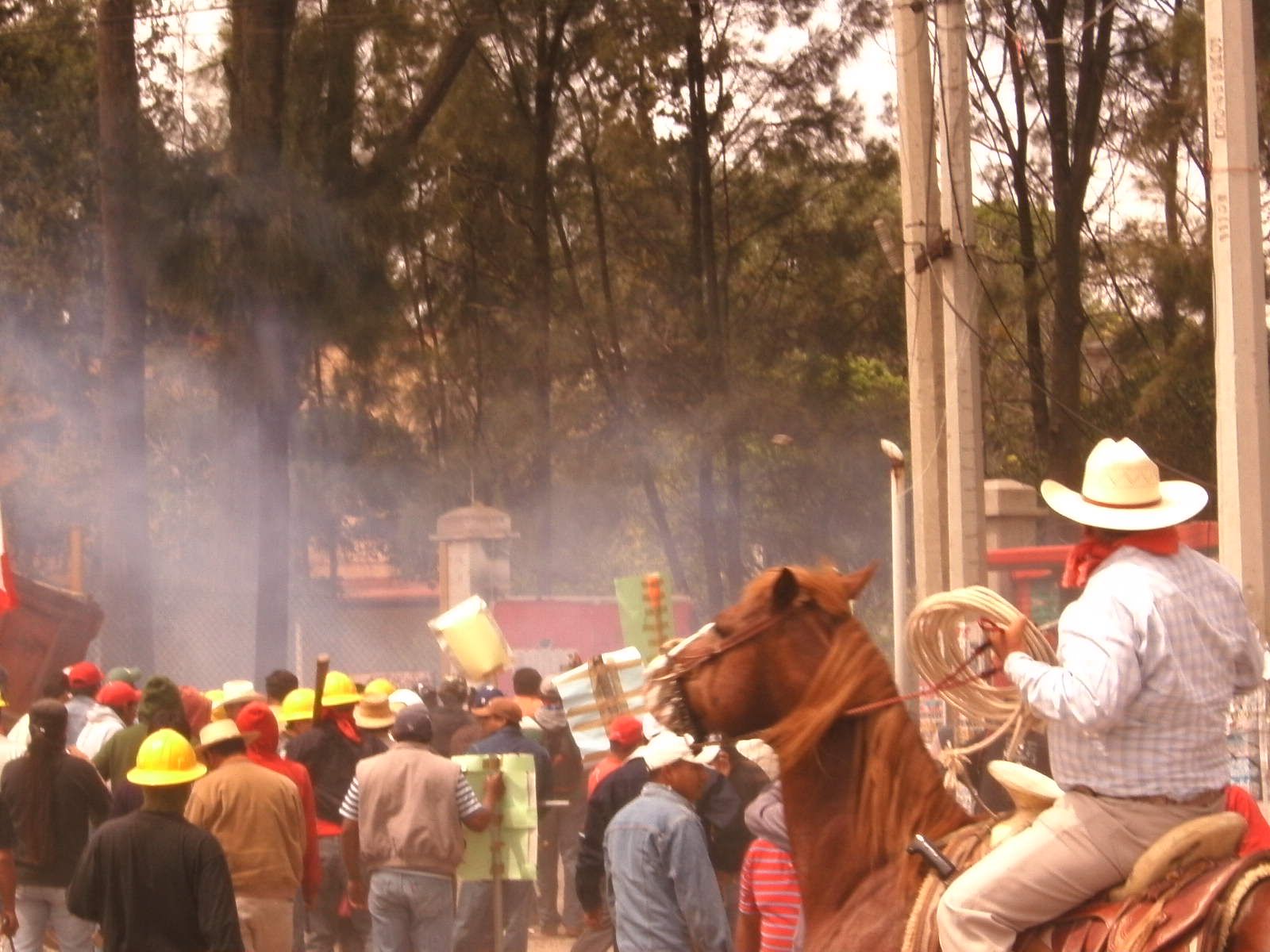
At noon on March 16, the Mexican Electrical Workers Union went on an indefinite strike, and unions all over the country went on strike with them. Electricians hung black and red banners across the entrances of their former workplaces, refusing to allow anyone to enter or leave the buildings. The actions occurred at all of the former Luz y Fuerza del Centro (LyFC) buildings in Mexico City, Mexico State, Puebla, Hidalgo, and Morelos. Actions in solidarity with the SME occurred in at least 21 other states. In addition to hanging strike banners on former LyFC buildings, supporters blocked major federal highways, took over government buildings, and held rallies. A significant number of the blockades remain, particularly in central Mexico.
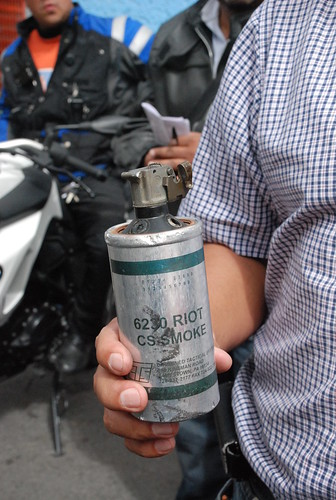
The tear gas was manufactured by US-based Combined Tactical Systems, the same company that manufactured the tear gas used in the 2009 Bagua, Peru, massacre of indigenous protesters and the violent attack against striking teachers in Morelos, Mexico in 2008.
When the PFP fired tear gas at the SME, the gas wafted into surrounding schools and homes, affecting the children inside. The Cables Bolivar complex is located across the street from an elementary school and catty-corner to a daycare. The SME reports that 2-month-old Alexis Emiliano Hernández was hospitalized when tear gas entered his home near Cables Bolivar.
Calls to support the SME in Cables Bolivar went out over Twitter and Radio SME, and support quickly arrived from other parts of the city. Students from the Autonomous University of Mexico City, the Urban Movement of Popular Power, and other organizations quickly arrived and drove back the police. Avelar says, "We will not move from here until the Ministry of the Interior or the Supreme Court presents a solution to this problem."
The second confrontation with police occurred in Juandho, Hidalgo. SME members and supporters blocked the entrance to the Juandho LyFC complex with piles of dirt. According to El Universal, "This angered the federal police, leading to a confrontation." The police fired tear gas and pepper spray at the crowd, and fired live rounds into the air. El Universal reports that following the repression, approximately three police helicopters and 400 federal police arrived on the scene to drive back protesters.
Following the police repression, floodgates that guard a canal of raw sewage were opened, flooding the LyFC complex and the police inside. At the time of publication, it has not been confirmed how the floodgates opened. However, the flood seems to have incapacitated the police--reports from Juandho indicate that the SME still holds its blockade of the LyFC complex there.
The SME continues to blockade key LyFC buildings, and will do so indefinitely. The workers have organized themselves into shifts that will maintain the picket lines around the clock. As nighttime fell, a "tense calm" fell over the blockades. Police continue to attempt to penetrate the blockades, particularly in Nexaca, Hidalgo, and there is fear that police will attack in the night while the majority of the region is asleep.
National Support
Actions in support of the SME reportedly occurred in about 25 states.
The national strike has inspired organizations all over the country to take bold measures to support the SME as well as their own causes. Several organizations took advantage of the national strike in support of the SME to pressure the government to cede to their own demands.
Oaxacan teachers, in addition to sending a delegation to the Mexico City protests, blocked government buildings and highways in their own state, bringing transit to a standstill. Their actions were in support of the SME, but also designed to pressure the government in their own 2010 contract negotiations.
Students from the Autonomous University of Mexico City rushed to the SME's aid in front of the Cables Bolivar complex after police attacked there. The city government has cut all funding for their university, leaving them unsure how they will continue their studies. They arrived at Cables Bolivar with signs that said, "Less Military, More Education."
Miners in Cananea, Sonora, blocked a federal highway there. The company that owns the mine where they work refuses to recognize their union and seeks massive layoffs. The government has authorized the military to take over the mine. The miners participated in the SME's national strike by blocking the Cananea-Agua Prieta federal highway and have vowed to remain there until their own labor dispute is resolved. The SME and the Miners Union have a strong relationship and a history of mutual aid.
Photos: Santiago Navarro, No a la Destrucción de Hidalgo, and Pateando Piedras
Friday, March 12, 2010
Canadian Mining Company Investigated for Bribes to "Quell Local Dissent" in Chiapas
If the evidence submitted by a coalition of organizations--including MiningWatch, the Council of Canadians, and the Sierra Club--is genuine, it demonstrates that Blackfire acknowledges that it paid a series of bribes to the Chicomuselo mayor.
The Calgary Herald reports that a coalition of anti-mining groups have submitted a Blackfire spreadsheet that "appears to show 14 payments made by Blackfire to the mayor, Julio Cesar Velazquez Calderon, and a letter to the congress of the state of Chiapas in which the company asks the mayor to be removed from office."
The Calgary Herald continues:
In a letter to the Chiapas congress in June 2009, Blackfire said the company was the victim of extortion by the mayor and made payments of about 10,000 pesos (about $1,000 Cdn) per month. The mayor then sought flights for himself, family and friends, which the company agreed to, according to the letter. But the company decided to stop the "ridiculous propositions" after the mayor asked for Blackfire to set up a sexual affair with a Playboy model.Read the entire article in the Calgary Herald.
Friday, January 15, 2010
Cover-Up and Political Revenge Alleged in Mariano Abarca Murder Case
On January 13, the Chiapas government arrested Walter Antonio León Montoya and accused him of being the "intellectual author" of the November 27 assassination of Chiapan anti-mining organizer Mariano Abarca Roblero. León Montoya is a former federal congressman from the opposition Institutional Revolution Party (PRI). Chiapan Gov. Juan Sabines is from the Democratic Revolution Party (PRD), which controls the state.
Abarca's organization, the Mexican Network of People Affected by Mining (REMA), denies that León Montoya had anything to do with Abarca's murder. In a press release, the organization argues, "It would appear that the accusation that León Montoya planned the assassination of Mariano Abarca Roblero is a strategy of political revenge."
REMA has accused employees of the Canadian mining company Blackfire Exploration of planning and carrying out Abarca's execution. The state arrested three former or current Blackfire employees after eyewitnesses identified them as the culprits.
Revenge
León Montoya has been a stone in the Chiapas government's shoe since this past October, when he filed a lawsuit against Gov. Sabines and the entire Chiapas state legislature in an attempt to block the cancelation of the 2010 interim elections in Chiapas.
This past September, the state legislature approved a bill that postpones Chiapas' 2010 interim elections until 2012. The measure extends congressmembers' terms an extra twenty months, until the end of Gov. Sabines' term in 2012.
The same law also changes the name of the state's city councils from "ayuntamientos" ("city councils" in English) to "consejos municipales" (coincidentally, also "city councils" in English). The Chiapas state government will inaugurate the new "consejos municipales" in 2010. However, because there will be no elections in 2010, the state Congress will hand-pick all members of the new city councils.
In other words, the Chiapan Congress voted to extend its term twenty months, and it is using the pretext of a name change and an election postponement to forgo elections and hand-pick the new city councils in the entire state.
The state government knew the measure would be controversial--Gov. Sabines postponed official publication of the law for thirty days. During that thirty-day period, rumors swirled that the state government had postponed the elections, but the local press reports that government officials and members of Congress denied the accusations.
When the postponement was finally official, León Montoya filed a lawsuit against Sabines and the entire Congress. His lawsuit decried the secrecy surrounding the bill and argued that the cancelation of elections is unconstitutional. The lawsuit sought to overturn the new law.
Cover-Up
REMA makes clear that León Montoya is no saint. It states, "REMA does not absolve Walter León Montoya of other accusations that have been leveled against him in the past, when various peasant, worker, and transportation organizations came out against him in October 2009 and accused him collaborating with foreign companies in order to plunder the state's resources without authorization." However, it argues that in the Abarca murder case, León Montoya appears to be the Sabines administration's scapegoat.
León Montoya's arrest appears to kill two birds with one stone: it effectively kills any legal action León Montoya had undertaken against the postponement of the 2010 elections, and it may also let employees of the Canadian mining company Blackfire Exploration, whom REMA accuses of planning and carrying out the Abarca assassination, off the hook. Blackfire employees--including one of the men currently in jail for his murder--have a long, legally documented history of harassment, threats, and violence against Abarca and his family.
REMA argues that there is no evidence against León Montoya, and it refutes the little evidence the government claims it has against him. All of the government's evidence against León Montoya comes from the testimony of a witness the government refuses to identify.
The government reports that in October León Montoya, accompanied by "armed persons," arrived at a REMA blockade outside Blackfire's mine and "threatened to cause harm to the organizer [Abarca] if he continued to cause transportation problems." REMA's blockade aimed to prevent trucks from entering and leaving the Blackfire mine. León Montoya is the leader of the Organization of Chiapas Transport Companies (OTRACH).
REMA counters the government's accusations: "REMA Chiapas denies outright the supposed witness' assertions. REMA Chiapas does not know of any confrontation between REMA and León Montoya or members of his guild. In fact, REMA has not personally met León Montoya." REMA also notes that police asked Abarca's children (who have also allegedly suffered physical attacks at the hands of Blackfire employees for their father's activism) if they knew León Montoya, and they told the police that they did not.
REMA fears that León Montoya's arrest signals that the government is moving to free the men it believes are responsible for the assassination and thus cover up Blackfire employees' alleged involvement. It is particularly concerned about the case of Ricardo Antonio Coutiño Velasco, a contractor hired by Blackfire to produce propaganda videosthat aim to refute claims that Blackfire's mine causes environmental destruction that could have harmful health consequences for Chicomuselo residents. Witnesses report that they saw Coutiño Velasco with other suspects in the case both immediately prior to and following the murder.
Coutiño Velasco is, according to REMA, the nephew of Chiapan Senator Manuel Velasco Coello, a member of the Mexican Green Party (don't be fooled by the name; the only thing "green" about the party is its logo). REMA accuses Sen. Velasco Coello of using his influence to intervene in his nephew's previous legal problems. Domingo Lechón, a representative from the Chiapan non-profit Otros Mundos, which partners with REMA in the anti-mining movement, told Narco News that the government arrested Coutiño Velasco in 2009 for "crimes related to drug trafficking. However, the case did not advance because of his influential family."
In response to the possible cover-up underway, REMA declares, "REMA maintains its demand that [the government] fully investigate the transnational Canadian mining company Blackfire, its workers, government officials, the Chicomuselo mayor from the PRD who is involved with the Canadian mining company in acts of corruption, and other people who are involved in the murder of Mariano Abarca Roblero." REMA's press release specifically demands that the government arrest nine people, the majority Blackfire employees or government officials. REMA claims those nine people participated in or have knowledge of illegal activities related to the case, including bribing local officials, harassing and threatening Abarca prior to his murder, and helping the murder suspects flee.
Originally published in Narco News on January 15, 2010.
Wednesday, December 16, 2009
Chiapas Murder Draws Criticism of Canadian Mining in Mexico
The recent murder of Chiapan anti-mining organizer Mariano Abarca Roblero has drawn sharp criticism of Canadian mining in Mexico. Abarca was shot to death in front of his home on November 27. Three men linked to Canadian mining company Blackfire Exploration Ltd. were arrested for the murder. Blackfire owns a barite mine in Chicomuselo, Chiapas. Abarca, a local resident, was the leader of a campaign to close the mine at the time of his assassination.
In response to the murder, Mexican communities and organizations have mobilized to demand accountability for the murder and permanent closure of the Chicomuselo and other Canadian-owned mines. Hundreds of people attended Abarca's funeral in Chicomuselo. The funeral procession stopped at Blackfire's Chicomuselo office to demand justice.
The protesters stopped by the Mexican Ministry of Economics to deliver a letter demanding that Blackfire's mining concession in Chicomuselo be immediately cancelled. According to a communique issued by Abarca's organization the Mexican Anti-mining Network (REMA), they told a Ministry representative, "If [the Ministry of] Economics doesn't cancel Blackfire's mining concession, the people will do it de facto. We won't tolerate more deaths, nor more environmental destruction, nor division within the Community." That isn't an idle threat: the community blockaded the road leading to the mine in July.
After meeting with an official from the Ministry of Economics, the caravan then headed to the Canadian Embassy to protest Abarca's murder. According to the REMA communique, "We also stressed that they [the Canadian government] need to support laws that would give the government teeth to be able to hold accountable the mining companies that they are currently supporting economically, and which have a general conduct of violating human rights and democracy."
Laws With Teeth
When the mining-affected communities demand "laws that would give the government teeth" to hold mining companies accountable for their actions in foreign countries, they are referring to laws like Bill C-300, An Act Respecting Corporate Accountability for the Activities of Mining, Oil or Gas Corporations in Developing Countries, which is currently making its way through the Canadian parliament. The bill, according to Canadian NGO MiningWatch, would set corporate accountability standards that would determine eligibility for the political and financial support that the Canadian government currently provides to Canadian extractive companies. These corporate accountability standards would include health, safety, security, and human rights criteria. The bill would also create a complaints mechanism wherein affected communities could file complaints with the Canadian government. If a company is found to be out of compliance with the corporate accountability standards, it would be ineligible for Canadian government support.
The Canadian NGO the Council of Canadians admits that the sanctions proposed in Bill C-300 are "modest." However, they believe that the mining industry's staunch opposition to the bill demonstrates that the industry views the bill as a threat.
The Harper administration has opposed Bill C-300.
Another proposed bill, Bill C-354, would allow foreigners to sue Canadian companies in Canadian courts for human rights abuses, regardless of where the abuses take place. According to the bill's sponsor, Peter Julian, the bill replicates the United States' Alien Tort Claims Act, which survivors of torture in other countries have used to sue their torturers in US courts.
Council of Canadians chairperson Maude Barlow linked Abarca's murder to the Canadian government's inaction when mining companies it supports commit abuses. "A man deeply involved in the protest against the Canadian mining company Blackfire has been murdered outside his home," said Barlow. "This tragic outcome can be traced directly to the Harper government's refusal to end the impunity currently enjoyed by Canadian mining companies."
Gordon Peeling, president and CEO of the Canadian mining industry's lobbying group, The Mining Association of Canada, told the press, “It is not helpful in terms of the dynamic of the discussion for those that want to link these things. Their thinking is flawed if they try to link it [the murder] to C-300,” he added.
Perhaps Bill C-300 would have been too weak to prevent the assassination of Abarca, who had been the victim of threats and physical attacks since at least August 2008. But the role of Canadian mining company Blackfire in the murder is unquestionable.
"Abarca Murder: Mission Accomplished"
The three men arrested for Abarca's murder are all current or former Blackfire employees.
Jorge Carlos Sepúlveda Calvo is accused of shooting Abarca. He was a driver for Blackfire.
Chiapan authorities have not revealed the role they believe another detained man, Ricardo Antonio Coutiño Velasco, played in the murder. Coutiño Velasco was a Blackfire contractor.
Caralampio López Vázquez is an operator and shift supervisor in the mine. According to witnesses, he drove the motorcycle in which the murders fled.
Blackfire cannot claim the murder was an isolated incident. REMA reports that in August 2008, three men wearing Blackfire employee vests beat Abarca and his son in their home. They held Abarca's wife at gunpoint. REMA says that in response to the attack, Abarca filed charges with the government. The government did nothing.
In the summer of 2009, Chicomuselo residents entered into negotiations with Blackfire regarding a road the company had illegally built on their communal land. The residents claim to be in possession of a January 2008 agreement signed by the company that determined where Blackfire should build the road to the mine. The company ignored the agreement and build the road in a place the Chiapas state government says it shouldn't have. When negotiations broke down between residents and Blackfire, the residents began to fence off the road in question in order to close it. According to the complaint anti-mining organizer Gustavo Castro Soto says residents later filed with the government, "Luis Antonio Flores (Blackfire Public Relations Officer), Rene Salvador Cartajena, Caralampio Lopez, and another man, along with Blackfire employees, came out and threatened to kill us and attack us with the sharp weapons and the firearms that they were armed with. For these reasons we didn't close the road. We decided to leave so that we wouldn't be led into the violent or deadly confrontation that they were hoping for. They tried to run over the compañeros with their machinery. Therefore today we ask that Gov. Juan Sabines Guerrero and his administration cancel [Blackfire's] permission in this ejido [communally held land]."
Just days before his murder, Abarca filed charges against two Blackfire employees, Ciro Roblero Perez and Luis Antonio Flores Villatoro, for threatening to shoot him if he didn't stop organizing against Blackfire's barium mine in Chicomuselo. According to a formal complaint filed by a government employee who works in the Chicomuselo municipal building, Roblero Perez arrived at the municipal building to say that he had gone to look for Abarca to "fuck him up in a hail of bullets." He also reportedly said that Abarca and other people were on a list of people Blackfire management wants to hurt. Blackfire public relations manager Luis Antonio Flores Villatoro was mentioned in the government employee's complaint as one of the people responsible for the list. The government had cited Roblero Perez and Flores Villatoro to testify regarding the charges the day of Abarca's murder, but they failed to appear. Abarca was murdered later that evening.
On December 7, Chiapas state authorities finally acted. They temporarily closed Blackfire's mine in Chicomuselo. Blackfire itself reportedly closed the mine and removed its light machinery soon after Abarca's death. The Chiapas government only made the act official by hanging a "Closed" sign on the gates.
The government claims the closure has nothing to do with Abarca's murder. According to the government, "The reason for the closure of said company is due to the creation of new roads without the authorization related to environmental impact, suspended particle emissions, as well as runoff and wastewater and changing the use of soil in an important area."
Pollution is the principal reason that Abarca and REMA were protesting Blackfire's barite mine. When he was alive, Abarca told everyone who would listen about the pollution the mine caused in Chicomuselo. According to Castro Soto, even after the brutal August 2008 beating at the hands of alleged Blackfire employees, "He continued fighting. He decried the lack of water in the streams and the consequences of the explosions. He decried the pollution of the rivers; they're full of mud and the fish have all died. Livestock and other animals have died."
The Chiapas-based Fray Bartolome de las Casas Human Rights Center is demanding that the government turn the temporary closure of Blackfire's mine into a permanent one. "This Human Rights Center celebrates that last Monday the barite mine located in Chicomuselo county and operated by Black Fire Exploration has been closed.... However, we consider it necessary that the cancelation not only be temporary; rather, it should be permanent now that the negative effects insistently denounced by residents have cost Mr. Mariano Abarca Roblero his life. He was assassinated allegedly for his active activism against the Canadian company's exploitation. It is also urgent that measures are taken so that this is not repeated, to guarantee that in the future these sorts of companies don't set up shop, in order to avoid damages to the environment as happened in the Chicomuselo region with Blackfire Exploration's mining exploitation."
It's a shame Abarca had to give his life so that Chiapas authorities would finally act and close the mine. Even more tragic is that the Canadian government, which heavily subsidizes its mining industry, has done absolutely nothing about Blackfire's human rights and environmental abuses. Canadian Governor-General Michaëlle Jean and Peter Kent, Canada's junior foreign minister for the Americas, visited Chiapas just two days after the state government closed Blackfire's mine. They were greeted by about fifty protesters who demanded that Blackfire's mine be closed and that the company pay for its crimes. REMA requested a meeting with the dignitaries, but Jean and Kent refused the invitation, citing time constraints.
Tuesday, December 15, 2009
Chiapas Anti-Mining Organizer Murdered
Mariano Abarca Led a Growing Movement to Kick Canadian Mining Companies Out of Mexican Communities
Mariano Abarca Roblero, one of Mexico's most prominent anti-mining organizers, was shot to death on the evening of November 27, 2009, in front of his house in Chicomuselo, Chiapas. He left behind a wife and four children. Another man was wounded in the shooting.
The incident comes just days after Abarca filed charges against two Blackfire employees, Ciro Roblero Perez and Luis Antonio Flores Villatoro, for threatening to shoot him if he didn't stop organizing against Canadian mining company Blackfire's barium mine in Chicomuselo. According to a formal complaint filed by a government employee who works in the Chicomuselo municipal building, Roblero Perez arrived at the municipal building to say that he had gone to look for Abarca to "fuck him up in a hail of bullets." He also reportedly said that Abarca and other people were on a list of people Blackfire management wants to hurt. Blackfire public relations manager Luis Antonio Flores Villatoro was mentioned in the government employee's complaint as one of the people responsible for the list.
Ejido* authorities from the Nueva Morelia ejido in Chicomuselo county took the complaint seriously and helped Abarca launch an investigation. The day before the murder, Roblero Perez and Flores Villatoro were summoned to testify regarding the alleged death threats, but they failed to appear.
A History of Harassment
Even though local authorities acted to try to protect Abarca, the Mexican Network of People Affected by Mining (REMA) blames the Chiapas state government for failing to protect the mining leader. On the contrary, the state government seems to have been complicit in Blackfire's legal harassment of Abarca.
On August 17, 2009, unidentified armed men in unmarked cars kidnapped Abarca as he was leaving an elementary school in Chicomuselo. He had visited the school to request permission on behalf of his organization, REMA, to use the building for an anti-mining meeting scheduled for August 29-30.
The kidnappers turned out to be police. They had arrested Abarca on charges filed by Blackfire regarding a June-July 2009 highway blockade REMA set up to prevent the passage of Blackfire trucks. REMA was protesting the company's failure to comply with promises it allegedly made regarding community development projects and environmental stewardship. According to community leaders, Blackfire's open-pit barium mine uses too much of the area's scarce water resources. They are concerned that the pollution could effect their crop cultivation in the near future.
The acting on Blackfire's formal complaint, the state government charged Abarca with attacks against public roadways, criminal association, organized crime, and offenses against the peace. Theoretically, organized crime charges are reserved for drug, arms, and human traffickers, and other members of Mexico's expansive mafia network. However, the Chiapas government has been known to accuse activists and community organizers of organized crime in order to take advantage of restricted due process rights for people accused of organized crime.
That is what happened in Abarca's case. The organized crime charged allowed the Chiapas government to imprison him under the highly controversial and international criticized legal instrument of "arraigo" or pre-charge detention. Under arraigo, the government can arrest a suspect and isolate him or her for months while it pressures and sometimes tortures the person into confessing.
The state government detained Abarca for eight days before it ceded to international public pressure to release him. Abarca was released and the charges were dropped due to lack of evidence. His lawyer, Miguel Angel de los Santos, criticized the Chiapas government for ceding to the mining company's pressure to arrest Abarca. "There was no legal justification for his arrest and detention. Preliminary investigation began on June 12th, two days after the blockade, and was only just beginning to come together. The investigation had not advanced," he told Proceso in August following Abarca's release.
Structural Adjustment Strikes Again
Social discontent regarding mines in Mexico has been steadily building over the past ten years, beginning when the effects of a World Bank-mandated mining sector deregulation scheme were first felt. A confidential World Bank document entitled "Implementation Completion Report: Mexico Mining Sector Restructuring Project," which Narco News makes available to the public, outlines exactly how a nine-year loan project drastically transformed Mexico's mining sector.
The project, first proposed by the Word Bank in 1989 and quickly adopted by the Mexican government, aimed to deregulate the mining industry in Mexico. The Bank proposed the project because, as its Implementation Completion Report (ICR) explains,
Past lending of the Bank for mining in Mexico was oriented towards specific investment projects, with direct lines of credit to the sector... The lessons learned from those operations were that the continued development of the mining sector required increased access to land rights, reduced ownership limitations, revision of the tax legislation, a restructuring of existing institutional setups, as well as policies that stimulate private investment in mining by both domestic and foreign firms. The Bank Mining Sector Review identified an inadequate regulatory and institutional framework as the major constraint to increase private investment and further growth of the sector.
One of the Bank's main goals for the project was to open up Mexico's previously protected national mining industry to foreign companies; the Bank listed "open the sector to foreigners" as its first "strategy to restructure the sector." It hoped to do so by privatizing state-owned mining companies, slashing taxes, awarding mineral and land rights to private companies, and facilitating foreign companies' ownership of Mexican land in order to "contribute to the increased exploration and exploitation of the vast mining potential of the country, to take advantage of Mexico's strategic location near the United States and Canada."
The Bank proposed a set of changes to Mexican law in its Mining Sector Report, and the Mexican government--at that point still under one-party rule--rushed to implement them under a plan called the National Mining Modernization Program. In just four years (1990-1994), the legal framework for mining in Mexico underwent a radical change. Before the ink on the new laws was dry, the Bank began to dole out money to private mining companies to "help finance the surge in demand for investment funding that was expected to result from the improved policy and institutional setting for mining operations."
The Bank was thrilled with the results of the National Mining Modernization Program and its subsequent loans. According to the Bank, over the course of the project, which ended in 1998, over 8.7 million hectares of land were released and 17,220 new mining concessions were granted. As a result of the legal changes mandated by the loan, the time required for processing mining concessions went down from 5 years to 5 months, and the Mexican government's backlog of about 14,000 concession requests that were pending since 1989 disappeared virtually overnight. The Bank was so pleased with the results of the Mining Sector Restructuring Project that it wrote, "Future Bank participation in the sector does not seem justified anymore, in view that mining exploration/exploitation is now open to domestic and foreign investors."
The Bank's structural adjustment of Mexico's mining sector has played a key role in the battle for "land and territory" (as the Zapatistas refer to it) in the country. Private ownership, increased economic pressure on small and subsistence farmers, and top-down "development" projects are acutely felt in mineral-rich communities. According to Gustavo Castro Soto of the Chiapas-based non-profit Otros Mundos, "Beginning in 2000, almost 10% of the national territory has been ceded to transnational companies through mining concessions." REMA notes that in Chiapas, 15.21% of the state's total territory has been ceded through mining concessions. Many of those concessions don't expire until the year 2050. If the social unrest that frequently follows mining concessions is any indicator, Mexicans are not willingly handing over their land to foreign mining companies.
Mining Industry Under Fire
Mariono Abarca's murder comes at a time that the mining industry in Mexico is feeling the heat from Mexico's social movements. Inspired by the national movement of communities affected by hydroelectric dam projects, mining-affected communities are joining forces in a unified front against destructive mining practices.
In 2008, representatives from Chicomuselo travelled to the state of Jalisco to found REMA during the First Encounter of the Mexican Network of People Affected by Mining. Representatives from mining-affected communities in eleven states and the Federal District participated in the historic event: Chihuahua, Sonora, Nayarit, Jalisco, Oaxaca, Chiapas, Guerrero, Mexico City, México State, San Luis Potosí, Coahuila, and Veracruz. REMA agreed at that meeting to raise consciousness about the social and environmental effects of mining. It also pledged that member organizations would support each other in their struggles against destructive mines in their communities.
One of the most high-profile joint actions that REMA carried out was a protest encampment in front of the Canadian Embassy in Mexico City this past July. Abarca and representatives from other communities affected by Canadian mining companies participated in the encampment, which demanded the withdraw of Metallic Resources/NewGold, a Canadian company, from Cerro de San Pedro, San Luis Potosi. At the protest, Abarca spoke about Canadian mining companies' contamination of traditional water sources.
Following the protest, mining-affected communities won a temporary victory: just last month, a federal judge ordered that the Cerro de San Pedro mine be closed because the mining company had failed to comply with environmental stipulations. The closure comes after ten years of struggle waged by a broad coalition of San Luis Potosi civil society organizations, which include organizations linked to Mexico's center-left Democratic Revolution Party (PRD) and groups affiliated with the Zapatista's Other Campaign. They opposed the gold mining project because, in addition to environmental concerns, the Cerro de San Pedro is an official historic monument. NewGold has promised to appeal the ruling.
In Chiapas, Abarca led a previously mentioned highway blockade that prevented Blackfire trucks from entering and leaving the Chicomuselo mine this past June and July. The community was protesting the company's excessive use of scarce water supplies, its failure to follow through on commitments it reportedly made to the community, and its back-door maneuverings that allowed it to purchase 13.5 hectares of ejido land without the required approval of the ejido assembly. Blackfire claims it lost $120,000 pesos ($9,334 dollars) as a direct result of the blockade.
This past August, REMA held its Second Encounter of the Mexican Network of People Affected by Mining in Chiapas. Guatemalan communities who are resisting mining projects traveled to Chiapas to participate and share their experienes. Abarca helped organize the Encounter, and as previously mentioned, it was during the Encounter's organizing process that state police kidnapped Abarca and charged him with organized crime at Blackfire's request.
A communique signed by 25 Mexican organizations from six states and Mexico City holds Blackfire's owners responsible for Abarca's shooting and any resulting violence in the region. They call for a protest encampment outside of the Canadian Embassy and the Ministry of Economy headquarters in Mexico City on December 3 in solidarity with the people of Chicomuselo.
*An ejido is commonly-held land traditionally managed by assembly.
Soure: This article originally appeared in Narco News on December 1, 2009.