Showing posts with label APPO. Show all posts

Sunday, February 27, 2011

Mexico’s Federal Police Open Fire on Protesters, Throwing Merida Initiative Accountability Into Question

by Kristin Bricker, Upside Down World

Doctors remove a bullet from journalist Gilardo Mota
Figueroa’s leg.
Mexican Federal Police allegedly shot radio journalist Gilardo Mota Figueroa as he covered a protest last Tuesday against President Felipe Calderón’s visit to Oaxaca City. Mota Figueroa told Crónica de Oaxaca that during clashes with Oaxaca’s teachers union, a Federal Police officer opened fire on the crowd from a distance of about six meters (or about twenty feet). One of the bullets struck Mota Figueroa in the leg. Another 2-4 bullets were embedded in an armored SUV that authorities had left parked on the street.

During the protest, Federal Police also fired teargas canistersdirectly at demonstrators at point-blank range, severely injuring at least two people. According to the teachers union, middle school teacher Raymundo Servando Santiago Sánchez was hospitalized with a bruised lung after a teargas canister struck him in the chest. Another canister—this one allegedly fired by state police—struck protester Marcelino Coache in the face fracturing his skull and causing brain trauma. Additionally, two reporters filed charges with the State Attorney General’s Office for physical injuries and damage to their equipment from teargas canisters that struck them during the protest.

Several bullets hit this armored vehicle’s window
when police opened fire on demonstrators.
In order to be considered a “less-than-lethal weapon,” teargas canisters must be fired into the air or onto the ground. Teargas canisters manufactured by Combined Tactical Systems Inc., which produces the teargas launchers used by Federal Police on Tuesday, carry a warning label that states: “Danger: Do not fire directly at person(s). Severe injury or death may result.”

The Federal Police are fully aware that a direct hit from a teargas canister can be lethal. In 2006, during a joint operation between state and federal police in San Salvador Atenco, a teargas canister killed 23-year-old protester Alexis Benhumea when it struck him in the head. As a result of the police’s “illegitimate use” of their weapons during the Atenco operation, the Mexican government’s National Human Rights Commission (CNDH) recommended that the Federal Preventative Police (PFP, which later became the Federal Police) and state police undergo training in “proper use” of their weapons. The head of the PFP rejected the CNDH’s recommendation, and five years later the Federal Police are still shooting teargas canisters at protesters’ heads.

Federal Police fire teargas canisters
directly at demonstrators, which can
cause serious injury or death.
Maureen Meyers of the Washington Office on Latin America (WOLA) argues that the police’s violent response to Tuesday’s protests “underscores the lack of any real accountability mechanisms within the Federal Police.” She notes that the Federal Police currently rank third in the number of human rights complaints filed against government agencies, with 595 complaints filed with the CNDH against the Federal Police in 2010. “There’s been more and more accounts of abuses committed by the Federal Police,” Meyers says. On October 29, 2010, Federal Police shot a young protester in the stomach with live ammunition as he painted graffiti during the 11th “Walk Against Death” in Ciudad Juarez.

More Merida Initiative Funding

Police shot this protester with an unidentified projectile.
He remains hospitalized with a fractured skull
The day before Federal Police opened fire on protesters and the press in Oaxaca, United States President Barack Obama unveiled his 2012 budget request. The budget includes $291.5 million for Merida Initiative programs in Mexico.

Mexico’s Ministry of Public Security (SSP in its Spanish abbreviation) is in charge of the Federal Police, and it is one of the biggest recipients of Merida Initiative funding. Through the Merida Initiative, the Federal Police receive equipment, training (from US and Colombian police, as well as private contractors), and even Black Hawk helicopters. While Obama’s 2012 budget request reduces Mexico’s Merida funding by about $250 million from the previous year, it increased International Narcotics Control and Law Enforcement (INCLE) funding by $500,000. INCLE funding is what funds most—if not all—aid to the Federal Police.

Some Merida Initiative funds are designed to reduce corruption within the Federal Police. That aid, notes Meyers, “focuses more on centros de control de confianza [police recruiting and vetting centers] and polygraph tests. That obviously doesn’t attend to this widespread pattern of abuse.”

Marcelino Coache is recovering
from a fractured skull and brain
trauma after police shot him

the head with a teargas canister.
Meyer notes that there are three accountability mechanisms that would, in theory, assure that Merida Initiative assistance doesn’t fall into the hands of human rights abusers like Federal Police officers who open fire on unarmed demonstrators. The first is the Leahy Amendment, which prohibits any US foreign assistance from funding “any unit of the security forces of a foreign country if the Secretary of State has credible evidence that such unit has committed gross violations of human rights” and hasn’t punished the offender(s). The US Embassy tracks individual human rights abusers in a database, but Meyers points out that the strength of the database depends on the amount of information the US Embassy enters into it. Kent Patterson from the Americas Program has criticized the United States’ enforcement of the Leahy Amendment: “Mexico, like Colombia, sidesteps the question by selecting for training only individuals from tainted units instead of having entire units trained.”

The other two accountability mechanisms that apply to US drug war assistance to Mexico are attached to the Merida Initiative itself. A mere fifteen percent of Merida Initative assistance is conditioned upon Mexico improving accountability and transparency in the Federal Police and military. Additionally, in order to receive the conditioned funds, Mexico must demonstrate that it is investigating and trying soldiers and Federal Police who are credibly accused of human rights violations. “The latter is where we really haven’t seen any cases that we’re aware of where Federal Police who have been implicated in abuses have been effectively investigated and sanctioned,” says Meyers.

Despite the rampant impunity for security forces’ human rights abuses, Merida’s human rights conditions have not significantly affected the flow of drug war aid to Mexico. The US Congress has symbolically withheld some of the funds, but thus far the human rights conditions haven't delayed Merida Initiative money for much longer than standard bureaucratic red tape has held up the other 85% of unconditioned funds.

Tuesday, February 8, 2011

Mexican Military Raids Social Organization’s Office in Oaxaca

by Kristin Bricker, Upside Down World


CODEP members stand in front
of the door that the military broke
 down in a warrantless raid.
 Photo by Santiago Navarro.
On Tuesday, January 11, at about 6:45 pm, the Mexican Army raided the Oaxaca City office of the Committee for the Defense of the People's Rights (CODEP) and the Committee for the Defense of Women's Rights (CODEM). According to CODEP members who were present during the raid, approximately 20 uniformed soldiers in an official vehicle pulled up in front of the organizations' building, broke down a makeshift sheet metal door, and searched their offices. After the soldiers broke down the door, they held CODEP member Patrocino Martinez at gunpoint. Martinez says that he demanded a search warrant, but that the soldiers pushed him and rushed up the stairs of the building, which is currently under construction.

Other members of the organization managed to lock the doors of the offices that contained their computers, copiers, and files, so the soldiers were unable to search those offices. However, the soldiers entered other unlocked offices, which included a dormitory and a screen-printing workshop. According to Martinez, the soldiers took photos of those offices. However, the soldiers did not remove any items from the building, nor did they make any arrests.

CODEP members who were present during the raid say that the soldiers questioned them at gunpoint about the organization's work and organized crime. Ernesto Lopez says that the soldiers’ commander, who identified himself only as “Carlos,” told him that they received an “anonymous tip” that “organized crime held meetings” in the building. Meanwhile, other soldiers questioned neighbors about possible criminal or drug trafficking activity in or near the building.

During the raid, the soldiers never showed a search warrant, and they refused to identify themselves. However, one CODEP member did manage to get the vehicle number off of the large military convoy-style truck that the soldiers used in the raid.


The Mexican military leaves CODEP's office
following the warrantless raid. Photo: CODEP.
In the days following the raid, CODEP and CODEM called a member of Congress who contacted the military about the raid. The legislator told them that the military would only say that it had "detected something" in the neighborhood, triggering the raid.

CODEP and CODEM have filed formal complaints with the state and national human rights commissions and the Mexican Congress’ human rights commission, requesting that those three entities investigate the raid and provide CODEP with information as to why it occurred.
History of Repression
In an interview with Upside Down World, CODEP and CODEM members appeared unfazed by the recent nighttime raid on their offices by soldiers armed with high-powered assault rifles. This is because this wasn’t the first time they’ve had run-ins with government forces, nor is it the worst attack they’ve suffered. In this latest raid, “they controlled themselves,” says CODEM leader Claudia Tapia. “They used to unleash unimaginable violence upon us.”

In their eighteen years of organizing women, peasants, taxi drivers, and indigenous peoples, CODEP and member organizations like CODEM have faced stiff opposition from the state government—and former governor Ulises Ruiz Ortiz in particular. “From his days as a Senator, we knew what sort of person [Ruiz] was,” says Tapia. “So we opposed him from the beginning of his [gubernatorial] campaign.”


CODEP members inspect damage to their sheet metal door,
which soldiers kicked down to enter the building.
Photo: CODEP
In February 2005, during the lead-up to the 2006 popular uprising that nearly toppled Ruiz, Mexico’s national human rights ombudsman at the time, José Luiz Soberanes, organized negotiations between the Oaxacan state government and CODEP. CODEP wished to negotiate the release of a political prisoner who had been arrested immediately after Ruiz took office. “However,” recounts Tapia, “instead of Ulises Ruiz arriving [at the negotiations] as he had agreed to do, he sent the police, and they detained our compañeros.” The police raided the hotel where the negotiations were to be held, as well as a CODEP office, arresting a total of seven CODEP members, some of whom spent months in prison.

CODEP, incensed, continued to organize against the Ruiz administration. In May 2006, when Oaxaca’s teachers union decided to strike for better conditions in their schools, CODEP joined their protest encampment in Oaxaca City’s main square. CODEP members and their children where in the protest encampment on June 14, the infamous day that Ruiz sent state police to violently break up the teachers’ protest encampment without warning.

CODEP is a founding member of the Popular Assembly of the Peoples of Oaxaca (APPO), the conglomeration of organizations, communities, and individuals that arose from the June 14 repression to oust Gov. Ruiz. When then-president Vicente Fox sent federal police to violently break the APPO’s hold on Oaxaca City on November 25, 2006, CODEP member 
Marcos Garcia traveled to sympathetic Oaxacan communities to rally them to defend the capital. On November 27, as he was traveling to a community, Garcia came under fire by a group CODEP identifies as a paramilitary death squad, one of the many that operated in the state at that time. They attacked Garcia with high-powered assault rifles, riddling his vehicle with 177 bullets, eight of which struck him. Miraculously, he survived the attack.

State repression against CODEP has continued since the 2006 uprising. On October 25, 2008, around twenty federal police raided a house in Oaxaca City where CODEP members worked and lived. The raid, according to the police, was an anti-organized crime operation. The police tortured CODEP member Luis Ramón González López for an hour. They beat him, put a plastic bag over his head, and applied the infamoustehuacanazo, a torture tactic that is popular amongst Mexican police. The tehuacanazoinvolves squirting mineral water (sometimes mixed with chile peppers) up the victim’s nose, which creates a drowning feeling and an intense burning sensation, sometimes causing the victim to lose consciousness. The torture session left González López with a broken rib and a punctured lung. During the interrogation, the police demanded that González López tell them the location of a “suitcase full of money,” a request that puzzles CODEP to this day. “That house is so humble that the question doesn’t even make sense,” argues Tapia. “They just want to terrorize us.” At the end of the torture session, the police confiscated a laptop, two cell phones, and documents and newspaper clippings about the 2006 uprising.
The Drug War is the New Cold War
CODEP knows that it’s no coincidence that this is the second drug war raid they’ve suffered since President Felipe Calderón deployed the military to battle drug cartels in late 2006. In a press release about the raid, CODEP argued: “There is no doubt that this strategy of state terrorism that is being advanced in our country is part of the Merida Initiative [a drug war aid package] and the Mesoamerica Project [formerly known as Plan Puebla-Panama, a neoliberal “development” project] that the [Mexican] government signed with the United States… with the goal of destroying human rights and social organizations who oppose the continuation of the destruction of our nation and the violation of our national sovereignty by foreign interests.”

“This isn’t new,” Lopez argues. “We saw this already with the Cold War and other wars. Now the United States doesn’t have a pretext or a fictitious enemy like it had in the 1970s, where the enemy was communism. When the Soviet Block fell, there was no longer an enemy to use to invent a war. So now the enemy that they created is drug trafficking and organized crime. Now, those who fight to demand their rights from the government, they are organized crime too. In Mexico, with the Merida Initiative, the US wants to have military control over the territory…and it won’t permit a social movement like that which occurred in Oaxaca in 2006 or in Chiapas [with the Zapatistas] in the 1990s. The US wants to control our government and control our country so that it can appropriate Mexico’s natural resources.”


Help Upside Down World continue to provide you with on the ground reporting. Donate HERE!

Friday, October 15, 2010

Autonomous Supporters Describe Their Last Days in San Juan Copala

by Zósimo Camacho, Contralínea

October 1, 2010

After almost ten months under siege, San Juan Copala fell.  The paramilitaries kicked up the siege this past September 7, and over the following days they occupied the political and ceremonial center of the Triqui culture.  Nothing, no one, stopped them from smashing down doors, tearing down walls, burning homes, and ransacking houses.  Terror took hold for the last thirty families that resisted, and they fled through the hills, carrying the elderly, hurrying up children, falling into gullies.  Many escaped with bullet wounds.  They haven't been treated by doctors.  Under fire for 303 days, now displaced, always invisible, the Triquis that demand autonomy blame MULT [the Movement for Triqui Unification and Struggle] and UBISORT [the Union for the Social Well-being of the Triqui Region].  They accuse Amado Ortiz and Antonio Cruz [1] of leading the assault.

Yosoyuxi, Copala.  Barefoot, Altagracia Fernández de Jesús hides between her father's legs.  At four years old, she barely speaks.  Her mother, Francisca de Jesús, was shot in the back last September 7 as she tried to leave San Juan Copala.  She is in a hospital in Oaxaca.  Her brother, Elías, was murdered at the age of nine on November 29, 2009, in a classroom when paramilitaries shot up the school.  Her sister, Maribel, couldn't leave Copala's boarding school and stayed in the town center.  Her father, Benito Fernández, a 53-year-old carpenter with wounds on one foot, is desolate. 

For almost a quarter of her life, she's had to remain hidden in her house.  On the rainy morning of September 19, her father took her in his arms.  Sometimes he had to make her walk over the rocky ground while he carried 80-year-old Jacinta González Guzmán on his back.  Sometimes the man rolled through the brush with the old woman, at other times, with the little girl.

Also in that group that was fleeing from the hail of bullets was 53-year-old peasant Gabino Hernández; Margarita López Martínez, 45; Cornelio López Martínez, 51; and Susana López Martínez, 18.  The group was lucky: they weren't found by the armed groups.

They didn't bring any food with them, because at that point they didn't have any.  They fled with only the clothing on their backs, which they still wear.  They left behind their houses, their huipiles, some animals, personal documents, family photographs, altars, mats, cooking utensils, domestic goods, clothing...

But what they mourn is intangible.  They have been expelled from the Chuman'a, as they call San Juan Copala, the Triquis' ceremonial center.  They are concerned for their saints [2], which are prisoners in the church, without the flowers and candles that sustain them.  Their voices crack when they count the years they lived there: 12, 20, 40, 80, according to their ages.  The women who were not born in San Juan, but married there, could forget their age or the year they were born, but they'll never forget the year they moved to San Juan Copala, nor the time that they lived there.

"There is hope that we'll return to San Juan Copala," says Cornelio López.  He had previously spoken strongly and firmly.  But now that he's talking about the Chuman'a, where he worked the land for almost 40 years, his voice cracks.

"First God," he adds with difficulty, "we don't know; God knows..."

From "loaned" homes, the displaced recount their stories and show their wounds.  Most of the time they talk through an interpreter.  The sadness and indignation are translated from Triqui to Spanish.  They explain how each group, each family, each individual managed to evade the paramilitaries.  All agree that the gunfire that kept them in their homes for almost ten months got worse on September 13, when the armed groups took over the town hall.

From there, they spread out day by day, until they occupied the whole town.  They attacked street by street, house by house.  They used a loadspeaker to order men and women to leave their homes and give themselves up; they warned that they would hang the autonomous municipal president, Jesús Martínez Flores, and the men in the community.  Some families began to leave town the next night.  Others decided to resist a few more days.

Those who began to leave and had the "bad luck" to be discovered by the paramilitaries were shot and subdued.  The women were raped, like 42-year-old Natalia Cruz Bautista, who was tortured and humiliated (they cut her hair, took off her clothes, and raped her), and Francisca de Jesús García (who managed to flee, but with a bullet wound in her right shoulder; she is now in danger of losing the arm).

Those who stayed for a few more days heard walls being torn down, plundering, and they saw the flames.  Angelina Ramírez Ortega, 71, was one of the last people to abandon San Juan Copala.  She witnessed the massacre of farm animals and pets, the shooting of houses where smoke from the kitchen gave away those who were resisting.  The woman left when the armed group occupied almost the entire town, on September 19.

She leans against the door of the house that is giving her shelter now.  Battered, she awaits the reporters' questions with skepticism, but respect.  Her grotesquely bruised and swollen left hand and arm stand out.  Her arm is broken at the elbow.  No doctor has examined her. 

She recounts that she left alone before dawn: she waited for the heaviest darkness.  It was raining.  She slipped in the mud and tumbled until she hit the bottom of a ravine.  She doesn't know how long she was unconscious.  The paramilitaries found her. 

Angelina Ramírez says that when she came to, Antonio "Toño Pájaro" Cruz, one of the leaders of UBISORT,  dragged her by her hair and pointed the barrel of a submachine gun at her head.  Thin with a wrinkled face and her white hair stained with blood, she begged him to spare her life.

Through an interpreter, the grandmother explains that she had no other choice but to tell Toño Pájaro that she was old, that she couldn't harm anybody, that she is a widow and that they had already wounded her granddaughters (Selene and Adela Ramírez, both shot; Adela has a bullet lodged in her spine that has paralyzed her).

Toño Pájaro told Angelina to never come back, that she stop thinking that she still has a house in San Juan Copala.  He promised her that if she tries to return or to tells anyone, that she will be killed.

Others didn't leave.  José González Cruz, María Juana Agustina (grandparents who are about 100 years old) and 17-year-old Sofía Martínez were trapped in their homes.  Their whereabouts remain unknown.

All of the displaced insist that one of the leaders of the group that attacked San Juan Copala is Antonio Cruz.  The other, they claim, is Amado Ortiz, from the Movement for Triqui Unification and Struggle (MULT), from the El Rastrojo community.  They say that UBISORT barely has a dozen armed men, while MULT has an "uncountable" number of armed men.  They say that the majority of the gunmen come from the Rastrojo, Cieneguilla, and Coyuchi communities.  And that amongst the paramilitaries, there were some mestizos (mixed indigenous with Spanish decent) with balaclavas. 

MULT, in the voice of Heriberto Pazos Ortiz and in communiqués, has denied its participation in the occupation of San Juan Copala.

The sun comes up.  The fog begins to rise.  The brush and the plots of cultivated land are an intense green.  The hilly cornfields are yellow.  Clouds of smoke come out of the houses.  The women from Yosoyuxi toss corn tortillas on the griddles.  The displaced from San Juan Copala will eat with their families.    Everything is shared, even the pain.

There are 82 refugees in this community; another 94 are spread out over another four communities and in the cities of Oaxaca and Mexico.  And these are only those who left after September 7.  The total number of people exiled from San Juan Copala since the siege began on November 28, 2009, is over 800.

Since the Autonomous Municipality was founded, the armed groups have murdered at least 15 people and wounded 16.  Leaders of the autonomist movement are amongst the dead.  The region's highest leader, Timoteo Alejandro Ramírez, was executed along with his wife in his own home.  It was an operation that took six months to develop, with masked hitmen. 

The autonomous municipality came out of a MULT splinter group: the Independent Movement for Triqui Unification and Struggle (MULTI).  In mid-2006, Timoteo Alejandro Ramírez and the leaders of four other communities broke with the mestizo leadership of MULT, which is lead from Oaxaca City by Heriberto Pazos Ortiz [3].  In addition to the disagreements over the distribution of resources and over the "disciplinary" measures that MULT imposes, MULT created the Popular Unity Party [4].  The Triquis said they felt cheated, and they decided to not join the party.  Both groups accused each other of being traitors.  And the ambushes against those who broke off from MULT began.

In 2007, MULTI promoted the creation of an Autonomous Municipality, based in traditional indigenous governance practices.  They believed that in this way, the indigenous people could be freed from political organizations and parties.  MULTI said that it was willing to dissolve itself as an organization in order to make way for the autonomous government.  Some communities from UBISORT and some MULT members also embraced the autonomous project. 

The two traditional organizations, MULT and UBISORT, antagonists for so long, felt displaced and threatened.  Their leadership rejected the creation of the Autonomous Municipality. [5]

Political power isn't everything.  Federal and state resources [aid] isn't delivered directly to the communities.  Since the 1980s, the money is handed over to the organizations and they decide how to invest it in "their" communities.

In January 2007, San Juan Copala, Yosoyuxi, Paraje Pérez, Santa Cruz Tilapa, Guadalupe Tilapa, and Agua Fría named autonomous municipal authorities who were backed by their respected community assemblies: councils of elders, the mayordomo [a traditional Oaxacan leader chosen through public works], and traditional leaders from each community.

For almost two years, the autonomous project worked: the number of supporters and autonomous educational and health projects grew and took the place of the old projects.  The paramilitary siege began on November 28, 2009.  For almost ten months, residents lived under a state of siege.  The calls for help were not headed, and the paramilitary groups ended up occupying San Juan Copala.  The federal, state, and municipal governments left the Triquis who demanded autonomy to their own fate. 

According to supporters of the autonomous movement, the occupation of Copala was only possible thanks to the assassination of Timoteo Alejandro Ramírez, a great speaker in his Triqui language who enjoyed prestige, even amongst the opposing communities.  He was the highest traditional leader of seven communities and of MULTI.

"Autonomy will go on.  Love live Timo.  I promised Timo that I would give my life for autonomy.  And that's how it will be.  We will not kneel down before MULT or UBISORT," says Miguel Angel Velasco from another community that supports the autonomous movement and has given him shelter.

He explains that he left at the end: on the 19th, with five "little guys," his youngest children.  His adolescent children also left that day, but they took a different route: "If someone was going to have 'bad luck,' we hoped that they wouldn't get all of us."

One of those young men, 16-year-old Pablo Velasco Dorantes,  was wounded by a bullet in his left foot and hand.  Calmly, he explains that in the early hours of September 17, his house was attacked.  It seemed as though it was raining bullets.

In order to leave San Juan Copala, he walked, dragging his foot through 18 km of brush for over five hours.

"And they say that we should sit down and dialogue.  I don't know if you all would agree to dialogue if they run you out of your homes," says an indignant Felipa de Jesús Suárez, 44.

In the houses, the fire dies down but doesn't go out.  Yosoyuxi residents and guests put down straw mats and blankets for the night.  Some prefer to sleep in the backyard in the grass; others lay down with the dogs.

"Narit duini' iue (see you tomorrow)," they say before they stop talking.  Not everyone can get to sleep.


Murders in San Juan Copala Since The Founding of the
Autonomous Municipality
Date Name Age
April 7, 2008 Teresa Bautista Merino 24
Felícitas Martínez Sánchez 20
November 1, 2008 Héctor Antonio Ramírez Paz
November 29, 2009 Elías Fernández de Jesús 9
April 17, 2010 José Celestino Hernández Cruz
April 27, 2010 Beatriz Alberta Cariño Trujillo
Jyri Jaakkola
May 20, 2010 Timoteo Alejandro Ramírez
Tleriberta Castro
August 21, 2010 Antonio Ramírez López 72
Antonio Cruz García 29
Rigoberto González 40
September 5, 2010 Pedro Santos Castro 31
September 18, 2010 David García Réyez 25
September 19, 2010 Paulino Ramírez Réyez 28

Translated by Kristin Bricker.


Translator's Notes:

1.  Amado Ortiz is a MULT leader from the Rastrojo community.  Antonio Cruz is an UBISORT leader whom the autonomous municipality has accused of personally committing various attacks on its supporters.
2.  It is common to put up altars to saints in Mexican homes and churches.  Believers leave offerings for the saints, such as flower, fruits, candles, bread, and alcohol.
3.  Heriberto Pazos Ortiz is not Triqui; he is from Oaxaca's coast.
4.  The Popular Unity Party is billed as the nation's first indigenous party.  However, its candidates are not Triqui; they're not even indigenous.  They have very light skin.
5.  Some UBISORT leaders embraced the formation of the autonomous municipality and left the group.  Here, the author refers to the leaders who stayed in the organization.

Thursday, September 23, 2010

All Autonomous Municipality Supporters Are Out of San Juan Copala

by Kristin Bricker

Reyna Martínez Flores speaking in the women's protest
encampment.  Photo: Verónica Villalvazo
Reyna Martinez Flores, spokesperson of the women's protest encampment in Oaxaca City's main plaza, reports that all residents of the autonomous municipality have made it out of San Juan Copala, with no help from the government.  

David García, previously reported as injured and missing, is now being reported as dead, although there is no word on where his body is.

UBISORT has taken over the municipal palace, and sent a press statement in Spanish and a Youtube video in Triqui calling on UBISORT supporters to repopulate San Juan Copala now that the "autónomos" are gone.

The Oaxaca government plans on continuing with its previously announced (but still unexecuted) police operation to restore electricity and school service (that UBISORT cut off in February) to the new UBISORT-run San Juan Copala.

The autonomous municipality has yet to issue a statement regarding its strategy now that it has lost the municipal cabezera (county seat) of its autonomous municipality.  "We no longer have people in Copala," said Martínez Flores, "but the autonomous municipality will not go away because it is in our hearts and minds."

Wednesday, September 22, 2010

Autonomous Authorities Order Total Evacuation of San Juan Copala, Oaxaca

by Kristin Bricker, Upside Down World
Tuesday, 21 September 2010 19:19
San Juan Copala's town hall, riddled with AK-47 bullets.
Authorities of the autonomous municipality of San Juan Copala, Oaxaca, have ordered the total evacuation of the town, which has been under siege since February of this year. The authorities issued the order when alleged paramilitaries raided San Juan Copala and said that they would massacre all supporters of the autonomous municipality.

Alleged paramilitaries cut off water, electricity, and access to the town in February. They also stationed gunmen in the hills surrounding the town and shot at anyone they saw on the streets. For months, San Juan Copala survived off of the little food that women could carry into town on their backs, using trails through the woods to sneak past the gunmen who patrol the perimeter.

However, on September 13, the situation became unbearable when gunmen took over San Juan Copala's town hall. The gunmen, whom the autonomous municipality claim are from rival Triqui organizations Movement for Triqui Unification and Struggle (MULT) and the Union for the Social Well-being of the Triqui Region (UBISORT), have kept San Juan Copala under a constant barrage of bullets since they took over the town hall.

The autonomous municipality has reported at least five females injured—including a little girl—and one man killed, all by gunfire, since MULT and UBISORT took over the town hall. Gunmen shot a second man, David Garcia, and at this time it is unknown if he is alive or dead. According to Jorge Albino, a spokesman for the autonomous municipality, police handed his body over to the alleged paramilitaries who are occupying the town hall. The autonomous municipality believes that Garcia was alive when police turned him over to the gunmen who shot him.

In addition, two disabled people disappeared as they fled San Juan Copala. One-hundred-year-old Jose Gonzalo Cruz disappeared as he fled with other people through the brush under heavy gunfire. Cruz is blind, and it is believed that he was separated from the group and became lost.

A mentally handicapped woman named Susana López Martínez is also reported disappeared. She attempted to flee San Juan Copala with a group of other women on September 18 under heavy gunfire. When the women re-grouped out of the line of fire, 21-year-old López Martínez was gone. No one saw her disappear, and it is unknown if she was injured in the shooting. If López Martínez has fallen into UBISORT’s hands, she is in extreme danger. This past May, UBISORT leader Rufino Juarez allegedlykidnapped López Martínezand her mother. The two women escaped and denounced the kidnapping to human rights organizations and the international media.

The autonomous municipality reports that the gunmen who raided San Juan Copala went house-to-house and beat people they found inside. The gunmen are also burning the abandoned homes of residents who have fled the violence.

The autonomous municipality reported that fifty families remained in San Juan Copala at the beginning of the raid on September 13. All but two families have managed to escape. Those two families are in two houses that are completely surrounded by gunmen.

Triqui women and children have maintained protest encampment in Oaxaca City’s town square since August to demand an end to the violence and justice for the victims. Those women declared a hunger strike on September 10 to pressure the government to send police into San Juan Copala to evacuate the two families who remain trapped inside. The striking women, who were driven out of San Juan Copala by the violence, want the government to bring the trapped families to Oaxaca City.

The Oaxaca state government said that it is preparing an operation to “restore order” in San Juan Copala. Oaxaca’s Undersecretary of the Interior Joaquín Rodríguez Palacios announced that Oaxaca state police planned to restore electricity and reopen schools in San Juan Copala. The plan seems completely absurd when it is taken into account that at most 25 residents remain in San Juan Copala—and all of them want to leave. Palacios did not mention any plans to evacuate the remaining residents.

It remains to be seen if the government will follow through with the operation. UBISORT leader Rufino Juarez told Noticias de Oaxaca that there would be a “bloodbath” if the government doesn’t “reach an agreement” with his organization regarding the proposed police operation.

Dialogue Failed Again

Lona Reyes, the bishop of Tehuantepec, Oaxaca, and Father Wilfrido Mayrén of the Diocese Commission for Peace and Justice in Oaxaca, called upon MULT and the Independent Movement for Triqui Unification and Struggle (MULT-I), a MULT splinter group that co-founded the autonomous municipality, to a dialogue mediated by the church. The goal of the proposed dialogue was to reach a peaceful solution to the conflict through negotiations. Past negotiations mediated by the government broke down because the autonomous municipality has refused sit at a negotiating table with MULT and UBISORT while those groups were allegedly murdering its supporters.

MULT-I refused to participate in the church-mediated dialogue because it claims that MULT is one of the groups carrying out the armed attack on San Juan Copala. MULT-I conditioned its participation in the dialogue on a cease-fire in the autonomous municipality and the presentation of the residents who disappeared during the attack.

The Mexican newspaper Milenio interpreted the failed dialogue and the evacuation of the autonomous municipality as a sign that the autonomous project is dead. However, a source close to the autonomous authorities said, “Once we get everyone out [of San Juan Copala] we will continue the project from the outside. Right now we are worried about getting those people out alive.”

The complete evacuation of San Juan Copala does not in and of itself mean that the autonomous project is dead: San Juan Copala is the name of a town and a municipality (a group of towns, like a county). Only the town of San Juan Copala, which is the municipal cabezera (county seat), has been under siege, and only the town is being evacuated.

Representatives from twenty Triqui communities reportedly participated in the founding of the autonomous municipality. In addition to the town of San Juan Copala, ten Triqui communities are officially aligned with the autonomous municipality. Autonomous authorities claim that an additional six communities support the autonomous municipality, but that they fear retaliation if they publicly declare their affiliation. In addition to the sixteen communities that give their full support to the autonomous municipality, the autonomous authorities claim to have supporters in another handful of communities that are controlled by rival organizations.

Of the ten communities that officially belong to the autonomous municipality, San Juan Copala was the only community under siege. The other communities have suffered attacks and assassinations, but they were not affected by the paramilitary blockade nor the recent invasion.

© 2010 Upside Down World

Tuesday, September 7, 2010

Triqui Women Attacked

by Patricia Castellanos, Oaxaca Red Capital

Two Triqui women from the autonomous municipality of San Juan Copala were attacked and raped on Tuesday in the afternoon.

42-year-old Natalia Cruz Bautista was tied up and raped by members of the Union for the Social Well- being of the Triqui Region (UBISORT), while 45-year-old Francisca de Jesús García was shot as she attempted to escape her attackers.

In a press conference, Mariana Flores, spokesperson for the Independent Movement for Triqui Unification and Struggle (MULT-I), stated that the victims accused Julio César Martínez Morales, Antonio Cruz García aka "El Pájaro," Ramiro Domínguez García, and Mauro Vásquez of having raped them.

The incident, she said, occurred when the women passed by the community of La Sabana, Santiago Juxtlahuaca, on their way to look for food.  There, they were intercepted by UBISORT members.  When they resisted, one was shot and the other was raped and beaten.

The Triqui representative said that the women had already filed a complaint with the Oaxaca State Attorney General's Office (PGJE).

Mariana Flores said that since the humanitarian caravan in which human rights activist Jyri Jaakkola and Oaxacan Bety Cariño were attacked and murdered, representatives of MULT-I have been threatened constantly.  Therefore, they decided to organize actions.  They have the Federal Attorney General's Office in Huajuapan blockaded, and they set up protest encampments in the Oaxacan capital and in Mexico City.

Translated by Kristin Bricker.  In the original article, the author identified Mariana Flores and the victims as being from the Movement for Triqui Unification and Struggle (MULT), which is incorrect and was changed in the translation.

Monday, September 6, 2010

Triqui Leader Executed in San Juan Copala

by Pedro Matias, Proceso

Heriberto Pazos Ortiz of the MULT, alleged
intellectual author of Santos Castro's murder.
Photo: Dimoru
Oaxaca, Oax., September 5 (apro)- Four armed men who are linked to the Movement for Triqui Unification and Struggle (MULT) and the Union for the Social Well-being of the Triqui Region (UBISORT) murdered the municipal agent of Agua Fría, Copala, Pedro Santos Castro, this past Sunday. [A municipal agent is similar to a mayor and is one of the highest elected positions in a town.]

The murder was denounced by Mariana Flores, the representative of the [Triqui] women and children who are in a protest encampment in Oaxaca City's main plaza.  Flores accused Heriberto Pazos Ortiz and Rufino Merino Zaragoza, leaders of MULT and MULT's Popular Unity Party respectively, as well as Pablo Guzmán Ramírez from UBISORT, of being the intellectual authors of the murder.

Including this new murder, there have been a total of 25 murders of members of the self-proclaimed autonomous municipality of San Juan Copala.

Mariana Flores said that the leader of Agua Fría was murdered in the presence of his wife Lucila Celestino de Jesús and his sister Angela Santos Castro, both of whom identified the men who killed Santos Castro.

The man's family members recognized the assailants of this murder as Emiliano Martínez Santos, Francisco Moreno Flores, Camilo Ramírez de Jesús, and Antonio Cruz García, aka "Toño Pájaro."

However, they believe that the intellectual authors are ex-congressman Rufino Merino Zaragoza and Heriberto Pazos Ortiz, from MULT, as well as Pablo Guzmán Ramírez from the UBISORT.

Flores, the representative of the 20 women and 25 children who are in self-imposed exile in Oaxaca City's town square in order to save their lives, insisted that it is obvious that Gov. Ulises Ruiz seeks to use his gunmen to do away with the autonomous municipality.

Translated by Kristin Bricker.

Tuesday, August 24, 2010

Triqui Women on the Frontline in San Juan Copala Conflict

A New Ambush Aimed at the Women-Led Caravan Leaves Three Dead; Caravan Postponed


by Kristin Bricker


Photo: José Carlo González, La Jornada
The paramilitaries who invaded San Juan Copala, Oaxaca, this past July 30 have since abandoned the autonomous municipality's town hall.  They didn't go far, however, and near-daily shootings from the paramilitary sharpshooters stationed around the town keep San Juan Copala under a state of siege.

San Juan Copala declared itself autonomous following the 2006 uprising that nearly drove Oaxaca's governor out of office.  The Union for the Social Well-being of the Triqui Region (UBISORT), a paramilitary organization founded by the Institutional Revolution Party (PRI, which has ruled Oaxaca for eighty years), has kept San Juan Copala under siege since January.  UBISORT has blocked the road into town with boulders and logs, forcing Copala residents to use trails through the woods to bring in desperately needed supplies on their backs.  UBISORT snipers are positioned in the hills surrounding the town, making it extremely dangerous for residents to leave their homes at all.

"No one can go outside in Copala," says Mariana Flores, a representative of the autonomous municipality.  "If they [paramilitaries] see you on the street, they will shoot at you."

Residents believe that the paramilitaries are more likely to kill men than women.  According to Flores, "If men try to go outside, they don't take more than two steps before [the paramilitaries] try to hurt or kill them."

As a result, Triqui women are playing increasingly vital roles in San Juan Copala.  "In San Juan Copala, it is mainly women who risk their lives to go out and look for food," says Flores. When paramilitaries raided San Juan Copala with the help of Oaxacan state police this past July 30, it was women who attempted to repel the invasion.  "Women have decided to demand their rights, and now it is women who are struggling for the community," reports Flores.

Women's increasingly protagonistic role in the conflict means that they now bear the brunt of the paramilitaries' violence.   Over the past four months:
  • UBISORT murdered Bety Cariño, a non-Triqui Oaxacan community organizer, along with Finnish observer Jyri Jaakkola, during an aid caravan to San Juan Copala on April 27.  It is believed that Cariño was targeted.
  • On May 15, UBISORT leaders beat and attempted to kidnap two Copala women.  Later that day, UBISORT members kidnapped 12 women and children who had snuck out of San Juan Copala to purchase food.
  • On May 20, unidentified assassins murdered Cleriberta Castro Aguilar and her husband Timoteo Alejandro Ramírez, one of the founders of the autonomous municipality.
  • On June 24, sharpshooters shot and wounded 8-year-old Miriam Martínez in San Juan Copala.
  • On June 26, sharpshooters shot and wounded Marcelina de Jesús López and Celestina Cruz Ramírez as they left a meeting in San Juan Copala.
  • On July 26, Maria Rosa Francisco disappeared near her home in San Juan Copala when sharpshooters opened fire.  She had left her house to look for firewood and is feared dead.
  • On July 30, when women attempted to repel the paramilitary/police raid on San Juan Copala, two girls aged 17 and 14 were shot.  The 14-year-old was paralyzed when a bullet fired by the UBISORT lodged in her spine.
During the same time period, in addition to the murders of Jaakkola and Ramírez, only one man was injured;  sharpshooters shot him in the leg when he left his home to use the bathroom.

On August 11, Triqui women took their fight to the state capital and are now occupying Oaxaca City's main plaza. They expect their protest encampment to grow as more and more Triquis who have been displaced by the violence converge on the state capital.  The women say they will stay in Oaxaca's main plaza until the government brings the people responsible for dozens of murders in the Triqui region to justice.  "We haven't received any response from the government," reports Flores.  She says that governor-elect Gabino Cué has not responded to their demands either. 

The women had planned to travel to Mexico City on Monday, August 23, to meet with social organizations in an attempt to gain more support.  However, the caravan was postponed following an ambush on August 21 that killed three men associated with the autonomous municipality and injured another two.  Amongst the dead is Antonio Ramírez López, the leader of Santa Cruz Tilapa, a community that belongs to the autonomous municipality.   Ramírez López was one of the founders of the autonomous municipality. The five men were helping organize the women's caravan, and the Bartolomé Carrasco Briseño Human Rights Center says that the men were ambushed as they travelled in a pick-up truck to pick up Triqui women who were supposed to participate in the women's caravan.  Forensic investigators report that AK-47s and AR-15s were used in the ambush.  Both weapons are classified as exclusively for military use, and it is illegal for civilians to own them.

The autonomous municipality claims that paramilitaries from both UBISORT and the Movement for Triqui Unification and Struggle (MULT) participated in the ambush, although at this point survivors have not identified their attackers. 

Organizers in the women's protest encampment in Oaxaca City say that they will remain in the capital's main plaza until their demands are met.  They are currently in the process of reenforcing the protest encampment with more supporters.  The reenforcement is a security precaution because Rufino Juarez, the leader of UBISORT, was seen on Saturday and Sunday near the women's protest encampment.  Juarez has personally participated in assaults against Triqui women, including the May 15 kidnapping of twelve women and children.

Wednesday, August 11, 2010

Triqui Women Prepare For Third Peace Caravan to Mexico City

Faced with Silence in Oaxaca, They Request That Paramilitaries Be Dismantled

by Gladis Torres Ruiz, CIMAC Noticias

Mexico City, August 9, 2010 (CIMAC).- Women in resistance from the autonomous municipality of San Juan Copala, Oaxaca, announced that, faced with the constant danger of being beaten, murdered, or sexually abused, they are preparing the "Third Peace Caravan," which will depart from Huajuapan de León and end in Mexico City.

In a press conference, Hilda Sánchez Gutiérrez and Josefina Albino Ortiz, coordinators of the autonomous municipality of San Juan Copala, said that women from their community have been disappeared, beaten, raped, and murdered by men who belong to the Union for the Social Well-being of the Triqui Region (UBISORT). [1]

In San Juan Copala, the Triqui people have a long history of struggle for indigenous peoples' right to self-determination. However, a decades-long social conflict has caused internal division.

For months, San Juan Copala has been under siege by paramilitary groups who, according to autonomous authorities and social organizations, act with the Oaxacan government's complicity.

"That is why today we don't want to remain silent. We want to publicly denounce that as women we are most affected by this violent situation, by isolation and lack of basic services such as education and food supplies. We are the ones who remain in the community," said Sánchez Gutiérrez.

She said that in order to survive, the women must risk their lives walking along paths in order to get to other communities in order to buy some basic goods and "when we return [to San Juan Copala] we run the risk that they will rob us or rape us or kill us."

Women have lived with this grave violence for years in San Juan Copala. "We just want to live in peace and we want our rights as indigenous people to be respected--[rights such as] self-determination and and the right to live without violence," they added.

They mentioned that this past Friday they met with the United Nations Assistant High Commissioner for Human Rights, Kyung-wha Kang. They informed her of the constant human rights violations, said Sánchez Gutiérrez.

She said that the High Commissioner was very attentive and expressed to them that impunity is one of the factors that encourages crime and violence. She told them that the only thing that can guarantee that human rights are respected is justice, and she requested that they document their community's situation in order to more deeply understand the problem.

In the name of the women in resistance in her community, Sánchez Gutiérrez denounced that men from UBISORT have been responsible for all of the attacks on Triqui women, and that for that reason they hold them [UBISORT] responsible for anything that happens to them, because they [UBISORT] always reacts violently when people denounce them.

"Above all, it is because they don't consider women to be human beings. They humiliate us, they don't take our opinion into account, and we are the ones who pay for their thirst for vengeance and for the hatred that they feel towards women," said the young indigenous woman.

Recent Attacks

Accompanied by six indigenous women with their daughters and sons, Sánchez Gutiérrez recounted that this past May 15, two differently abled women were attacked, beaten, and dragged during a kidnapping attempt perpetrated by UBISORT leaders Rufino and Anastasio Juárez, who were drunk.[2]

That same day, 30 women who were returning to San Juan Copala after collecting their aid from the Opportunities Program [a government welfare program] had their supplies stolen. Nine women, two children, and a baby were detained for over twelve hours by members of the UBISORT group.

On May 20, Cleriberta Castro Aguilar was murdered along with her husband. On June 24, 8-year-old Miriam Martínez was wounded during a shooting perpetrated by the armed group. On June 26, the municipality was attacked and Marcelina de Jesús López and Celestina Cruz Ramírez were wounded, added Sánchez Gutiérrez.

Third Caravan

In support of the autonomous municipality, she said, on August 23 the "Third Peace Caravan" will leave from Huajuapan de León, Oaxaca, for Mexico City. It will be led by women and their daughters and sons.

She said that the Caravan plans to stop in the community where human rights defender Beatriz Alberta Cariño lived. Cariño was murdered this past April 27 during an armed attack on the International Human Rights Observation Caravan, which was headed to San Juan Copala.

The delivery of humanitarian aid to the town of San Juan Copala has been thwarted on two occasions, most recently on June 8, when [the second caravan] attempted to deliver over 30 tons of supplies that were left in a warehouse in Huajuapan de León.

Faced with that situation, the supplies had to be transported by residents in an "Operation Ant." To date, 70% of the aid has been carried into San Juan Copala on the backs of residents of the Triqui community.

Hilda Sánchez added that the caravan also plans to make a stop in San Salvador Atenco.

The goal is to demand that the federal government dismantle paramilitary groups and that peace return to the municipality, because the Oaxacan government has not listened to them. They will also visit government offices such as the Secretary of the Interior and the Federal Attorney General's Office.

Translated by Kristin Bricker.

Translator's Notes:


[1] The United Nations High Commission on Refugees classifies UBISORT, which was founded by the ruling political party in Oaxaca, as a paramilitary organization.
[2] Anastasio Juárez was murdered last week, leading to a joint raid on San Juan Copala carried out by UBISORT and Oaxacan state police. State police have since left the community, but the paramilitaries have taken over San Juan Copala's town hall and the military has deployed to the paramiltary-controlled town of La Sabana, located 5-10 minutes from San Juan Copala.

Saturday, July 31, 2010

San Juan Copala, Oaxaca, Under Paramilitary Control Following Police Raid

Police Raid Belies Government Excuses About Why It Refused to Break the Months-Long Paramilitary Blockade

by Kristin Bricker

UPDATE 8/3/2010: Women from the autonomous municipality who live in San Juan Copala held a press conference today.  They gave updates on the two women who were injured when UBISORT shot them during the police/paramilitary raid.  Seventeen-year-old Selena Ramírez López was shot in the lung and is in critical condition.  Her 15-year-old sister Adela is also in critical condition; the bullet that struck her damaged her intestines and imbedded itself in her backbone.  Adela might not ever regain her ability to walk.

Triquis from San Juan Copala protest in front of government
office, demand that paramilitaries leave their community.
(photo: Francisco Olvera/La Jornada)
At approximately 12:15 pm on July 30, over one hundred Oaxaca state police raided the autonomous municipality of San Juan Copala.  Approximately thirty heavily armed members of the Union for the Social Well-being of the Triqui Region (UBISORT, a paramilitary organization) accompanied the police on the raid.  Rufino Juárez, UBISORT's leader, reportedly participated in the raid.

The goal of the raid, according to the state government, was to remove the body of Anastasio Juárez Hernández from his home in San Juan Copala.  Police did remove the dead man from his home and then left San Juan Copala.  However, the paramilitaries, taking advantage of the police presence, took over San Juan Copala's town hall.  The town hall is now occupied by thirty UBISORT paramilitaries armed with automatic assault rifles.  "They have taken over control of the entire town," reports a source close to the autonomous authorities.

Meanwhile, the Mexican military has deployed soldiers to La Sabana, a nearby town that is controled by UBISORT.  Thus far the soldiers have not entered San Juan Copala.

Two young indigenous Triqui women were wounded when the paramilitaries and police entered San Juan Copala.  The women were part of a human blockade at the entrance to the town that attempted to impede the police and paramilitaries' access.  The two women, ages 15 and 18, were "gravely wounded" when paramilitaries from UBISORT shot them as they entered San Juan Copala.  The women were evacuated and are being treated at an undisclosed location.

Mysterious Murder

Autonomous authorities questioned the circumstances of the raid in a communique published on their website, http://autonomiaencopala.wordpress.com.  In the communique, the autonomous municipality claims that Juárez Hernández was actually murdered in the city of Juxtlahuaca, implying that his body was later planted in San Juan Copala in order to justify the police raid.

Local press immediately parroted the government's claims that Juárez Hernández, who was UBISORT leader Rufino Juárez's brother and the government-recognized "municipal agent" of San Juan Copala, was murdered in his home in San Juan Copala.  Juárez Hernández was not elected to the position of municipal agent; UBISORT appointed him to that position this past November.

Regardless of how or where Juárez Hernández died, the consequences of his murder are painfully apparent for San Juan Copala's residents.  Their town is occupied by heavily armed paramilitaries who were escorted in by state police. To add insult to injury, the raid comes after seven months of a paramilitary blockade that the government has claimed it is incapable of breaking despite the autonomous municipality's claims that residents may starve to death if the blockade continues. The raid's irony wasn't lost on the Oaxaca-based Bartolomé Carrasco Briseño Human Rights Center, who wrote in a press release:
"It is inconsistent and paradoxical that when security measures were requested so that the 'Bety and Jiry' Humanitarian Caravan could enter [San Juan Copala] and leave food supplies, the State did not fulfill its responsibility and prevented the Caravan from fulfilling its mission.  At that time, [the state] put together an impressive operation that was headed by the State Attorney General, the State Security Commissioner, and the President of the Oaxaca Human Rights Commission, which impeded the caravan's passage.  They argued that conditions did not permit a safe entrance, and that not even the police could enter that territory.  But in reality, they were just protecting the armed group named UBISORT.  
"Now it is absurd that the authorities could put together an entire operation in order to carry out the initial investigation of the homicide, and that now they can enter [San Juan Copala] and on top of that repress the people, when before they did not listen, nor did they act, when faced with the demands of hundreds of residents of the autonomous municipality who requested food, the reinstallation of basic services, treatment for sick people, under the false argument that they were incapable of entering the zone and that they would not risk their people."
The government's preferential treatment of the paramilitaries is unmistakable: in addition to deploying armed state police to guard the UBISORT's blockade when the humanitarian caravan attempted to enter San Juan Copala this past June, the government has failed to act when members of the autonomous municipality have come under attack, presumably by government-aligned paramilitaries.  Just this past July 26, Maria Rosa Francisco disappeared when her home in San Juan Copala came under fire.  All of her animals were killed in the attack, and she remains missing and is feared dead.  The Bartolomé Carrasco Briseño Human Rights Center publicly denounced the attack and called on its supporters to contact the government and demand that put an end to the violence.

The Human Rights Center's pleas were met with indifference in the government.  However, as soon as a paramilitary's cadaver appeared in San Juan Copala, the government acted.

The autonomous municipality reports that it desperately needs money to pay for the wounded women's medical treatment and to buy phone credit in order to communicate with the press and human rights organizations.

Friday, July 2, 2010

Tensions and Violence Rise in Oaxaca As Elections Near

This is part of a longer article about San Juan Copala that won't be published before Oaxaca's state elections on July 4.  I'm making this excerpt available here, because after this Sunday's elections, everything will change.

by Kristin Bricker

UPDATED JULY 5 to clarify UBISORT murder.

Violence in Oaxaca is increasing as state elections draw near. Nearly all of the opposition parties have formed an alliance against the ruling Institutional Revolution Party (PRI) and are backing one gubernatorial candidate, Gabino Cué.  The PRI has ruled Oaxaca with an iron fist for the past eighty years.

While violence and elections always seem to go hand-in-hand in Oaxaca, the close race seems to be raising tensions to a boiling point. Section 22 of the teachers union, which lead the nonviolent uprising that nearly unseated Ruiz in 2006, remains on strike pending resolution of their contract negotiations with the state. Section 22 hasn't been on strike this long since 2006, when Ruiz attacked sleeping teachers and children in their protest encampment without warning, sparking the uprising. With Oaxaca's most important cultural and tourist event of the year, the Guelaguetza, following on the heels of the election, the state government has a lot of motivation to get the teachers off the streets...one way or another. On June 30 in Santo Domingo de Morelos, unidentified gunmen murdered the mayor and another high-ranking official. Both men were Section 22 teachers and members of the opposition Democratic Revolution Party (PRD).

Tensions are rising in the autonomous municipality of San Juan Copala as well, as the government debates whether or not it will send ballot boxes into the besieged area. Likewise, the autonomous municipality, which was formed with the goal of banishing political parties from the indigenous Triqui region, is debating whether or not it will allow the government to place the ballot boxes in the municipality. The Triquis who founded and support the autonomous municipality blame political parties for creating divisions within their communities. These divisions have lead to a situation in which much of the violence in the region is the result of Triquis killing other Triquis.

San Juan Copala declared itself autonomous following the 2006 nonviolent uprising that nearly drove out Oaxaca’s governor, Ulises Ruiz Ortiz.  Founders of the autonomous municipality played an important role in the uprising as advisors to the Popular Assembly of the Peoples of Oaxaca (APPO), which coordinated the protests.  The paramilitary organization Union for the Social Well-being of the Triqui Region (UBISORT), which was formed by the PRI in 1994 to keep the Zapatista uprising in the neighboring state of Chiapas from spilling over into Oaxaca.

In Copala, violent attacks appear to becoming more frequent as the elections draw near. Last week, snipers shot an eight-year-old girl and two women in San Juan Copala in two separate attacks. All three survived the shootings. On July 1, unidentified gunmen executed UBISORT leader* Severiano Flores.


* The Oaxacan media, which is very pro-government, claimed that Flores was an UBISORT leader.  That same media, without providing a shred of proof, claimed that MULTI, the Triqui organization that is pushing for autonomy in the region, carried out the execution.  Sources close to the autonomous municipality tell me that Flores wasn't an UBISORT leader.  A member, yes, but a leader, no.  He was murdered in a dispute that is unrelated to the fight over Triqui autonomy, and the UBISORT is only now claiming that he is a leader in order to blame the autonomous municipality of San Juan Copala.  Who knows who is telling the truth, but that's the other side of the story.

Tuesday, June 8, 2010

San Juan Copala Aid Caravan Enters the Danger Zone

Update 5:52pm: The caravan did not make it to Copala because of the danger.  It has turned around and is heading back to Huajuapan.

A second international aid caravan is on its way to San Juan Copala in the Triqui region of Oaxaca, Mexico.  The caravan has entered an area without telephone service, severely limiting communication.  The lack of communication puts the caravan in grave danger of a paramilitary attack.

Paramilitaries ambushed the first aid caravan on April 27, killing Mexican Bety Cariño and Finnish international observer Jyri Jaakkola.  As a result, the aid caravan could not reach its destination.

The new caravan, which is currently en route to San Juan Copala, is comprised of eight buses.  The caravan is reportedly carrying 40 tons of aid for the municipality, which has been under constant paramilitary siege for the past seven months.  Caravan participants report that people in communities along the route to Copala are lining the streets to cheer on the caravan.

Overt Government Collaboration With Paramilitaries?

The Oaxacan state government attempted to physically impede the caravan on two occasions today.  Once, in Juxtlahuaca, state police physically blocked the entrance to the town so that the caravan could not pass.  Caravan members began to get off the buses and continue on foot, leading the police to move their vehicles and let the buses pass.

While police blocked the entrance to Juxtlahuaca, Oaxaca state Attorney General Candelaria Chiñas reportedly approached the caravan and demanded to negotiate with Alejandro Encinas, the leader of the center-left Democratic Revolution Party (PRD).  Encinas is accompanying the caravan as a participant and is not in a position to negotiate on behalf of the caravan nor the autonomous municipality.  The caravan participants' determination to reach San Juan Copala, even if it had to be on foot, successfully pressured the government to lift the police blockade and allow the community to proceed on to Santa Rosa.

In Santa Rosa, the state government once again attempted to stop the caravan.  There, Chiñas demanded that the paramilitary organization UBISORT be permitted to join the caravan. Chiñas' party, the Institutional Revolution Party (PRI), founded the UBISORT and reportedly maintains close ties with the armed organization.  Authorities from the autonomous municipality refused to allow the paramilitaries to join the caravan.
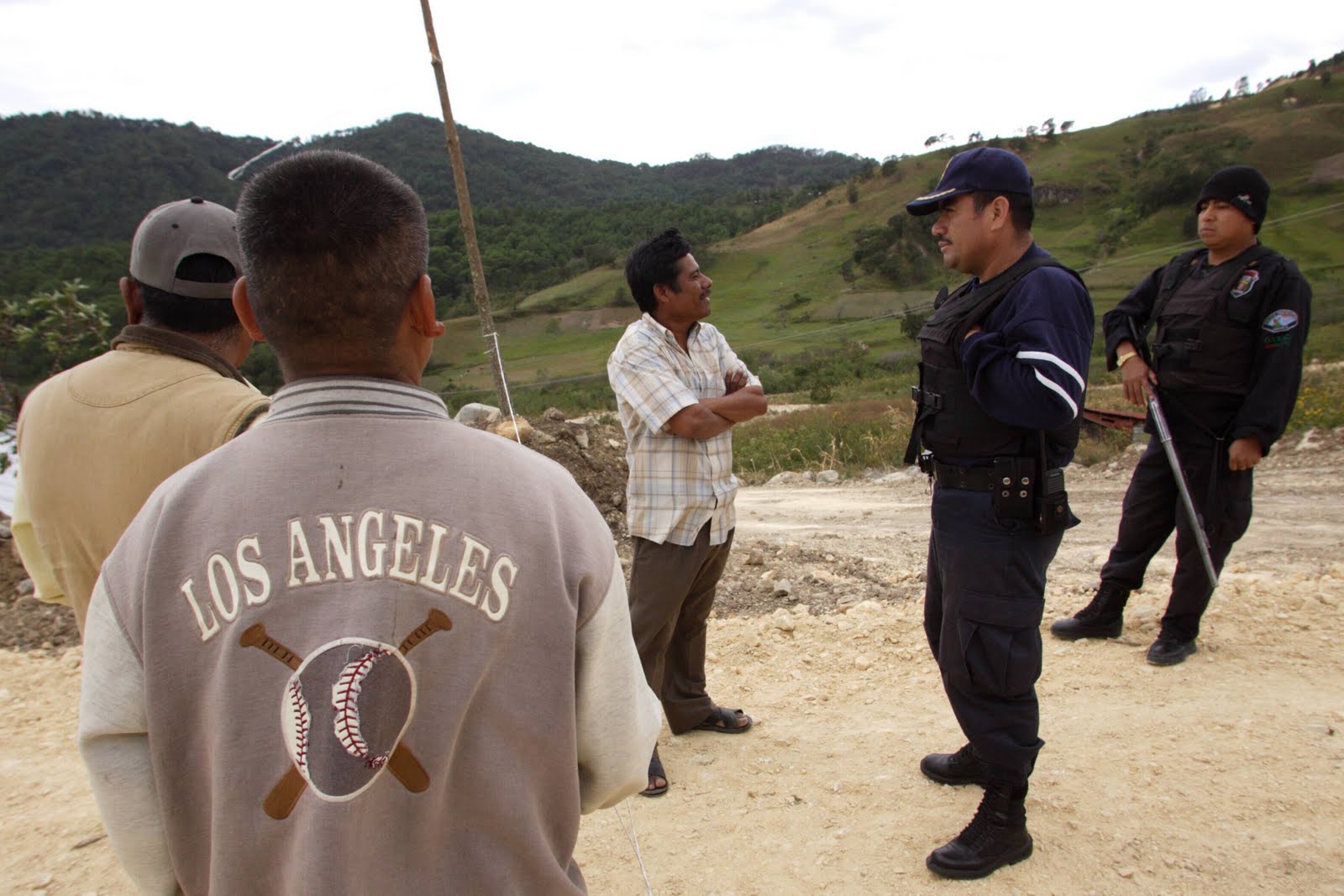
The caravan is now headed for Agua Fría.  From this point on, the caravan is out of telephone range.  This puts the caravan in considerable danger.

Oaxaca City-based Radio Plantón has speculated that the state government's stall tactics are playing into the paramilitaries' hands.  The government stalled the caravan for hours, meaning that if the caravan does reach San Juan Copala, it would have to spend the night there or run the risk of returning after nightfall.

There are reports that UBISORT has sent women and children to re-enforce its physical blockade of the highway into San Juan Copala.  Over the weekend, someone re-enforced the blockade with much heavier rocks that can only be removed with heavy machinery.

As the caravan travels in the telephone dead zone, there are protests in Mexico and around the world demanding that the government guarantee the caravan's safe passage to San Juan Copala so that it can deliver its aid.  In Oaxaca City, supporters have blocked Cinco Señores, a key intersection, in support of the caravan.  A march in Mexico City was attacked by riot police, reportedly leaving several protesters injured.  In Buenos Aires, protesters have set up a protest encampment outside the Mexican Embassy.  They are dialoguing with embassy officials. 

Background

San Juan Copala declared itself autonomous following the peaceful uprising in 2006 that nearly overthrew Oaxaca's governor.  The paramilitary organization UBISORT, which the ruling Institutional Revolution Party (PRI) created in 1994 to counter potential Zapatista influence in the indigenous Triqui region, has violently opposed the autonomous project.  In January, UBISORT blocked the road into San Juan Copala, preventing supplies and teachers from entering the municipality.  UBISORT also cut the running water and electricity to San Juan Copala.  The months-long siege means that San Juan Copala is running out of food.

At least 18 Triquis have been assassinated in the region this year.

Thursday, May 20, 2010

Copala Autonomous Leader and His Wife Assassinated

by Kristin Bricker

Timoteo Alejandro Ramirez and his wife Cleriberta Castro were found dead in their home today, according to San Juan Copala's blog.  Contralinea reports that the perpetrators are "hitmen from MULT," the Movement for Triqui Unification and Struggle.  Neighbors saw an armed commando that they say works for MULT in the area around the time of the killing.

Ramirez was a "natural leader" of the Yosoyuxi neighborhood, which forms part of the autonomous municipality of San Juan Copala.  According to indigenous customs, "natural leaders" are those who don't propose themselves as leaders; the community chooses them because of their long record of community service.

San Juan Copala declared itself autonomous following the 2006 peaceful uprising that nearly overthrew Gov. Ulises Ruiz Ortiz.  It threw out all political parties and organizations and governs itself through traditional indigenous governance, known in Mexico as "uses and customs."  The autonomous project initially enjoyed support amongst the rank-and-file of some of the political organizations that operate in the zone.  However, some organizations' leaders, concerned that they would lose power if the autonomous project moved forward, actively and violently opposed the project.  Those leaders who supported autonomy were quickly replaced by people who were sympathetic to the political parties.

San Juan Copala made international headlines last month when alleged members of the Union for the Social Well-being of the Triqui Region (UBISORT) opened fire on an international aid caravan headed to the besieged community.  Mexican social leader Bety Cariño and Finnish observor Jyri Jaakkola died in the attack. The caravan was bring food, clothing, water, and medicine to San Juan Copala, which UBISORT paramilitaries have blockaded since January.  No one can enter or leave the community, and the paramilitaries cut off electricity and running water.

The intense international outrage that followed the caravan attack did nothing to stem the violence.  Two weeks after the attack, UBISORT paramilitaries kidnapped six Triqui women, five children, and a baby when they snuck out of Copala to purchase food in the market of the nearby town of Juxtlahuaca. The Oaxaca state government and the Oaxaca State Human Rights Commission refused to accompany the woman back to San Juan Copala to ensure their safe passage.

San Juan Copala has called for a second, larger international caravan to the autonomous municipality on June 8.

First photo: Courtesy of Contralinea.
Second photo: by Heriberto Rodriguez.  Timoteo Alejandro Ramirez talks to Oaxacan state police.

Sunday, May 9, 2010

The Punishment of San Juan Copala

by Zósimo Camacho, Contralinea
photos by Julio César Hernández

The reorganization of paramilitary groups in the Triqui region began after the Popular Assembly of the Peoples of Oaxaca (APPO) movement.  The construction of the autonomous municipality was seen by the local political bosses and by sectors of the state government as a declaration of war.  The reprimand is directed at the Triquis who thought they could be "autonomous."

Santiago Juxtlahuaca, Oaxaca.   Rufino Juárez Hernández, president of the Union for the Social Well-being of the Triqui Region (UBISORT), walks down the streets of this municipal seat without being bothered.  On the contrary, he decides when to talk to the commanders who come from Huajuapan de León to transfer the bodies and the bullet-ridden and plundered automobiles, which were victims of the ambush this past April 27 in the vicinity of the La Sabana community, one of the few communities that his organization, affiliated with the ruling Institutional Revolution Party (PRI), still controls.


It would seem that Juárez Hernández is a peer or a superior of the commanders of the State Investigation Agency (AEI), Lázaro Hernández Rendón and Rodrigo Peralta Mejía.  Not a single police investigator nor commander nor public prosecutor questions Rufino Juárez about his participation in the ambush against the peace caravan, despite the fact that the victims accuse him of being the intellectual author of the murders, and that he has publicly declared himself to be the leader of the UBISORT, the organization that has put the Triqui culture's most important political and ceremonial community, San Juan Copala, under siege.

Nor did agents from the Center for Investigation and National Security (CISEN, the federal government's domestic security agency) reproach him, nor did members of the Mexican Army's second section, which is deployed in the zone.  Some pretend not to see him; others watch him pass without questioning him at all.  All this, despite the fact that Rufino is armed, and four of his bodyguards don't even bother to hide their rifles and shotguns under their long leather coats that reach their knees.

The Consequences of Autonomy

No one remembers a shootout in this municipal seat.  The complex agreements between the conflicting sides in the Triqui region have managed to keep this tiny city of less than ten thousand residents in peace.  The municipal seat is located less than 100 kilometers from the heart of the dispute, San Juan Copala, which its residents declared an autonomous municipality in January 2007.

The construction of Triqui autonomy set off two simultaneous processes: one the one hand, an ethnic cohesion that hadn't been seen in decades.  In 2007, for the first time in over 30 years, the most important Triqui holiday, known as the "third Friday" or carnival, was held in San Juan Copala by members of all of the organizations that have been at odds: the Movement for Triqui Unification and Struggle (MULT), the Independent Movement for Triqui Unification and Struggle (MULTI), UBISORT, and members of the National Peasant Federation (CNC).

The other process that was set off was the rearming of the leaders who felt displaced by the new autonomous authorities.

"The Mexican State benefits more than anyone else when the Triqui are fighting amongst themselves.  But the region's political and economic bosses also benefit.  It is about the powerful families in the cities of Putla, Juxtlahuaca, and Tlaxiaco," explains lawyer and Metropolitan Autonomous University postgraduate investigator Francisco López Bárcenas.

According to the author of San Juan Copala: Dominación Política y Resistencia Popular (San Juan Copala: Political Domination and Popular Resistance), the violence that the Triqui people are experiencing has been imposed and exacerbated by outside forces.

"The Triquis' lands and harvests have been coveted: coffee, banana, and corn.  And they've suffered from a very strong distain and racism: everyone knows that they can be killed and nothing will happen.  And they have generated very strong resistance and pride."

The postgraduate investigator explains that the political bosses from nearby cities say that the Triquis are violent and murderers, "but they don't say that they sell them weapons;" they say that they are lazy, "but because they don't work for them;" and they say they are ignorant, but not "that the political bosses have always opposed the entrance of teachers in Triqui communities."

The creation of the autonomous municipality broke up the MULT and UBISORT organizations.  When it became about an ethnicity that groups itself into clans, dozens of families, neighborhoods, and entire communities abandoned the organizations to which they had belonged for decades and joined the autonomous municipality.  The organization that resolutely pushed for autonomy was the MULTI.  As López Bárcenas explains, the autonomous Triquis' inspiration and discourse was Zapatista, but "the example and the practical experience" was the Popular Assembly of the Peoples of Oaxaca (APPO).

The Triqui Organizations

The UBISORT almost disappeared.  It remained in small communities: La Sabana, where the peace caravan was attacked, barely ten kilometers from San Juan Copala, and Unión Los Ángeles.  It also has some sympathizers in Tilapa.  It is estimated that, in total, its members don't add up to more than 300.  The UBISORT is now supported almost exclusively by its weapons.  It isn't a secret that the three main organizations are armed with AK-47s.  The difference is that the UBISORT is trained, has more weapons, and enjoys the alleged complicity of local political bosses and Gov. Ulises Ruiz's state government.  The organization was created in October 1994 in order to contain the influence of the Zapatistas who had taken up arms in Chiapas.

After a scattering that it managed to stop with assemblies, concessions, threats, and confrontations, the MULT preserved itself as the largest organization of the Triqui people.  It is comprised of approximately 22 communities and has about seven thousand members.

The organization that pushed for Triqui autonomy, after having joined the APPO in 2006, was the MULTI.  It is made up of ten communities, one of them being San Juan Copala.  It has about 3,500 members.

Finally, there are those who belong to the PRI, but not through UBISORT, but through the CNC.  It is basically one community, El Carrizal, and minority members in other communities.  They aren't more than 500 people.

The Paramilitary Siege

In the zone, all Triquis belong to an organization.  Affiliation is by clan.  Even though ideological discourse is present, everything is subordinated to family ties.  If a grandfather decides to belong to an organization, he does it along with his children's families.

In Mexico there are 30,000 Triquis.  Only about 15,000 of them are found in their region.  Due to violence and poverty, the other half have moved their residences to Mexico City and Hermosillo, Sonora, and other states in the country.  Others have migrated to the United States.

The paramilitary siege on San Juan Copala was installed on November 28, 2009.  Since then, there is no market, and merchandise is not easily obtained.  UBISORT also cut the telephone and power lines.  The schools are closed.  Even the Commission for the Development of the Indigenous Peoples, a federal agency, closed its offices in the town.  The only ones who didn't abandon the community were the nuns from the Copala diocese, who maintain a boarding school for local children.

"Things are really difficult there.  People can't leave the town because they shoot at them.  There's nothing to eat," explains Victor Castillo, a member of MULTI and sympathizer of the autonomous municipality.

"And how does the community survive?"

"The compas have figured out ways..."

The Echo Chamber

The news about the ambushes, the confrontations, the executions, and the revenge rarely hit the pages of the local and national newspapers.  Even more rarely do they appear in online media.  But Triquis, nu'saavi, and mestizos from Juxtlahuaca always know what's going on in the brush above.

The main plaza, the market, and taxi stands are the great eyes and ears where even the antagonist organizations can exchange messages.  And, like the drug trafficking organizations, they have halcones who inform them of who arrives and who leaves the municipal seat.  Rufino Juárez has an organization of market vendors, two taxi stands, and guards positioned around the town hall and in businesses in the city's outskirts.  When a person or group of people sets out towards San Juan Copala, the UBISORT leader already knows.

Translator's note: the statistics provided in this article regarding membership in various Triqui organizations should be taken with a grain of salt.  Due to the violence that prevails in the region, there are families and even communities who are afraid to publicly declare or change their allegiance, particularly if they sympathize autonomous municipality.


Translated by Kristin Bricker