Wednesday, March 17, 2010

National Strike Begins in Mexico, Police Respond With Violence

SME Members Defend Themselves and Continue to Block Their Former Workplaces

by Kristin Bricker

At noon on March 16, the Mexican Electrical Workers Union went on an indefinite strike, and unions all over the country went on strike with them. Electricians hung black and red banners across the entrances of their former workplaces, refusing to allow anyone to enter or leave the buildings.  The actions occurred at all of the former Luz y Fuerza del Centro (LyFC) buildings in Mexico City, Mexico State, Puebla, Hidalgo, and Morelos.  Actions in solidarity with the SME occurred in at least 21 other states.  In addition to hanging strike banners on former LyFC buildings, supporters blocked major federal highways, took over government buildings, and held rallies.  A significant number of the blockades remain, particularly in central Mexico.

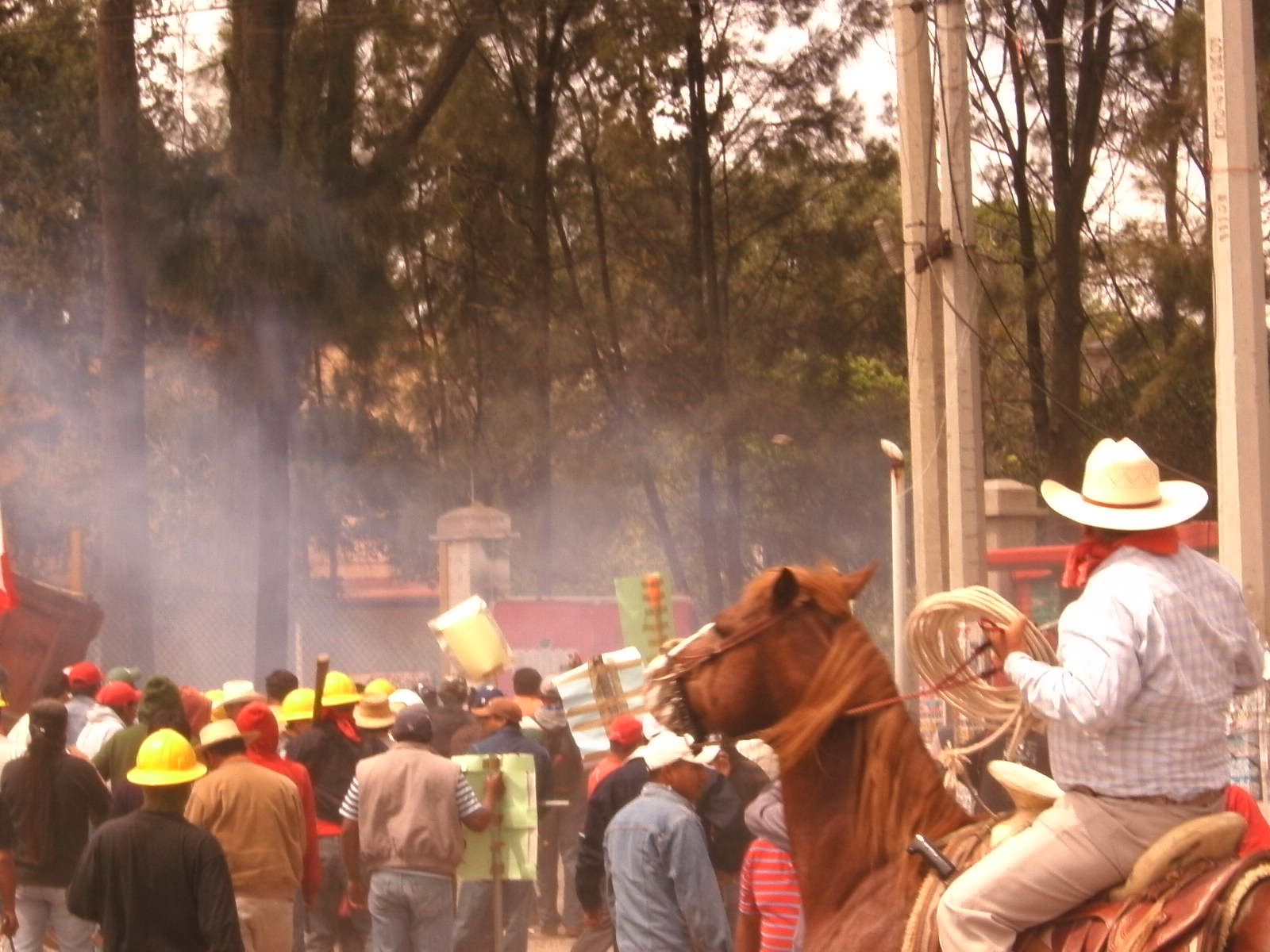
At least two SME actions outside LyFC buildings were violently repressed when Federal Police (PFP) attempted to prevent the SME from hanging its strike banners.  However, in both instances the SME and supporters repelled the police and hung their strike banners.


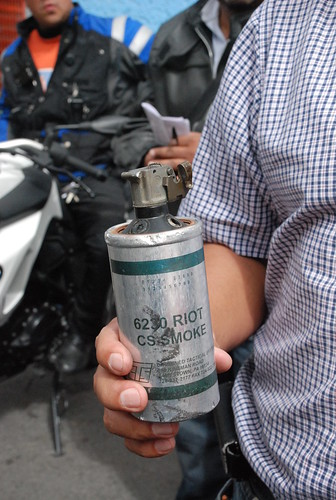
The repression began at Cables Bolivar in central Mexico City.  "When we tried to hang our strike banners, the PFP started yelling insults at our compañeros," says Gerardo Avelar, the SME's Secretary of Agreements.  "We dialogued with the PFP's commanding officer on site so that we could peacefully hang our banner.  He accepted this.  However, when the banners were hung, a member of the PFP irresponsibly pulled down a banner that we had hung with [the commanding officer's] permission."  The PFP then began to fire tear gas into the crowd, according to Avelar.  While the exact number of tear gas canisters fired is unknown, SME members were able to show this reporter pieces from four spent canisters: two rifle-fired canisters and two hand-thrown grenades.

The tear gas was manufactured by US-based Combined Tactical Systems, the same company that manufactured the tear gas used in the 2009 Bagua, Peru, massacre of indigenous protesters and the violent attack against striking teachers in Morelos, Mexico in 2008.

When the PFP fired tear gas at the SME, the gas wafted into surrounding schools and homes, affecting the children inside.  The Cables Bolivar complex is located across the street from an elementary school and catty-corner to a daycare.  The SME reports that 2-month-old Alexis Emiliano Hernández was hospitalized when tear gas entered his home near Cables Bolivar.

Calls to support the SME in Cables Bolivar went out over Twitter and Radio SME, and support quickly arrived from other parts of the city.  Students from the Autonomous University of Mexico City, the Urban Movement of Popular Power, and other organizations quickly arrived and drove back the police.  Avelar says, "We will not move from here until the Ministry of the Interior or the Supreme Court presents a solution to this problem."

The second confrontation with police occurred in Juandho, Hidalgo.  SME members and supporters blocked the entrance to the Juandho LyFC complex with piles of dirt.  According to El Universal, "This angered the federal police, leading to a confrontation."  The police fired tear gas and pepper spray at the crowd, and fired live rounds into the air.  El Universal reports that following the repression, approximately three police helicopters and 400 federal police arrived on the scene to drive back protesters.

Following the police repression, floodgates that guard a canal of raw sewage were opened, flooding the LyFC complex and the police inside.  At the time of publication, it has not been confirmed how the floodgates opened.  However, the flood seems to have incapacitated the police--reports from Juandho indicate that the SME still holds its blockade of the LyFC complex there.

The SME continues to blockade key LyFC buildings, and will do so indefinitely.  The workers have organized themselves into shifts that will maintain the picket lines around the clock.  As nighttime fell, a "tense calm" fell over the blockades.  Police continue to attempt to penetrate the blockades, particularly in Nexaca, Hidalgo, and there is fear that police will attack in the night while the majority of the region is asleep.

National Support

Actions in support of the SME reportedly occurred in about 25 states.

The national strike has inspired organizations all over the country to take bold measures to support the SME as well as their own causes.  Several organizations took advantage of the national strike in support of the SME to pressure the government to cede to their own demands.

Oaxacan teachers, in addition to sending a delegation to the Mexico City protests, blocked government buildings and highways in their own state, bringing transit to a standstill.  Their actions were in support of the SME, but also designed to pressure the government in their own 2010 contract negotiations.

Students from the Autonomous University of Mexico City rushed to the SME's aid in front of the Cables Bolivar complex after police attacked there.  The city government has cut all funding for their university, leaving them unsure how they will continue their studies.  They arrived at Cables Bolivar with signs that said, "Less Military, More Education."

Miners in Cananea, Sonora, blocked a federal highway there.  The company that owns the mine where they work refuses to recognize their union and seeks massive layoffs.  The government has authorized the military to take over the mine.  The miners participated in the SME's national strike by blocking the Cananea-Agua Prieta federal highway and have vowed to remain there until their own labor dispute is resolved.  The SME and the Miners Union have a strong relationship and a history of mutual aid.

Photos: Santiago Navarro, No a la Destrucción de Hidalgo, and Pateando Piedras

Monday, March 15, 2010

War: The United States' Failed Model

El Universal editorial

How advanced must a military be in order to eliminate an enemy that is easily confused with the civilian population?  The United States, which possesses the most powerful armed forces on the planet, has not figured out the answer.  This is why it will leave Iraq decimated, discredited, with public opinion against it, and leaving the Middle East in conditions that favor extremism:  polarization, insecurity, and misery.  This is why it is incapable of stopping drug trafficking in its own territory.  Various areas of Mexico, as well as our military, could suffer the same fate if the climate of war that they suffer from is further prolonged.

Ciudad Juarez is the classic example.  Thousands of soldiers have not been able to put an end to extortion, kidnappings, murders, economic collapse, and a dead nightlife.  It is logical up to a certain point because procuring justice isn't the military's job.  Only a security force under civilian command, dedicated to due process, can achieve that.  Acapulco, Reynosa, and Tampico seem to be following the same path.

And what does the United States do?  It grants resources through the Merida Initiative to train police, while the Pentagon plans to increase anti-drug training for Mexican soldiers.  A contradiction.  Wasn't it our neighbors' State Department that this past March announced that the police would be professionalized to that the military would no longer have to do public security work?  The United States should know this already: when soldiers remain amongst the civilian population, abuse proliferates and with it delegitimization of the soldiers.  If the Pentagon is taking these actions without the White House's consent, Barack Obama should concentrate on coordinating his agencies rather than issuing press releases expressing his outrage.

It appears that the United States does not want its neighbor to learn the painful lesson that it has had to learn.  Because even though Mexico is different than Colombia or Afghanistan, all armed conflicts have one thing in common: the breakdown of the social fabric and the destabilization of institutions.  In chaos, the law of the jungle prevails, and so do groups who operate outside the law, call them what you wish: paramilitaries, drug traffickers, or terrorists.

At this point, Mexico should learn that it cannot trust directives from the United States.  Our powerful neighbor is a horrible example to follow for two reasons.  1) It has been unable, with all its might, to stop drug trafficking in Asia and Latin America.  2) The high level of corruption amongst its border officials as well as its population's massive addiction to drugs demonstrate that it is not willing to take on the costs of a real war on drugs.  It is never good to emulate losers.

Translated by Kristin Bricker

Government Blocks SME's Telephones; Soldiers Arrive in New Necaxa

by Arturo Alfaro Galan, La Jornada

Since yesterday afternoon, callers who dialed the cell phone numbers that belong to the Mexican Electrical Workers Union's principal leaders in the Nuevo Necaxa division began to receive the message: "The number that you dialed is restricted by government order."  This came after 200 members of the Mexican military and the Ministerial Federal Police (PFM) arrived before dawn this past Sunday morning.

Leaders from the Democratic Council of the Puebla Teachers Union (CDMP) and the Mexican Electrical Workers Union (SME) who were interviewed by La Jornada de Oriente, expressed their fear that the military and federal forces would carry out an operation to repress the electricians, who will try to close highways and occupy Federal Electricity Commission (CFE) buildings tomorrow.  On Tuesday there will be mobilizations and marches around the country with the intention of seeking a national consensus on the recall of President Felipe Calderon.

As part of the actions, the electricians are expected to take over highways, public spaces, and government buildings in the Huauchinango region to demand their reinstatement in their old jobs.

According to reports from the CDMP, various groups of soldiers and federal police began to arrive in Puebla's Sierra Norte to take up positions in the communities of Santa Catalina in Huachinango, Nuevo Necaxa in Juan Galindo, and Lomas de Ocotzotal in Xicotepec de Juarez, which has caused anxiety among residents.

The places where the soldiers and Federal Police took up positions since yesterday morning are the main access points over land that connects the Sierra Norte with the states of Hidalgo, Veracruz, and Tlaxcala, which have been blocked on various occasions by electricians to demand the suspension of the presidential decree that shut down the company Luz y Fuerza del Centro (LFC).

According to the electricians, the soldiers and PFM officers remain stationed on highways and in hotels in Huachinango, while their vehicles are located near LFC's electric substation in Huachinango, next to the local fairgrounds.

"As of this moment they have not committed any act of repression, nor have they tried to deploy, but people here are very nervous due to the soldiers' presence.  They're just parked, watching every movement," said Roberto Robles Monzón, a member of the CDMP.

A few days ago the SME's Undersecretary of External Affairs, Miguel Angel Montiel Eslava, did not rule out that during the protest there could be confrontations with the military and police.  He asked the federal government to "not repress the electricians" in Sierra Norte.

Translated by Kristin Bricker

Friday, March 12, 2010

Canadian Mining Company Investigated for Bribes to "Quell Local Dissent" in Chiapas

Blackfire Exploration, the mining company whose employees have been linked to the murder of anti-mining organizer Mariano Roblero, may have paid bribes to the mayor of Chicomuselo, Chiapas.  Roblero lived, organized, and was murdered in Chicomuselo.

If the evidence submitted by a coalition of organizations--including MiningWatch, the Council of Canadians, and the Sierra Club--is genuine, it demonstrates that Blackfire acknowledges that it paid a series of bribes to the Chicomuselo mayor.

The Calgary Herald reports that a coalition of anti-mining groups have submitted a Blackfire spreadsheet that "appears to show 14 payments made by Blackfire to the mayor, Julio Cesar Velazquez Calderon, and a letter to the congress of the state of Chiapas in which the company asks the mayor to be removed from office."

The Calgary Herald continues:
In a letter to the Chiapas congress in June 2009, Blackfire said the company was the victim of extortion by the mayor and made payments of about 10,000 pesos (about $1,000 Cdn) per month. The mayor then sought flights for himself, family and friends, which the company agreed to, according to the letter. But the company decided to stop the "ridiculous propositions" after the mayor asked for Blackfire to set up a sexual affair with a Playboy model.
Read the entire article in the Calgary Herald. 

Wednesday, March 3, 2010

Federal Police Intimidate Electrician Union Members in Iztapalapa, Mexico

Laid-Off Workers Vow to Relocate Their Table to Continue Assisting Striking Customers
On Monday, March 1, at about 9am, approximately ten heavily armed Federal Police arrived at the former Luz y Fuerza del Centro's Santa Cruz Meyehualco office in Iztatapalapa, Mexico, and forced union electricians to remove a table they had set up outside their former workplace. The electricians, all members of the Mexican Electrical Workers Union (SME), have continuously staffed the table since December 17, 2009.
The table in Iztapalapa is one of about 250 "information modules" that the SME set up all over the area that Luz y Fuerza del Centro (LyFC) served before President Felipe Calderon's October 11 executive order that summarily shut down the power companyand threw its 44,000 workers out on the street.
While the SME refers to the tables as "information modules," in reality they act as guerrilla customer service centers--and all of the services they offer are free to the public. Electric customers can go to the tables to file legal complaints with the government regarding service problems they have experienced since Calderon shut down LyFC and put its grid under the control of the Federal Electricity Commission (CFE). Customers who file complaints can also join the consumer strike and refuse to pay their bills. Electric customers who experience service interruptions either due to CFE incompetence or strike-related shut-offs can request that a team of SME electricians come out to restore their power.
"Theft Disguised As Inventory"
The Iztapalapa information module began to experience problems on February 22 whenagents from the Ministry of Administration and Asset Transfer (SAE) arrived at LyFC's Santa Cruz Meyehualco office with a public notary and several local police under the auspices of carrying out an inventory. They were met by 16 SME members who were staffing the information module.
The SME members told the police and SAE officials, "You can't go in. If you want to go in, then we go in, too, because we have personal belongings inside." When the police insisted that the SME let the SAE officials enter, an SME member responded, "There's negotiations going on with the federal government, directly with [Secretary of the Interior Fernando Francisco] Gómez Mont. The union is negotiating so that we can go in and get our personal belongings out, accompanied by a public notary. But we [in the meantime] we can't let strangers inside."
Joaquin Gomez, one of the SME members that has staffed the information module outside the Santa Cruz Meyehualco office, told Narco News, "Ever since [Calderon sent Federal Police to take over LyFC without warning on] October 11, we haven't been able to enter. We think these people are trying to steal our belongings. We have a lot of personal belongings inside, including money. We left a lot of personal belongings in our desks and lockers."
In addition to personal belongings, Gomez and his former co-workers also fear that the SAE will steal LyFC's customer databases. "They came with laptops, so we think that what they want is the database with all of our customer information. We served about 100,000 customers [at the Santa Cruz Meyehualco location]. So we think they want the files to be able to locate the customers.
As soon as the SAE and the local police tried to enter the LyFC office, the workers called their fellow union members for backup. They also called the Francisco Villa Popular Front - Independent (FPFV-I), who are members of the Zapatista's Other Campaign in Mexico City. The FPFV-I immediately sent dozens of members to the office in Santa Cruz Meyehualco office to guard the doors and rally in support of the SME.
Faced with such a show of solidarity, the SAE officials and the police retreated, warning that they would be back another day.
The SAE officials and local cops didn't come back. However, heavily armed Federal Police came to Santa Cruz Meyehualco on March 1 and forced the SME to take down its information module in front of the office.
According to Gomez and the other SME members gathered near the office, the police rotate their positions: approximately four police are inside the offices at any given time while another six stand guard outside. Gomez told Narco News, "We don't know what they [the Federal Police] are doing inside. We suspect that they want to remove vehicles and equipment and files, as they've done in other [LyFC] buildings."
The workers report that thus far they have no visual confirmation that the police have removed items from the Santa Cruz Meyehualco office. However, their suspicions aren't unfounded: the SME has video documenting police stealing computers, tools, and even huge suitcases full of copper wiring from LyFC buildings.
Consumer Strike
Gomez reports that the Federal Police's presence intimidates people. "People are scared to come here because they see the federales outside the agency," he says. "In this zone we were turning in 40-50 complaints daily" before the Federal Police showed up. Now with armed police standing guard, hardly anyone stops by the table, the workers report.
Much to the police's chagrin ("Who gave you permission to take photos?" snarled one officer at our photographer), this friendly news team interviewed former LyFC worker Carlos Romero outside the Santa Cruz Meyehualco office. He explained the free services the SME offers at the information modules, and how customers can join the strike.
Narco News: What services do the information modules provide?
Romero: We explain the reasons for why people shouldn't pay their bills. First, it's because they never signed a contract with the CFE, and therefore they never hired that company to provide any services.
Narco News: So, for example, if I were a Luz y Fuerza customer and I didn't want to pay the CFE, what would I have to do?
Romero: You just need your voter identification, an old bill from Luz y Fuerza, and your bill that you received from CFE. If the CFE bill hasn't arrived--because in many neighborhoods people haven't received CFE bills yet--then you just need your voter identification and and old Luz y Fuerza bill. This is to demonstrate that you had contracted electric service with Luz y Fuerza and to demonstrate to Profeco (the Federal Prosecutor's Office for Consumer Affairs) that you are being affected. You need to bring three copies of every document to the information module.
Narco News: If I stop paying my electric bill and the CFE comes to turn off my power, what happens?
Romero: The CFE doesn't have the legal right to shut off your electricity. In fact, they don't even know who has paid and who hasn't paid because they don't have an accurate database. And they don't have a database or a list where they keep track of who has paid and who hasn't paid. In fact, some people are getting CFE bills that tell them that after they paid their bills they should call a number to inform the CFE that they've paid. That's rediculous. They should know who paid and who hasn't.
If it happens that they do shut off your power for nonpayment--which would be a very unlikely case--compañeros here from the union would go and reconnect your power for free. This is a service that we're providing to the public so that they have the security of knowing that absolutely nothing will happen to them. It's a benefit we're offering our customers.
Since Mexico City is very big, there are modules in neighborhoods and boroughs all over the city. You can find a list of all of the modules online at sme1914.org and radiosme.org.mx. If you go to the module in your neighborhood or borough, they'll give you phone numbers for the teams that are closest to you so that they can come out to your house and help you out.
"We Can't Back Down"
Gomez says that the police presence outside of the Santa Cruz Meyehualco office won't deter the SME. "We'll put the table next to the office instead of in front of it so that we can continue to serve the public. We can't back down." To former Luz y Fuerza customers, he says, "Don't stop filing complaints. Don't pay your electric bills. File legal complaints with the government. Don't be afraid of the police. We're not afraid of them. We respect them because they have guns. But keep supporting us, and come out with us on March 16 during the national strike."
Photos and additional reporting by Santiago Navarro.

Mexican Drug Policy Reform Movement Takes Shape

International Conference in Mexico City Provides Hope, Inspiration to a Budding Domestic Movement

This past February 22 and 23, drug policy experts and organizers from around the world gathered in Mexico City for “Winds of Change: Drug Policy Around the World,” a conference organized by the Collective for a Comprehensive Drug Policy (CUPIHD).

The conference was the first event CUPIHD has organized as a collective. Jorge Hernández Tinajero, CUPIHD’s president, told Narco News, “All of [CUPIHD’s members] have been working on this issue for at least ten years from our respective areas of expertise.” However, it was only recently that they joined forces under the banner of CUPIHD, which they founded last year “in order to transform the drug policy in Mexico to one with a harm reduction and human rights perspective.” According to fellow CUPIHD member and former federal Congresswoman Elsa Conde, the Winds of Change conference “is just the beginning.”

At the conference, drug policy experts from Peru, Argentina, Brazil, Holland, the United States, and the United Kingdom shared their experiences in their own countries. While recognizing that the situations in their respective countries were very distinct from that of Mexico, they hoped that Mexicans could learn from their experiences, strategies, tactics, and experiments in drug policy reform.

Pien Metaal from Holland, for example, spoke about the backslide towards criminalization that her country is currently experiencing after years of increasing decriminalization. Her organization,Transnational Institute, analyzes and compares drug policy around the world. Metaal provided a broad overview of how various European and Latin American countries have experimented in decriminalization. She focused on the various ways governments have reclassified drug distribution, possession, and use as they move towards decriminalization, giving conference participants a variety of options to consider and advocate for as they fight for reform in their own countries. She noted that in order to move towards more just sentencing policies, many countries have begun to draw legal distinctions between different drugs, between users and dealers, between dealers and major distributors, between mules* and large-scale traffickers, and between small and large producers.

The Transnational Institute has also compiled information from studies in countries that have decriminalized drug use to some extent in order to draw conclusions about the impact of drug decriminalization on drug use and drug-related crime. Metaal argues, based on an analysis of available data from various countries, that “law enforcement measures are not effective in reducing the expansion of drug markets. Rather, it is the poorest and most marginalized people and families who pay the price of these policies. There is sufficient evidence that alternative policies do not increase [drug] consumption, but they do increase access to [prevention and rehabilitation] services and medical attention.”

Ethan Nadelmann from the US-based Drug Policy Alliance (DPA) spoke during two plenary sessions. Nadelmann explained how and why his organization has focused most of its efforts on legalizing medical marijuana in the United States. While the DPA seeks to “end the war on drugs” in general, it has chosen medical marijuana as a wedge issue, one that seeks to remove or reduce stigmatization associated with drugs and open the door to a broader debate on the war on drugs. “We hoped and we believed that by working on the use of medical marijuana, it would begin to transform the public dialogue around marijuana,” Nadelmann said. “It would change the conversation, and we hoped it would reduce the resistance to speaking about marijuana legalization more broadly. I think we’ve been successful in that regard.”

Nadelmann told the mostly Mexican audience that he was by no means arguing that Mexican drug reformers should also take up the cause of medical marijuana. Rather, he said, “If you look at the way drug policy reform evolves and educationally leaps forward in different parts of the world, it can be for very different reasons… Each place is different. I think in Mexico you are still looking and struggling for what will be the angle, the specific thing that enables Mexico to leap forward on this debate. In the United States it was medical marijuana.”

Nadelmann argues in choosing a key issue to focus on in order to advance the movement, drug reformers must ask, “Where can we get traction? Where can we dig in? Where can we make a stand in order to begin to fight back?” As Nadelmann points out, a good issue to begin with in policy reform is the issue most people can agree upon—an issue where most people believe the drug war has gone too far.

Nadelmann, while reminding conference attendees that he is not an expert on Mexico and is not in a position to tell Mexicans how to go about building a drug reform movement, “guessed” at what might be key issues in Mexico that the movement could seize upon. “My advice, take it for what its worth, is to focus on moving opinion in Mexico on the marijuana issue. It is almost impossible to speak realistically in political terms about the legalization of cocaine or heroine or methamphetamine, but with marijuana yes, it is possible, and it can happen,” Nadelmann argued. “In Mexico right now only 30% of Mexicans support the legalization of marijuana. Mexico needs a rapid jump in support for the legalization of marijuana. And it needs to be linked in the public mind that legalizing marijuana is the best way to deprive the drug gangsters of billions of dollars.” Nadelmann noted that the US Drug Enforcement Agency (DEA) and the US drug tsar claim that at least half of Mexican drug gangs’ earnings come from marijuana.

Nadelmann also shared several examples of how his organization seized on specific opportunities to launch campaigns that changed people’s opinions on drug policy. InTulia, Texas, for example, forty black people were arrested in a drug raid, with the only evidence against them being the testimony of a single white police officer. All of the prisoners were later released. Drug policy reform organizations seized on the case to foment a criticism of drug policy, which disproportionately affects black and brown communities in the US, within the traditionally socially conservative black community.

Nadelmann believes that Mexico is also living an educational moment, one that can be seized upon to open up a debate on drug policy. “Currently, there are places in Mexico that look like Chicago during the era of Prohibition and Al Capone. If there has ever been a moment to question the costs and benefits of prohibitionist policies, the moment is now.”

Several conference attendees wondered out loud if the key to moving the Mexican public on drug policy reform lies in Ciudad Juarez, the new “murder capital of the world.” A journalist pointed out that President Felipe Calderon’s recent visit to Juarez was a complete disaster. On February 11,police violently attacked a protest outside the convention center where Calderon was to speak on security. Many of the protesters were students from the Juarez high school that suffered a massacrein which gunmen murdered at least 15 people—mostly students—at a party. Inside the convention center, the mother of a murdered student railed against a speechless Calderon for three minutes. Given the recent unrest against government policy in Juarez, the journalist told conference attendees, “I think there is something going on in Juarez and El Paso. Even if it’s just ‘We don’t want aggressive law enforcement, we don’t want the military in our community,’ even if that’s the only result, it softens people up” and opens up the possibility of a debate on broader drug policy reform.

In addition to choosing a key issue to push in order to advance drug reform, Nadelmann offers a second piece of advice to Mexican drug policy reformers: “Insist on the legitimacy of open dialogue. The worst prohibition is a prohibition on thinking. When the government engages not just in censorship, but in self-censorship, and when it discourages and denies the possibility of open and honest dialogue, it undermines the ability to come to a better policy, and it reveals their own fears and securities about the value and legitimacy of the policies they are enforcing.”

While Mexicans may still be grappling with how to take their first steps towards building an effective movement to end the drug war, CUPIHD’s conference made a giant leap forward in promoting an open and honest debate on the issue. While the drug war is omnipresent and discussed nearly constantly in the media, in Congress, in schools, and on the streets, false information abounds. This prevents an honest and informed debate on how to go about fixing what everyone acknowledges is a serious problem.

Two Mexican experts in particular debunked common misconceptions about the drug war in order to promote a more honest debate based on accurate information. Professor Alejandro Madrazo, a member of CUPIHD, discussed Mexico’s recent legal reform that the media billed as “drug legalization.” He pointed out that while the government did legalize the possession of very small quantities of drugs, the majority of users generally carry more than the legally permitted amount. Thanks to the new law, this consumer “is being pursued with more force and more tools,” and the law makes the prosecution of consumers much easier. Furthermore, Madrazo argued, the law seeks to forcefully incorporate states into the federal government’s war on drugs, and it redistributes power and responsibilities in that war. The end result, he argues, is far from legalization.

Luis Astorga from the National Autonomous University of Mexico’s Institute for Social Investigations debunked many of the government’s so-called statistics that relate to the war on drugs. “Nearly every day the media gives credibility to declarations from public officials, but they never demand that they show a study and a methodology for how they arrived at those numbers.”

Astorga taught conference attendees how to evaluate the numbers they hear in the media, particularly those that come from the government, to determine if they are credible or questionable. In doing so, Astorga systematically debunked or called into question statements Mexican and US government officials have made in the media regarding the amount of Mexican land that is used for cultivating drugs, the number of people who work in drug trafficking, the amount of money drug trafficking brings into the Mexican economy, and the number of drug consumers and addicts.

Moving Forward

Ex-Congresswoman Conde closed the conference with the following words:

“There is no doubt that we recognize the failure of the so-called war on drugs. We require new winds of change to advance alternative policies for the world’s drug problem. We have seen that prohibitionist policies have not been effective in most countries. This paradigm has resulted in grave human rights violations and violations of individual rights. It has also entailed discrimination and social exclusion. The escalating violence increases with every passing day, increasing the territory within which organized crime operates with impunity. We insist that prohibitionist policy means that states have given up their control over the drug market. We insist that prohibition, in market terms, is much more costly and useless than regulation.”

“Now,” Conde asked, “after two days of work and reflection, where do we go from here?

“Gabriel Tokatlian, an Argentinian investigator, invites us to use common sense in drug policy. He tells us that the best policy is one that privileges justice, equality, health, human rights, education, and employment. This is precisely the vision that is absent in current drug policy, at least in our country.”


Notes:

* A mule or mula is an individual, generally poor, who transports relatively small amounts (less than a few kilos) of drugs, generally in or on their body, at the behest of a large-scale drug trafficker.


This report originally appeared in Narco News.

Bolivian President Evo Morales Visits Mexico City

The Event, Organized by the Mexico City Government, Was Evo's First Official Visit to Mexico

Evo Morales visited Mexico City on Sunday evening on his way to a Rio Group summit in Cancun. The Mexico City government, controlled by the center-left Democratic Revolution Party (PRD), organized a public event and press conference to receive the Bolivian president.

Hundreds of Mexicans crowded into the central plaza in Coyoacan, an upscale neighborhood in southern Mexico City, to hear Morales speak. Many wove wiphala flags, the rainbow-colored flag that represents Andean indigenous peoples in Bolivia. Bolivia's new constitution, written during President Morales' administration, officially recognizes the wiphala as a government flag.

Union leaders and some rank-and-file union members were in attendance. Uniformed members of the Mexican Electrical Workers Union (SME) could be seen dispersed throughout the crowd. SME Secretary General Martin Esparza was also reportedly in attendance. Other unions, such as the PRD-aligned Public Transport Workers Union, hung their banners around the plaza in Coyoacan.

Grassroots and indigenous organizations for the most part did not have a visible presence in the crowd. However, Felisa Segundo Mondragon, a mazahua originally from Mexico State, spoke at the event. She originally arrived in Mexico City with her 9-year-old daughter in search of work. In the 1990s she helped found the Flor de Mazahua artisan cooperative, where she and other mazahua women produced traditional mazahua toys, dresses, and blouses for sale in Mexico City and abroad. She is now an indigenous representative in the United Nations. Segundo enthusiastically received Morales: "His struggle is our struggle... because he is the only man who is recognized throughout Latin America who listens to us, and because he has suffered with us."


Trinidad Ramirez, wife of the imprisoned leader of the People's Front in Defense of the Land (FPDT), also appeared in stage to present Morales with a red bandana.

During the event some indigenous people held an Ancestral Ritual in which they ceremoniously presented a scepter to President Morales. During the ceremony, participants burned copal, an incense made of tree resin. In Mexican indigenous cultures, copal is used in ceremonies as a bridge or mediator between people, heaven and earth, and the living and the dead.

Bolivia's indigenous president recognized the contradiction that Sunday's visit presented: his first public visit to Mexico was organized by a political party, not indigenous organizations. His first order of business during the event in Coyoacan was to apologize to Mexican indigenous organizations who had sent him many invitations to meet with them. "I'm sorry that I couldn't come because I had the difficult work of defending myself as President," he said.

Morales said that his speech was directed at "the social movements...that dream of another world." He recounted his experiences in social movements and later in the electoral arena. "First, we identified internal enemies and purged them from the popular movement."

Morales identified a 1991 meeting of indigenous peoples in Quetzaltenango, Guatemala, as the moment leaders of the popular movement in Bolivia decided to organize themselves to take state power. "It took us four or five years [after that] to transform ourselves from a popular struggle to an electoral struggle, from resistance to taking political power." He went on to explain that in 1995, after forming concrete proposalsregarding the defense of Bolivia's natural resources and public services, the movement worked to unite peasant and indigenous movements. "Then we united ourselves with leftist political parties, communist parties, socialist parties--with everyone." Morales says that when the electoral campaigns began, "We made a call to the middle class, to the intellectuals, to join us as well." Uniting so many different factions, Morales argued, was key to winning 64% of the popular vote in December's elections.

Morales argued that workers and indigenous peoples throughout America can unite around the common issues of dignity, sovereignty, the recuperation of natural resources, and against the privatization of public services.

Later in the evening Morales offered a press conference in the Sevilla Palace hotel on Paseo de la Reforma. There, he stressed the importance of creating a new Organization of American States that does not include the United States. He said that he will present this proposal at the upcoming Rio Group summit in Cancun. Morales asked those gathered at the press conference, "How far can we get with empire or without empire? In my experience, it's better without empire."

Fernando Leon contributed to this report.

This report originally appeared in Narco News.