Showing posts with label Puebla. Show all posts

Wednesday, March 17, 2010

National Strike Begins in Mexico, Police Respond With Violence

SME Members Defend Themselves and Continue to Block Their Former Workplaces

by Kristin Bricker

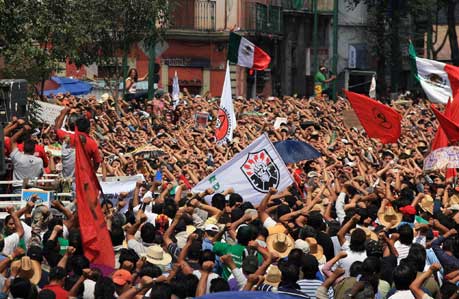
At noon on March 16, the Mexican Electrical Workers Union went on an indefinite strike, and unions all over the country went on strike with them. Electricians hung black and red banners across the entrances of their former workplaces, refusing to allow anyone to enter or leave the buildings.  The actions occurred at all of the former Luz y Fuerza del Centro (LyFC) buildings in Mexico City, Mexico State, Puebla, Hidalgo, and Morelos.  Actions in solidarity with the SME occurred in at least 21 other states.  In addition to hanging strike banners on former LyFC buildings, supporters blocked major federal highways, took over government buildings, and held rallies.  A significant number of the blockades remain, particularly in central Mexico.

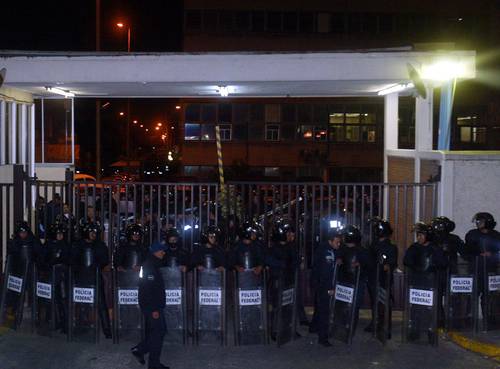
At least two SME actions outside LyFC buildings were violently repressed when Federal Police (PFP) attempted to prevent the SME from hanging its strike banners.  However, in both instances the SME and supporters repelled the police and hung their strike banners.
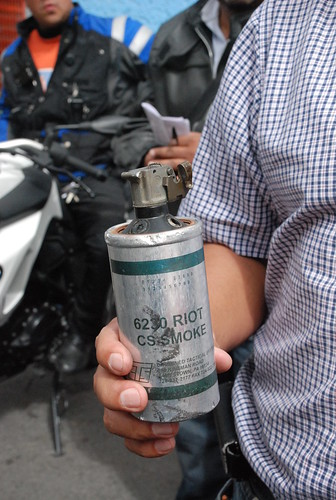

The repression began at Cables Bolivar in central Mexico City.  "When we tried to hang our strike banners, the PFP started yelling insults at our compañeros," says Gerardo Avelar, the SME's Secretary of Agreements.  "We dialogued with the PFP's commanding officer on site so that we could peacefully hang our banner.  He accepted this.  However, when the banners were hung, a member of the PFP irresponsibly pulled down a banner that we had hung with [the commanding officer's] permission."  The PFP then began to fire tear gas into the crowd, according to Avelar.  While the exact number of tear gas canisters fired is unknown, SME members were able to show this reporter pieces from four spent canisters: two rifle-fired canisters and two hand-thrown grenades.

The tear gas was manufactured by US-based Combined Tactical Systems, the same company that manufactured the tear gas used in the 2009 Bagua, Peru, massacre of indigenous protesters and the violent attack against striking teachers in Morelos, Mexico in 2008.

When the PFP fired tear gas at the SME, the gas wafted into surrounding schools and homes, affecting the children inside.  The Cables Bolivar complex is located across the street from an elementary school and catty-corner to a daycare.  The SME reports that 2-month-old Alexis Emiliano Hernández was hospitalized when tear gas entered his home near Cables Bolivar.

Calls to support the SME in Cables Bolivar went out over Twitter and Radio SME, and support quickly arrived from other parts of the city.  Students from the Autonomous University of Mexico City, the Urban Movement of Popular Power, and other organizations quickly arrived and drove back the police.  Avelar says, "We will not move from here until the Ministry of the Interior or the Supreme Court presents a solution to this problem."
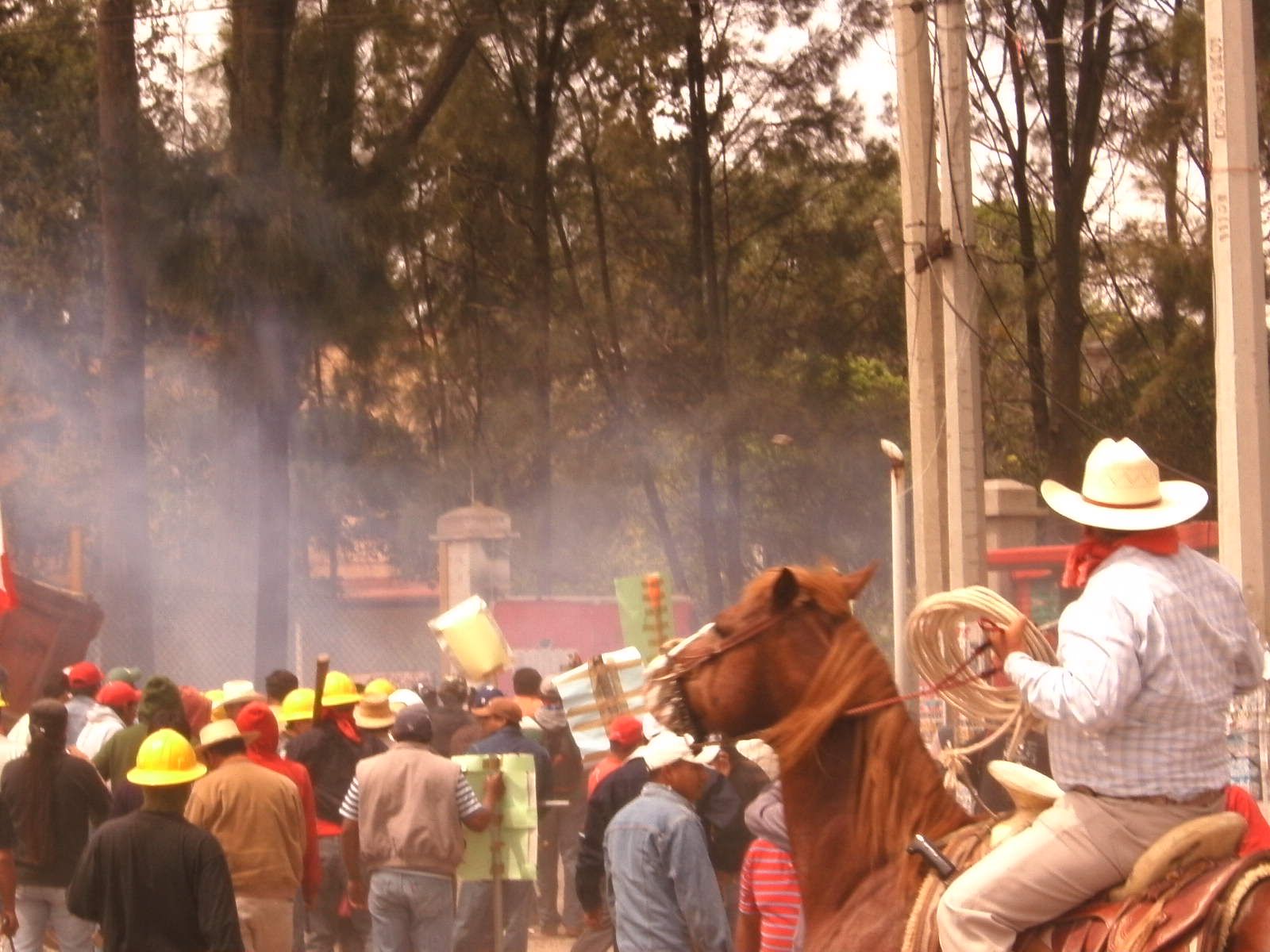
The second confrontation with police occurred in Juandho, Hidalgo.  SME members and supporters blocked the entrance to the Juandho LyFC complex with piles of dirt.  According to El Universal, "This angered the federal police, leading to a confrontation."  The police fired tear gas and pepper spray at the crowd, and fired live rounds into the air.  El Universal reports that following the repression, approximately three police helicopters and 400 federal police arrived on the scene to drive back protesters.

Following the police repression, floodgates that guard a canal of raw sewage were opened, flooding the LyFC complex and the police inside.  At the time of publication, it has not been confirmed how the floodgates opened.  However, the flood seems to have incapacitated the police--reports from Juandho indicate that the SME still holds its blockade of the LyFC complex there.

The SME continues to blockade key LyFC buildings, and will do so indefinitely.  The workers have organized themselves into shifts that will maintain the picket lines around the clock.  As nighttime fell, a "tense calm" fell over the blockades.  Police continue to attempt to penetrate the blockades, particularly in Nexaca, Hidalgo, and there is fear that police will attack in the night while the majority of the region is asleep.

National Support

Actions in support of the SME reportedly occurred in about 25 states.

The national strike has inspired organizations all over the country to take bold measures to support the SME as well as their own causes.  Several organizations took advantage of the national strike in support of the SME to pressure the government to cede to their own demands.

Oaxacan teachers, in addition to sending a delegation to the Mexico City protests, blocked government buildings and highways in their own state, bringing transit to a standstill.  Their actions were in support of the SME, but also designed to pressure the government in their own 2010 contract negotiations.

Students from the Autonomous University of Mexico City rushed to the SME's aid in front of the Cables Bolivar complex after police attacked there.  The city government has cut all funding for their university, leaving them unsure how they will continue their studies.  They arrived at Cables Bolivar with signs that said, "Less Military, More Education."

Miners in Cananea, Sonora, blocked a federal highway there.  The company that owns the mine where they work refuses to recognize their union and seeks massive layoffs.  The government has authorized the military to take over the mine.  The miners participated in the SME's national strike by blocking the Cananea-Agua Prieta federal highway and have vowed to remain there until their own labor dispute is resolved.  The SME and the Miners Union have a strong relationship and a history of mutual aid.

Photos: Santiago Navarro, No a la Destrucción de Hidalgo, and Pateando Piedras

Monday, March 15, 2010

Government Blocks SME's Telephones; Soldiers Arrive in New Necaxa

by Arturo Alfaro Galan, La Jornada

Since yesterday afternoon, callers who dialed the cell phone numbers that belong to the Mexican Electrical Workers Union's principal leaders in the Nuevo Necaxa division began to receive the message: "The number that you dialed is restricted by government order."  This came after 200 members of the Mexican military and the Ministerial Federal Police (PFM) arrived before dawn this past Sunday morning.

Leaders from the Democratic Council of the Puebla Teachers Union (CDMP) and the Mexican Electrical Workers Union (SME) who were interviewed by La Jornada de Oriente, expressed their fear that the military and federal forces would carry out an operation to repress the electricians, who will try to close highways and occupy Federal Electricity Commission (CFE) buildings tomorrow.  On Tuesday there will be mobilizations and marches around the country with the intention of seeking a national consensus on the recall of President Felipe Calderon.

As part of the actions, the electricians are expected to take over highways, public spaces, and government buildings in the Huauchinango region to demand their reinstatement in their old jobs.

According to reports from the CDMP, various groups of soldiers and federal police began to arrive in Puebla's Sierra Norte to take up positions in the communities of Santa Catalina in Huachinango, Nuevo Necaxa in Juan Galindo, and Lomas de Ocotzotal in Xicotepec de Juarez, which has caused anxiety among residents.

The places where the soldiers and Federal Police took up positions since yesterday morning are the main access points over land that connects the Sierra Norte with the states of Hidalgo, Veracruz, and Tlaxcala, which have been blocked on various occasions by electricians to demand the suspension of the presidential decree that shut down the company Luz y Fuerza del Centro (LFC).

According to the electricians, the soldiers and PFM officers remain stationed on highways and in hotels in Huachinango, while their vehicles are located near LFC's electric substation in Huachinango, next to the local fairgrounds.

"As of this moment they have not committed any act of repression, nor have they tried to deploy, but people here are very nervous due to the soldiers' presence.  They're just parked, watching every movement," said Roberto Robles Monzón, a member of the CDMP.

A few days ago the SME's Undersecretary of External Affairs, Miguel Angel Montiel Eslava, did not rule out that during the protest there could be confrontations with the military and police.  He asked the federal government to "not repress the electricians" in Sierra Norte.

Translated by Kristin Bricker

Saturday, November 21, 2009

Electricians Take Over Luz y Fuerza Buildings

Ex-Workers from Luz y Fuerza del Centro Tried to Enter the Pachuca Station and Hung Red and Black Banners in the Nuevo Necaxa, Puebla, Hydroelectric Plant

Wire Reports
El Universal

Ex-workers from defunct Luz y Fuerza del Centro power company intensified their actions in simultantaneous protests outside the company's buildings in two states.

In Hidalgo, the protesters created a protest encampment (plantón) outside the Juandho division in the Tetepango municipality, where the majority of the residents are ex-Luz y Fuerza workers. Meanwhile, in Tula and Pachuca, they burned banners, flags, and sticks. The situation remains tense, and they are expected to be forcibly removed.

At about six o'clock Thursday morning, electricians protested in Pachuca, Tula, Tulancingo, and Juandho, where they yelled chants against the federal government and burned flags, sticks, and some banners that announced the shutdown of Luz y Fuerza. In Juandho they closed off access to the buildings with pick-up trucks and cars in order to keep out police. The authorities have announced that the ex-workers could be forcibly removed.

In Pachuca, in the Santa Julia substation, about 100 electricians forced open the substation doors. However, they were only able to advance a few meters into the building because Federal Police were on guard inside with billy clubs. [Translator's note: The Federal Police have occupied Luz y Fuerza since thousands of federal troops first entered the power company's buildings in order to fire all of the workers.]

The electricians, led by the Mexican Electrical Workers Union (SME) secretary Luis Espinoza*, hung red and black strike banners as part of the general strike that has been called for November 11.

Municipal police arrived on the scene, and they remain on alert near the substation. According to Luis Espinosa, the ex-workers will remain at the site indefinitely because he insists that looting has begun in the Luz y Fuerza buildings.

"We don't want them to start blaming us. Equipment such as conductors have been stolen, and we aren't going to allow that to continue," he said.

Meanwhile, in Puebla the electricians hung red and black flags in the Nuevo Necaxa hydroelectric plant, where they will hold an assembly to call for a national general strike that is tentatively scheduled for November 11.

Union organizations that support the SME will participate in the assembly. Miguel Angel Montiel, the SME's Undersecretary of the Exterior for the Necaxa division, said that the electricians will "stop at nothing" to reverse the shutdown of Luz y Fuerza.

Regarding the workers who have picked up their severance package in Huauchinango, Miguel Angel Montiel says he doesn't know how many have accepted the government's offer.

"I wouldn't know how many have begun the paperwork to receive their severance package because we know that the SME has filed over 30,000 individual injunctions against the president's executive order to shut down Luz y Fuerza," he explained.

El Universal correspondent Dinorath Mota and Notimex contributed to this report.

Translator's note:
* This may have been an error in the original Spanish article. SME's secretary general is Martin Esparza. Luis Espinosa (alternatively spelled Espinoza in the press) is a former SME secretary general.

Translated for Narco News by Kristin Bricker

Wednesday, October 14, 2009

Military, Federal Police Bust Mexican Electrical Workers Union

Calderon Uses 6,000 Federal Agents to Fire Over 44,000 Luz y Fuerza Workers
source: Narco News

SME workers protest
Mexican Electrical Workers Union members protest the summary firing of 44,000 members. Photo: La Jornada

In the middle of the night last Saturday, President Felipe Calderon sent six thousand soldiers and militarized Federal Police to take over state power company Luz y Fuerza installations in Mexico City and the states of Mexico, Puebla, Morelos, and Hidalgo. Immediately following the takeover, Calderon issued an executive order closing Luz y Fuerza. Because no law or decree can go into effect until it is published in the federal government's Official Diary of the Federation, the government published the executive order in a special edition of the Official Diary of the Federation to coincide with the military and police raids that closed Luz y Fuerza.

Mexican legal experts have criticized Calderon's action as illegal, unconstitutional, and "an excessive and abusive use of power" because he by-passed Congress when he decided to close Luz y Fuerza and deploy the military and police against workers.

The government's official justification for closing Luz y Fuerza is that the company's operating expenses exceed those of other state-owned companies. It claims its use of the military and militarized federal police was a pre-emptive strike: it wanted to prevent workers from striking, taking control of the facilities, and cutting off power in protest of the closing of Luz y Fuerza. However, a week prior to the police and military takeover, the union specifically stated in a press release that it had no intentions of striking nor cutting off power to electricity customers.

However, Mexican Labor News & Analysis' Dan La Botz has a different perspective on the government's intentions:

This current threat is the latest in a series of attacks on the union by the government of Felipe Calderón.The Felipe Calderón administration, having spent three years trying to destroy the Mexican Miners and Metal Workers Union (SNTMMRM), has now opened a new front in its war on the working class. In September the government launched a multifaceted attack intended to destroy the Mexican Electrical Workers Union (SME) which has been at the center of resistance to its neoliberal programs.

The government's attack has several elements. First, the government is supporting a small dissident faction within the union, using that as an opportunity to meddle in the union's internal life with the goal of breaking its militant leadership. Second, the government, which is also the employer, has reduced the budget for the state-owned Central Light and Power Company (LFC). Third, the government is also calling for a change in company management and for the complete restructuring of the company.

La Botz also notes that the Mexican government officially refused to recognize the union's president, Martin Esparza Flores, following his recent re-election. According to La Botz,

In practice, these administrative procedures (which are nowhere found in Mexican labor law) are used against independent or democratic unions or against unions opposing government policies, and almost never against government backed, employer controlled or gangster-run unions. Without government approved and recognized officers, the union officials cannot engage in collective bargaining or other union activities, leaving the union officially leaderless.

With Luz y Fuerza officially non-existant, the governmental Federal Electricity Commission (CFE) has announced that it is sending thousands of its employees to run Luz y Fuerza until CFE can absorb Luz y Fuerza's operations entirely. Prior to the takeover, Luz y Fuerza ran electricity operations in central Mexico: in Mexico City and the states of Mexico, Puebla, Morelos, and Hidalgo. The CFE provided electricity to the rest of the country.

La Botz argues that the CFE takeover means that the independent and democratic 44,000-worker SME will be replaced by the government-controlled Sole Union of Mexican Electrical Workers (SUTERM), which represents CFE workers. In Mexico, government-controlled unions are the norm, and independent democratic unions are a rarity.

In an article written just before the military and police takeover of Luz y Fuerza, La Botz wrote:

Calderón's administration has two motives in its attack on the SME. First, it wants to break the SME because it has been the center of so many movements resisting the Calderón government, its neoliberal policies, and particularly its plans to privatize the petroleum and electric power industries. Second, Calderón wants specifically to privatize the electrical industry, including the Central Light and Power Company, and to do so it must break the power of the SME.

NAFTA Armed

While government officials have promised that they won't take advantage of the Luz y Fuerza takeover to privatize the electricity sector, the Calderon administration's political trajectory states otherwise.

The Calderon administration participated whole-heartedly in the Security and Prosperity Partnership (SPP), a private sector strategy to expand and "arm" the North American Free Trade Agreement (NAFTA) without having to obtain domestic legislatures' approval. As of this past summer, the SPP is no longer an active initiative; however, several of the SPP's working groups, comprised of private sector industry leaders, will continue to meet. The North American Energy Working Group (NAEWG), for example, pre-dated the SPP by four years. It met within the SPP framework to develop and advance SPP energy policy and procedures. The NAEWG is likely to continue to operate in some form despite the SPP's official and indefinite "inactivity."

Indeed, despite the tabling of the SPP initiative, North American energy interests met over the summer to develop regional energy corridors that would increase the flow of energy from neighboring countries into the United States.

The SPP's view of energy management is clear. According to the SPP's "Prosperity Agenda," in order to "facilitate business," Canada, Mexico, and the United States must "strengthen North America's energy markets by working together, according to our respective legal frameworks, to increase reliable energy supplies for the region's needs and development." Energy, according to the SPP, rather can being used for human development (providing every citizen with electricity in their homes, for example), must increase the business sector's prosperity. Energy is a market, not a national resource.

The North American Competitiveness Council (NACC), which coordinated the SPP's working groups, stated one of its principle energy concerns in its initial recommendations. The NACC, which was comprised of equal numbers of private sector representatives from Mexico, Canada, and the US, wrote, "The prosperity of the United States relies heavily on a secure supply of imported energy."

What does the North American energy agenda mean for Mexico? In Mexico, a significant sector of the population does not have electricity and other basic utilities in their homes. Entire communities lack electric service. Some of Mexico's poorest indigenous communities pay some of the highest electricity rates on the North American continent.

Even though Mexico's electricity sector has not reached a basic level of functionality at the domestic level (electricity for every citizen), Mexican leaders have decided to enter into regional agreements such as Plan Puebla Panama (now the Mesoamerican Project) and the SPP, which aim to increase energy flows into the United States, not vice-versa.

Mexico's energy sector, as it is currently structured, runs entirely counter to the SPP's Prosperity Agenda. Mexico's energy companies are state-owned. Some energy sector unions, such as the Pemex oil workers union and the SME, have actively opposed the further privatization of the nation's energy resources, which is commonly considered to be an SPP goal in Mexico. La Botz notes that the SME formed the National Front Against Privatization. Pemex, on the other hand, recently (more or less) survived a Calderon initiative to privatize the Mexican oil sector.

Militarizing Mexican Life

Calderon's Saturday night invasion of Luz y Fuerza's facilities in the capital and four states is reminiscent of other recent joint police-military operations against drug cartels. Since Calderon deployed 40,000 soldiers and thousands of militarized Federal Police, one of the campaign's hallmark operations has been the sudden takeover of police stations in towns and cities where drug trafficking organizations are believed to have corrupted entire police forces. In these operations, soldiers and federal police surround a police station, relieve the local police officers of their duties, and occupy the building. When 6,000 soldiers and federal police suddenly invaded Luz y Fuerza's buildings and then occupied them to prevent the workers from retaking the facilities, one would have thought that Luz y Fuerza was a drug cartel's base of operations. But it wasn't.

Mexico is becoming increasingly militarized under the pretext provided by the war on drugs. Mexican citizens are becoming correspondingly desensitized to such blatant displays of state military power in the civilian realm. Mexico's Constitution expressly prohibits the military's use in times of peace; however, this was not Mexicans' principle criticism of the operation against Luz y Fuerza. Mexicans consulted by this reporter complained that the operation was a blow to the country's democratic unions, as well as a step towards privatization of the energy sector. When this reporter commented on the barbarity of deploying the military and riot police against a civilian union--one that wasn't even on strike, as if that were to justify such represion--the response was, "Tienes razon. You're right. I hadn't even considered that."

The use of the military and the Federal Police--who receive military training--against unions is fairly common in Mexico. The military and the Federal Police (formerly known as the Federal Preventive Police or PFP) have been deployed against striking miners and teachers. Likewise, in 2006 federal police violently put down social conflicts in Oaxaca and Atenco, both of which had their roots in labor disputes.

Both the Mexican Military and the Federal Police receive training, equipment, and armament from the United States government under the Merida Initative. The Merida Initiative is designed in part to carry out the Security and Prosperity Partnership's "Security Agenda."

Federal Police occupy a Luz y Fuerza building. Photo: La Jornada

Thursday, October 16, 2008

Alleged Zetas and Municipal Police from Puebla Kidnap 32 Undocumented Migrants

  • Those responsible demanded ransom from the victims' families in the United States
  • Upon escaping, the Central Americans were helped by the population, who attacked the agents

by Martín Hernández Alcántara (La Jornada de Oriente)
translation and notes by Kristin Bricker

Lara Grajales, Puebla, October 12, 2008. Some 32 undocumented Central Americans had been kidnapped and tortured since last Thursday by at least twelve men who were identified as members of the Los Zetas* group and received support from municipal police with the goal of extorting money from their family members who reside in the United States. They demanded USD$3,500 ransom for each one.

The victims managed to escape this morning, and their testimony about the complicity of the police provoked the wrath of the population, who during the night burned a patrol car and two police motorcycles in retaliation against the authorities.

The migrants, who come from Guatemala, Honduras, and Nicaragua, were detained in the Lara Grajales municipality--50 kilometers from the capital of Puebla--while they were traveling hidden in a train coming from Tierra Blanca, Veracruz. Two municipal police searched the freight cars, forcing the stowaways off the train at gunpoint and bringing them to a safe house two blocks from the city council building.

On the property there were a dozen men with military-style haircuts--commanded by a bald and robust individual--who threatened to kill the Central Americans so that they would write down the names and telephone numbers of their families and friends in the United States. When the victims refused they began to torture them. They burned the abdomen of one of them, they stabbed the hands of others, and they beat the rest in the ribs and testicles.

Upon obtaining the information, the kidnappers made the phone calls, putting a few of the undocumented migrants on the phone and demanding USD$3,500 ransom for each one. Later--on Friday and Saturday--other migrants arrived at the safe house, amongst them five women, and the torment continued.

However, this morning the victims took advantage of the fact that the property was guarded by only two men, and they escaped. Many ran naked and they arrived at the Lara Grajales town center, where witnesses saw one of the captors wound one of the escaping hostages.

The residents helped them and captured two people: Carlos Alvarado Espinoza and Tomás del Ángel Muñoz, who the undocumented migrants identified as the police who forced them off the train. The accusations provoked the rage of the neighbors, who during the night started disturbances and were dispersed with tear gas.

Towards midnight at least six state and municipal police remained entrenched in the municipal palace, repelling the neighbors' attacks, and the state government was preparing an intervention with SWAT teams in order to calm the crowd.

During the disturbances some reporters were hit with rocks that the neighbors threw, although there were no reports of serious injuries.

Translator's note:
* Los Zetas was a specialized unit of the Mexican military that received training in the US School of the Americas. After completing their US taxpayer-funded training, they defected from the military and became the armed wing of the Golfo drug cartel. The DEA recently reported that Los Zetas may be trying to break off from the Golfo cartel and form their own independent cartel. The DEA's theory is supported by numerous recent executions of Golfo cartel members and police in Tamaulipas by Los Zetas.

Los Zetas was also involved in the terrorist attack on the Morelia, Michoacan, Independence Day celebration this past September 15 that left eight people dead. Suspected Zetas members were arrested for the attack. A competing theory suggests that the La Familia cartel that controls Michoacan carried out the attack in order to provoke a military response against Los Zetas, which also operates in Michoacan.