Showing posts with label human rights. Show all posts

Monday, February 24, 2014

Freedom for Yakiri, Imprisoned in Mexico for Defending Herself Against Rapists

"Freedom for Yakiri" 

From Yakiri Libre Tijuana:

"Colectivo Yakiri Libre Tijuana invites you to support action for Yakiri Rubio’s freedom. Yakiri is a 20 year-old activist from Mexico City, who after being raped by two men, in December 2013, is now incarcerated facing homicide charges. As one of the attackers stabbed her, Yakiri fought back to save her life and stabbed him instead. The man died after fleeing the scene along with his accomplice. In January 10, 2014, Colectivo Yakiri Libre Tijuana took action for the first time by making the video “Yo Hubiera Hecho Lo Mismo,” (I would have done the same) in which about 100 people demonstrated against gender violence and the sexist penal law process that threatens human rights, women rights. With this, we attempt to network with others in order to disclose Yakiri’s case and make it an instrument of pressure to condemn the injustice. It is clear that in this case as in others, the present Mexican authorities will not favor the citizens; therefore, if Yakiri becomes free, it would only be because of national and international civil pressure. If you are interested in collaborating, we will be connected and ready to network this Friday January 24 at 7:30 p.m. You can participate from your Twitter and Facebook accounts. These are the hashtags we will use: #24Emx, #YoHubieraHechoLoMismo,#YakiriLibre, #YakiriLibreTijuana, #NoMásViolenciaDeGénero. This event will take place simultaneously with Yakiri Libre (Mexico City). Facebook.com/yakirilibretijuana and Twitter.com/YakiriLibreTJ, Subscribe to our youtube channel.YakirilibreTijuana"

Sign on to the Amicus Curiae filed by the Mexico City Human Rights Commission arguing for Yakiri Rubí Rubio Aupart's release.

"Sexist violence is a crime, so is imprisoning you for defending yourself."


Wednesday, September 18, 2013

The Invisibilization of Indigenous Hurricane Victims in Guerrero

While the media focuses on the Mexican government’s efforts to evacuate tourists stranded in Acapulco by Hurricane Ingrid and tropical storm Manuel, Guerrero’s indigenous population is abandoned and forgotten.

Alert by Tlachinollan Human Rights Center
Tlapa, de Comonfort, Guerrero. September 18, 2013


The Tlachinollan Human Rights Center denounces that hurricane victims in the Montaña region have been treated as though they were invisible. To date, the government has not taken action to deal with the damages caused by the recent storms in this region.

In Guerrero’s Montaña region, hundreds of communities remain cut off from the outside world, and the number of deaths caused by the storms is still uncertain. The situation that Na’savi and Me’phaa indigenous communities are facing in the municipalities of Malinaltepec, Atlamajalcingo del Monte, Iliatenco, Cochoapa el Grande Metlatonoc, Tlacoapa, Acatepec, and Copanatoyac is urgent; people there are cut off and abandoned. Deaths of children and adults have been reported in Mixtecapa, San Luis Acatlán municipality, due to a mudslide on the hill where the community is located. In the Moyotepec and El Tejocote communities in the Malinaltepec municipality, community authorities have reported over ten deaths. In Tilapa and its annex El Salto in the same municipality, three people were reported dead. In that same municipality there is flooding and damage to hundreds of homes as well as the destruction of crops. In Huehuetepec, Atlamajalcingo del Monte municipality, the Ixtle Hill has begun to slide and residents have left their homes to take refuge in the hills. Likewise, about 70 families face the serious risk that their homes will be buried.

To Tlachinollan, the rains’ impacts in the Montaña are incalculable. In addition to not having an accurate number of deaths, the loss of corn sown by subsistence farmers during this agricultural cycle means that the majority of communities in the region will face an alarming food scarcity in the immediate future. On top of that, homes have been completely destroyed in many communities. In this context, it is urgent to guarantee the human rights to food and dignified housing through emergency actions.

Nevertheless, the state’s response has not arrived to the Montaña region. The traditional community authorities who have arrived on foot to Tlapa have run into public officials’ indifference and discriminatory treatment. There is a total lack of coordination between the three levels of government [municipal, state, and federal], and there is no political representation to quickly deal with victims’ proposals and demands. It is extremely frustrating that the indigenous population that made a great effort to get to Tlapa must return without assuring that the authorities accompany them to their communities to confirm the damages.

On the other hand, Tlachinollan has confirmed that in semi-urban centers such as the municipal seat of Tlapa, the situation is becoming alarming due to the fact that the city is cut off due to the damage to highways that connect it to Chilpancingo, Puebla, and Marquelia. This is already causing a scarcity of gasoline and food, and various neighborhoods remain without telephone service and electricity.

Faced with this situation, the Tlachinollan Human Rights Center laments that the situation of the victims in the Montaña region has not received sufficient attention, neither from the public nor from government agencies, being that the region’s extremely poor suffer the worst consequences of these natural disasters. Once more, the marginalized are also the most forgotten. Therefore, Tlachinollan calls for emergency measures to deal with the situation of victims in the Montaña region and demands that the extraordinary funds that are delivered to Guerrero state authorities incorporate mechanisms of transparency and oversight in order to avoid discretional use for political gain, because such embezzlement is unfortunately frequent in the state.

Finally, the Tlachinollan Human Rights Center calls upon civil society to support the solidarity campaigns that seek to collect food for the people in Guerrero who have been affected by the rains, given that the situation the state faces is critical.


Translated by Kristin Bricker.

Saturday, July 6, 2013

Mexico: Indigenous Oaxacan Political Prisoners Caught in the Drug War Prison Boom

by Kristin Bricker and Santiago Navarro, Upside Down World  

After spending nearly 17 years in the same prison cell just outside of Oaxaca City, seven indigenous Loxicha political prisoners were transferred this month—twice. The transfers, which enraged and frightened their families and supporters, were part of a nationwide shuffle of existing prisoners to fill beds at newly opened facilities that were financed by Mexican and United States drug war money.

The prisoners, Agustín Luna Valencia, Eleuterio Hernández Garcia, Fortino Enriquez Hernández, Justino Hernández José, Abraham Garcia Ramirez, Zacarias Pascual Garcia López, and Alvaro Sebastián Ramirez, are Zapotec indigenous men from Oaxaca’s Loxicha region, one of Oaxaca’s poorest and most marginalized regions.

The seven Loxichas are accused of participating in the August 29, 1996, Popular Revolutionary Army (EPR) uprising in la Crucecita, Oaxaca, in which 11 government agents were killed. The indigenous men say they were tortured into signing hundreds of pages of blank paper that were later filled in with confessions. The Loxichas were convicted of murder (of the federal agents), terrorism, and conspiracy, and they were sentenced to up to 31 years in prison.

This past June 7, the Loxicha prisoners were transferred to the new private medium security federal prison Cefereso #13 in Miahuatlan, Oaxaca, located three hours from the Ixcotel state prison where they spent the past sixteen years. The publicly financed, privately managed prison opened this past March. It is Oaxaca’s first federal prison and Mexico’s first private prison.

In response to increasing prison overpopulation throughout the country, the federal government has promised to transfer federal prisoners out of the state prisons where they are currently incarcerated and into new federal prisons. As part of this reshuffling, the seven Loxichas—all held on federal charges—were transferred to the Miahuatlan prison along with 186 other federal prisoners from state prisons around the country. When prison officials didn’t notify the prisoners’ families about the transfer, this led to fears that the Loxicha political prisoners had been disappeared.

When the Loxichas’ families located them in Miahuatlan’s new private prison, they attempted to visit them there in order to assure that the prisoners were not abused during the transfer. The families were shocked to discover that the prison prohibits face-to-face visits. The prisoners are only allowed 30-minute visits via closed-circuit television. “My father thought that I was calling him from somewhere else,” recounted Erica Sebastián, Alvaro Sebastián Ramirez’s daughter, following a televised visit. “He told me that all of the other prisoners were surprised because we were the first people to visit that prison. That’s how we know that was due to political pressure that we were allowed to see them.”

Contrary to the government’s claims that its new “modern” private prison would “offer clinic services, education, and recreation areas to the prisoners,” as well as “job training” and “dignified facilities,” Erica found her father and the other Loxichas living in “degrading and inhumane” conditions. “They went a whole week without any toilet paper,” complained Erica. “They had to bathe themselves in front of female guards.”

In a press release, the families denounced that the prisoners had gone “13 days without seeing the sun, without leaving their cells, without being able to change their clothes, drinking [dirty] tap water, eating small rations of only beans and a piece of bread, suffering from chronic illnesses and not having access to neither medicine nor medical attention.” The families also discovered that Federal Police abused the inmates during the transfer. “[Federal Police] violently removed them from cell #22 in the Ixcotel prison, they stole their money and valuables, [and] they left them outside exposed to the elements for several hours with their hands tied behind their backs and in uncomfortable positions.”

On June 21, the same day the families held a press conference to denounce the inhumane conditions at the Miahuatlan prison, the government transferred the prisoners yet again—this time, to a maximum security federal prison in Tabasco, which is located over 12 hours from their families in Oaxaca. “The government is mocking us,” commented Erica after learning of the new transfer. “It wants to wear us down.”

During a three-hour face-to-face visit in the Tabasco prison on June 26, Alvaro told his daughter that the conditions there were better than in Miahuatlan’s private prison. “They’re thankful to be out of that place,” reported Erica after leaving the prison. “They aren’t thinking of [the transfer] as retaliation. They think of it as a victory that they were transferred out of Cefereso #13, because whoever gets sent to that prison goes crazy.”
Nonetheless, the families are upset that their loved ones were sent so far away because the trip is prohibitively expensive. The relatives had to beg for donations to cover travel costs for their first visit, and they borrowed a vehicle from the Oaxacan teachers union to get to the prison in Huimanguillo, Tabasco.

The Tabasco and Miahuatlan prisons are two of 12 new federal prisons that are financed in part by funds from the United States government’s Merida Initiative drug war aid package. Under the rubric of “prison reform,” the Merida Initiative aims to increase federal prisons’ capacity from 6,400 to 20,000 prisoners by funding new prisons, training prison guards in the United States, and establishing a corrections academy and canine training facilities in Mexico.

The construction of new prisons has been a priority due to concerns that Mexico’s overburdened, corrupt prison system could not handle the influx of new prisoners that officials hoped the drug war would create. The 12 new prisons constitute a veritable boom for Mexico’s budding industry, bringing the total number of federal prisons up to 25.

Legal Recourses Exhausted


The seven Loxicha prisoners deny that they belonged to the EPR and participated in the uprising. Furthermore, Erica argues that the government’s charges against her father are contradictory and unlawful: “The State accuses my father of participating in a rebellion, but he was judged as a common criminal.”

Erica points out that Article 137 of Mexico’s Federal Penal Code states, “When the crimes of homicide, robbery, kidnapping, looting, and other crimes are committed during a rebellion, the rules of combat apply. The rebels will not be responsible for the homicides nor injuries occasioned by the acts of a combatant…” If the Loxichas were tried and convicted as rebels—as the government claims they are—instead of common criminals, they would have been sentenced to 1-20 years for rebellion instead of thirty years for homicide and terrorism. In other words, they could have possibly already served their sentences instead of living in federal prison alongside some of the drug war’s most ruthless convicts.

The Loxicha prisoners have exhausted their legal options within the Mexican court system. On May 6, 2013, Alvaro Sebastián filed a complaint with the Inter-American Human Rights Commission in the hopes that the Inter-American Human Rights Court will hear his case. Because the Mexican government is legally required to abide by all Inter-American Human Rights Court verdicts, a favorable verdict is his only remaining legal recourse.

However, Sebastián and his supporters, known as the Voice of the Zapotec Xiches Collective, are not idly waiting for the Inter-American Commission to review his case. They believe political pressure from civil society will ultimately free Sebastián and the other Loxicha prisoners.

Sebastián has followed in the footsteps of other high-profile indigenous political prisoners and publicly declared his support for the Zapatistas. During his tour of Mexico in 2006, the Zapatistas’ Subcomandante Marcos appealed to supporters to create a national campaign for the liberation of the country’s political prisoners. Since then, dozens of indigenous political prisoners and their supporters, particularly in the Zapatistas’ home state of Chiapas, have united under the Zapatista banner to agitate for their freedom.

The strategy gives political prisoners access to the Zapatistas’ supporters around the world. The resulting political pressure has forced the government to release dozens of imprisoned Zapatista supporters, including Gloria Arenas and her husband Jacobo Silva Nogales, both former commanders of the Guerrero-based Revolutionary Army of the Insurgente People (ERPI).

Friday, February 1, 2013

Call for Solidarity: For Kuy, in Coma Following Mexican Presidential Inauguration Protest

Kuy in a coma.
In a recent communique, the Zapatista National Liberation Army called upon their supporters to donate money to help with the medical expenses of Juan Francisco "Kuy" Kuykendall, who was injured by a police projectile during the protests against Enrique Peña Nieto's presidential inauguration on December 1, 2012.  Kuy is in a coma and has undergone multiple surgeries.  He's lost portions of his brain due to the attack and subsequent surgeries, including a recent one where surgeons had to cut out infected brain tissue.

As the communique from the Network Against Repression and For Solidarity states below, supporters within Mexico are asked to deposit donations in a Mexican bank account.  If you're not in Mexico, you can do that, or you can donate through my Paypal account.  If you want to make a very large donation (more than a few hundred dollars), it's probably cheaper to make an international wire transfer directly to that account from your bank.  If you want to make a smaller donation, donating through my Paypal account is almost certainly cheaper.  Paypal charges thirty cents USD + 2.9% of the overall donation.  Any questions?  Email me.  I'll email all donors receipts of cash deposits into the Mexican bank account designated for Kuy's medical expenses.  Please use this special button to donate:

Here is the complete Call to Action from the Network Against Repression and for Solidarity, whom the EZLN designated to coordinate Zapatista supporters' donations in Mexico.

Call to Action: For Kuy

On December 1, 2012, Enrique Peña Nieto's first day as president, was the day of his administration's first repression against those who protested against his imposition.  That repression, that attack which was planned and approved by the outgoing administration of Felipe Calderón Hinojosa, executed by Peña Nieto's administration and supported by the outgoing and incoming [mayoral] administration in Mexico City of Marcelo Ebrard and Migual Angel Mancera respectively, still continues.  The attack continues in a hospital bed and carries the name of Fancisco Kuykendall, a compañero of the Other Campaign, now known as the Sixth, who was seriously injured in the head by the cowardice of those above who believe they are untouchable.

Almost two months since the attack, Kuy is still hospitalized and fighting for his life, now forgotten by the cameras and reflectors that that December 1st condemned the protests in order to legitimize, voluntarily or involuntarily, the ignorance, banality, and violence of the recently named president.  Kuy is still alive thanks to the strength and conviction and camaraderie of those who collectively work with Otra Cultura ["Other Culture"] and other collectives, organizations, groups, and individuals who are adherents to the Sixth Declaration of the Lacandon Jungle. 

But compañero Kuy continues to resist, thanks to the strength and conviction and the camaraderie of those who collectively work with Otra Cultura and other collectives, organizations, groups, and individuals who are adherents to the Sixth Declaration of the Lacandon Jungle.

Kuy resists and needs the solidarity of all of the honest and simple people on this planet in order to be able to keep being treated and so that he recuperates, so that as a cultural worker he can continue saying "no" to the above that oppresses, plunders, disdains, and exploits us, and to build that other form of expressing life and dignity, that Other Culture.

From the Network Against Repression and for Solidarity, we call for all those honest and supportive people to support compañero Kuy, demanding justice for him and for all of those who were injured on December 1; and that the harassment through the prosecution of those who protested on that day against injustice cease.  We asked that you also support the indispensable fundraising efforts for the hospitalization and rehabilitation of the compañero Kuy.

Due to the above, we call for:

Campaign: For Kuy

We call on all of the compañeros in the Network against Repression and For Solidarity, in the Sixth, and good-hearted people to protest, organize, and mobilize all over Planet Earth according to your time, means, and methods, to carry out:
  • A campaign of solidarity, denouncing the attack our compañero was subjected to, demanding justice for him and for all of those injured on that date, and to demand unconditional freedom for all of those detained in Mexico City and in Guadalajara during the protests against the imposition of Enrique Peña Nieto as head of the federal executive branch.
  • According to each of your methods, time, means, and spaces, join us with local, national, and international activities on Sunday, February 17, 2013, as part of the Political-Cultural Day of Action for Kuy.  In Mexico City we will join the cultural-artistic act in front of the Palacio de Bellas Artes, beginning at noon.
  • Ongoing fundraising campaign, to be deposited in the following bank account:  2824024214 BBVA Bancomer, in the name of Eva Palma Pastrana.
  • In the Mexico Valley, take shifts guarding the hospital where our compañero is located, and take up collections as needed.
  • Support a political-artistic-cultural act [on a date to be announced] that will denounce the Mexican State and demand justice, as proposed by the compañera Eva [Kuy's partner].
It is important to emphasize that each act should highlight the compañero Juan Francisco Kuykendall's life's work, his organizational work in art and culture, elements of which should be present in our protests and mobilizations.  As well as the demand for unconditional freedom for all of our compañeros who were arrested on December 1, 2012, and the repeal of Article 362 of Mexico City's penal code, which permits the incarceration and persecution of activists and any other person who travels on the streets of Mexico City under the pretext of "disturbing the peace," that was promoted and approved during Andrés Manuel López Obrador's administration; the law includes what [Dirty War president] Gustavo Díaz Ordaz called "social dissolution."

For Kuy…

Against plundering and repression:

Soidarity!

Network Against Repression and for Solidarity [Red Contra la Represión y por la Solidaridad]

(RvsR)

Friday, January 25, 2013

Them and Us Part 4: The Pains from Below by Subcomandante Marcos

THEM AND US

IV.- The Pains From Below

January 2013.

How many times have the cops stopped us on the street for the crime of "having a suspicious face" or a mohawk, and then after a beating and extortion they let us go?

"Repression and Criminalizatoin," Anarchist Black Cross-Mexico.  January 2013

-And [what do you say] to the young people who see you as a hero and an example of a person who has been unjustly punished by a repressive system?

-That I'm not a hero.  That every one of the young people who hit the streets every day to organize and change this unjust society and this economic and political system are heroes.  They organize, they defend themselves… That they shouldn't be afraid, that fear is going to change sides--

Alfonso Fernández, detained in prison after N14 in the Spanish State, interviewed by Shangay Lily in Kaos en la Red.  January 2013. [1]

"An enemy is needed to give the people hope. (…) That said, the feeling of identity is based in the hatred of those who aren't the same.  It is necessary to cultivate hate as a civil passion.  The enemy is the people's friend.  They need someone to hate so that they feel justified in their own misery.  Always.  Hatred is the true primordial passion."

Umberto Eco.  The Prague Cemetery.

Where and when did the violence start?

Let's see.

In front of a mirror, on any calendar, and in any geography…

Imagine that you are different from everyone else.

Imagine that you are something very other.

Imagine that you have a certain skin or hair color.

Imagine that they look down on you and make fun of you, that they persecute you, that they jail you, that they kill you because of it, for being different.

Imagine that since the day you were born, the system has repeatedly told you that you are something weird, abnormal, sick, that you should be sorry for who you are and, after blaming it on bad luck or divine justice, you should do everything you can to change this "factory defect."

Juan Francisco "Kuy" Kuykendall
/ And of course, look, we have a product that easily works w-o-n-d-e-r-s with congenital defects.  This way of thinking relieves rebelliousness and that annoying complaining about everything.  This cream changes skin color.  This hair dye gives you a fashionable shade.  This course about "how to win friends and be popular on the internet" gives you everything you need to be a modern person.  This treatment will give you your youth back.  This DVD will show you how to act at the table, on the street, at work, in bed, during illegal muggings (robbers), during legal muggings (banks, government officials, elections, legally established businesses), at social gatherings… what?  Oh, they don't invite you to social gatherings? … ok, it also tells you how to make it so they do invite you.  In short, here you will know the secret of how to succeed in life.  Leave Lady Gaga and Justin Bieber in the dust on Twitter with your number of followers!  It includes a mask of your choosing.  We have them all!  Even a CSG [Carlos Salinas de Gortari] mask… ok, ok, ok, that was a bad example, but we do have one for any need.  So they won't look at you with disgust anymore!  So they no longer call you a degenerate, indian, prole, black, region 4, zombie, zapatistaphile! /

Imagine that, in spite of all your efforts and good deeds, you can't seem to hide your skin or hair color.

Now imagine that a campaign is launched to eliminate all of those who are like you.

Uriel Sandoval
It's not that there's an event to kick it off, or a law that establishes it, but you realize that the whole system starts to work against you, and against people like you.  The whole society turns into a machine whose goal is to annihilate you.

First there's looks of disapproval, disgust, distain.  Then there's the insults, attacks.  Then there's detainees, deportees, prisoners.  Then there's cadavers here and there, legal and illegal.  Finally there's an actual campaign, the machine at full capacity, to disappear you and all of those who are like you.  The identity of those who make up society is maintained through hatred towards you.  Your crime? Being different.

-*-

You still don't see it?

Ok, imagine that you are… (use masculine, feminine, or other pronouns, depending on the case).

Celedonio Prudencio Monroy
An indigenous person in a country dominated by foreigners.  A flock of military helicopters is headed toward your lands.  The press will say that the wind farm occupation impedes the reduction of pollution or that the jungle is being destroyed.  "The eviction was necessary to reduce global warming," says the Interior Minister.

A black man in a nation dominated by whites.  A WASP judge is going to sentence him.  The jury found him guilty.  Amongst the evidence presented by the prosecutor is an analysis of his skin color.

A Jew in Nazi Germany.  The Gestapo officer stares at him.  The next day the official report will say that the human race has been purified.

A Palestinian in present-day Palestine.  The Israeli army's missile is aimed at the school, hospital, neighborhood, house.  Tomorrow the media will say that they took out military targets.

An immigrant on the other side of any border.  The border patrol approaches.  The next day there won't be anything about it in the news.

A priest, nun, layperson who sided with the poor, in the middle of the Vatican's opulence.  The Cardinal's sermon is against those who meddle in worldly affairs.

 Adrián Javier González Villarreal
A street vendor in an exclusive mall in an exclusive residential zone.  A truck full of riot police parks. "We defend free trade," the government delegate will declare.

A woman by herself, day or night, on public transportation full of men.  A small tick in the "gender violence" statistics.  The cop will say: "it's that sometimes they provoke them."

A gay by himself, day or night, on public transportation full of machos.  A small tick in the "homophobic violence" statistics. 

A sex worker on a strange street and someone else's corner… a squad car pulls up.  "The government is cracking down on white slavery," the press will say.

A punk, a Rastafarian, a rudeboy, a cholo, a metal head, on the street at night… another squad card approaches.  "We're putting a stop to antisocial behavior and vandalism," says the elected official.

Cruz Morales Calderón
A graffiti artist "tagging" the World Trade Center… another squad car pulls up.  "We'll do everything necessary in order to have a beautiful and attractive city for tourism," says some official.

A communist at a rightwing fascist party meeting.  "We're against the totalitarianism that has done so much damage around the world," says the party president.

An anarchist in a communist party meeting. "We are against the petit bourgeois deviations that have done so much damage to the global revolution," says the party's chairman.

A segment from the "31 minutos" news broadcast on the CNN news ticker.  Tulio Triviño and Juan Carlos Bodoque look at each other, disturbed, but they don't say anything. [2]

An alternative band trying to sell its CD at a concert starring Lady Gaga, Madonna, Justin Bieber, whoever comes after them.  The cops approach.  The fans scream like crazy.

Juvencio Lascurain
An artist performing traditional indigenous dances outside of the great cultural center where the (yes-gala-invitation-only-we're-sorry-ma'am-you're-getting-in-the-way) Bolshoi ballet company is performing.  Security proceeds to reestablish calm.

An old man in a meeting chaired by Japanese finance minister Taro Aso (he studied at Stanford and just a little while ago asked that the elderly "hurry up and die already" because it's really expensive to keep them alive).  Social spending is cut even further.

An Anonymous criticizing a Microsoft-Apple shareholders meeting about copyrights.  "A dangerous hacker behind bars," the media will say.

A young Mapuche who, in Chile, demands his ancestors' territory as he watches the olive-green offensive roll in with tanks and carabineers.  The bullet that fatally wounds him in the back will not be punished.

Matías Valentín Catrileo Quezada
A youngster and/or student or unemployed worker at a military-police-civil guard-carabineer checkpoint.  The last thing he heard?  "Shoot!"

An indigenous Nahua in the offices of a transnational mining company.  Men in uniforms kidnap him.  "We're investigating," say respective governments.

A dissident in front of a grey metal fence that's been erected, while on the other side the Mexican political class bites their tongues about yet another imposition.  He's hit with a rubber bullet that causes him to lose an eye or break his skull. "It's called uniting for the good of the country.  It's time to put the bickering behind us," say the talking heads on the news.

 Francisco Sántiz López
A peasant in front of an army of lawyers and police hearing that the land that he works, where his parents, grandparents, great-grandparents, and so on were born and grew up, now belongs to a real estate company, and that you're depriving the poor businessmen of something that legally belongs to them.  Jail.

Someone who opposes the electoral fraud sees how 40 thieves and their boot-lickers are exonerated.  The mockery: "We've got to turn over a new leaf and look forward."

A man or woman approaches to see what all the ruckus is about and is suddenly surrounded by law enforcement.  While they shove, beat, and kick her or him as they take her to the squad car, you manage to see that a well-known television channel's cameras are pointed somewhere else.

An indigenous Zapatista in the bad government's (PRI-PAN-PRD-PT-MC) jail for years.[3]  He reads in the newspaper: "Why did the EZLN reappear now that the PRI has returned to power?  Very suspicious."

-*-

Are you still with us?

Now…

Do you feel with certainty that you're out of place?

Do you feel the fear from being ignored, insulted, beaten, mocked, humiliated, raped, imprisoned, murdered just because of who you are?

Do you feel the impotence of not being able to do anything to avoid it, to defend yourself, to be heard?

Do you curse the moment that you went to that place, the day you were born, the hour you began to read this text?

-*-

Several of the aforementioned examples have names, calendars, and geographies:

Juan Francisco Kuykendall Leal.  The compa "Kuy," adherent to the Other Campaign, professor, thespian, director.  Skull smashed open on December 1, 2012, by a shot from "law enforcement."  He planned to do a play about Enrique Peña Nieto.

José Uriel Sandoval Díaz.  Young student at the Autonomous University of Mexico City and member of the Student Struggle Committee.  He lost an eye in the repression on December 1, 2012, as a result of a "law enforcement" attack.  He was planning  to resist the imposition of Enrique Peña Nieto.

Celedonio Prudencio Monroy.  Indigneous Nahua.  Kidnapped on October 23, 2012 by "law enforcement."  He was planning to resist the plundering of Nahua lands by mining companies and loggers.

Adrián Javier González Villareal.  Young student at the National Autonomous University of Nuevo Leon's Mechanical and Electrical Engineering Department in Mexico, murdered in January 2013 by "law enforcement."  He was planning to graduate and become a successful professional.

Cruz Morales Calderón and Juvencio Lascurain.  Peasants taken prisoner in Veracruz, 2010-2011, by "law enforcement."  They were planning on resisting the plundering of their lands by real estate companies.

Matías Valentín Catrileo Quezada.  Young indigenous Mapuche, murdered on January 3, 2008, in Chile, Latin America, by "law enforcement."  He was planning on resisting the plundering of Mapuche land by the government, estate owners, and transnational companies.

Francisco Sántiz López, indigenous Zapatista, unjustly imprisoned by "law enforcement."  He was planning on resisting the government counterinsurgency campaign of [former Chiapas governor] Juan Sabines Guerrero and [former president] Felipe Calderón Hinojosa.

-*-

Now… don't despair, we're almost done...

Now imagine that you aren't afraid, or you are but you get it under control.

Imagine that you go and, in front of the mirror, not only do you not hide anything or cover up your difference with makeup, and instead you emphasize it.

Imagine that you turn your difference into a shield and weapon, you defend yourself, you find others like you, you organize, you resist, you struggle, and without even realizing it, you go from "I'm different" to "we're different."

Imagine that you don't hide behind "maturity" and "good judgement," behind "now is not the time," "the conditions aren't right," "we have to wait," "it's useless," "there's no way to fix it."

Imagine that you don't sell out, that you don't give up, that you don't give in.

Can you imagine it?

Ok, well even though neither we nor you know it yet, we're part of a "we" that's bigger and has yet to be built.

(to be continued…)

From any corner of any world.

SupMarcos.
Planet Earth.
January 2013.

:::::::::::::::::::::::::::::::::::::::::

Listen and watch the video that accompanies this text:


"Born Free" by M.I.A. (Mathangi "Maya" Arulpragasam).  Video director: Romain Gavras (son of Costa Gavras).  Photography: André Chemetoff.  Produced by: Mourad Belkeddar.  Executive Producer: Gaetan Rousseau / Paradoxal.  This video was censored by YouTube due to its content.


"Burnin' an Lootin" by Bob Marley.  Video is the beginning of "La Haine" ("The Hatred"), written and directed by Mathieu Kassovitz, 1995.  Subtitles in Spanish.


Translated from the original Spanish by Kristin Bricker.

Translator's Notes:
  1. N14: the November 14, 2012, general strike called by Spanish unions.
  2. 31 Minutos is a Chilean mock news program anchored by puppets.  Triviño and Boduque are puppets on the show.
  3. PRI = Institutional Revolution Party; PAN = rightwing National Action Party; PRD = center-left Democratic Revolution Party; PT = Workers' Party, a front for the PRI; MC = Movimiento Ciudadano, a PRD splinter party.  Marcos mentions all of the major political parties, even the so-called leftist parties, because the Zapatistas oppose all of them.  The PRD ruled Chiapas for years, and during that time the government and PRD party members attacked the Zapatistas (frequently physically) just as the other parties had done.

Read the rest of "Them and Us:"

Tuesday, December 13, 2011

Rural Student Protesters Under Siege in Guerrero, Two Killed by Police

by Kristin Bricker

Plainclothes police opened fire on unarmed students.
Photo: El Universal
Mexico's normales rurales, or rural teaching schools, are publicly funded socialist schools that train poor peasants to be rural teachers.  In a country where many rural students don't have the opportunity to study because there are no schools in their area, or the schools don't have teachers, the rural teaching schools are crucial to rural development. 

The rural teaching schools believe that a populace must be educated in order to demand that their rights be respected and to organize to raise their standard of living.  For this reason, the Mexican government is attempting to shut down all of the normales rurales by slashing their budgets, doing away with the boarding schools (making it nearly impossible for the schools to teach their desired student base, which is rural, marginalized, isolated, poor students), slashing the incoming class sizes, reducing the number of teaching positions guaranteed to graduates, and eventually shutting down the schools entirely. 

The government's position has forced the normalistas to defend their schools.  The student union frequently negotiates contracts with government officials, and like any union, they use protest to strengthen their hand during these negotiations.  They frequently use highway blockades to force a meeting, as was the case in Guerrero yesterday. 

Photo: EFE
The students were unarmed; the police immediately responded to the protest with high-powered assault rifles.

What follows are translated clips from media reports about the confrontation.  The first two articles are regarding the confrontation itself; the third article provides more background on the situation at the Ayotzinapa Rural Teaching School and what led up to the protest; and the fourth is an update on the wounded, detained, and disappeared, as well as continuing police and military operations against the students.

Police Kill Two Students While Clearing a Highway Blockade

*They were students at the Ayotzinapa Rural Teaching School
*The protesters demand a meeting with Gov. Angel Aguirre
*The students report wounded and disappeared persons

by Sergio Ocampo Arista, La Jornada
translated by Kristin Bricker
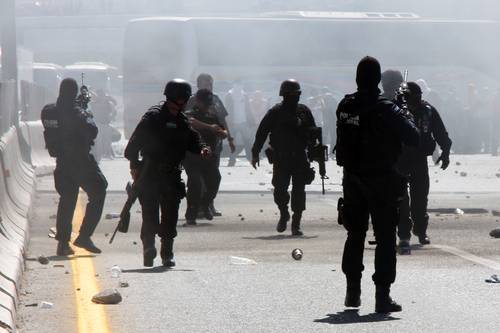

Chilpancingo, Gro., December 12. Jorge Alexis Herrera Pino and Gabriel Echeverría de Jesús, students at the Raúl Isidro Burgos Rural Teaching School in Ayotzinapa, died after they were hit by shots fired by federal and state police, as well as agents from the state attorney general's office, during a violent [police operation to] clear a group of students from that school who were blocking the Mexico-Acapulco Sun Freeway and a federal highway near the city of Chilpancingo.

At about 11:45am on Monday, about 500 formalists arrived in buses, supported by 26 indigenous people from the Peasant Organization of the Tecoanapa Municipality, and another 20 from the organization Xanii Tsavvi ("Mixtec Dream"), and closed the lanes of the aforementioned highways.

Their main demand is a meeting with Governor Angel Aguirre Rivero, whom they accuse of standing them up four times.  They also ask that classes be reinitiated in the school.  They have been suspended since November 2 because the teachers "are trying to impose" Eugenio Hernández García as school director.  The students say he is a repressor. 

Other demands are an increase in the class size from 140 to 170 students for the 2011-2012 freshman class and that the potential students who have a average of 7 points [on a scale of 1-10] be permitted to take the admission exam.

The blockade had barely begun when at least 300 officers with the federal and state police, with the latter led by Guerrero's undersecretary of Security, General Ramón Arreola Ibarría.  Later, agents from the attorney general's office arrived.

Workers from the Servicio Centro Comercial gas station recounted that just minutes after noon, the federal agents attempted to clear the formalists, who repelled the police by throwing stones, bottle rockets, and molotov cocktails.

At that point, in the gas station, some of the students from Ayotzinapa set fire to a gas pump, and that was when the federal agents shot into the air. [Translator's note: the students deny that they set fire to the gas station, see below.]

Dozens of state police, led by Gen. Arreola, were positioned about 50 meters away, on the bridge over Huacapa River near the Liverpool department store.

Several of the police were dressed in plainclothes.  "Let's go, cabrones!" yelled the undersecretary of Security to incite his officers to confront the formalists.  Several agents fired their guns.

[...]

The students were attacked on two flanks, from the north and the south, from both sides of the Sun Freeway, and from the Huacapa River bridge.

One group of students attempted to take cover in one of the busses, and another attempted to repel the police with bottle rockets and stones, but they didn't succeed.

On the contrary, the gunfire intensified.  The bus windows were shattered and the side panels were pocked with bullet holes.

Astonished and nervous, drivers of cars, busses, and trucks who witnessed the indecent from both lanes, fled to protect themselves from the gunfire.

The driver of a truck with license plate number 249-DC-5 was grazed in the face by a bullet, and an elderly man who took refuge in the truck was detained by police.  His whereabouts remain unknown.

Police also detained Eric Escobar, a reporter with the Chilpancingo weekly Trinchera, whom they beat in the face and body and then later released.

At 12:10pm the gunfire intensified, and that is when student Gabriel Echeverría de Jesús was killed.

Jorge Alexis Herrera was shot down at about the same time.  Their classmates, thinking that they were only injured, tried to get them onto a bus to protect them, but when they realized that they were dead they decided to leave them on the ground.

The gunfire continued for about 20 minutes from both lanes.  The police, guns in hand, chased the students, who threw stones at the agents.

Several students took refuse in the hills located on both sides of the highway and from there they moved to their school.  Others headed towards the town of Petaquillas, located about five kilometers from the highway blockade.

Some fled towards the municipality of Tierra Colorada, located about 45 kilometers away.  According to the students, two of their classmates were injured.

On the ground there remained stones, pipes, molotov cocktails, and dozens of bullet shells from weapons of the calibers that police use.

The shooting ended at about 12:35pm.  Minutes later, three military vehicles arrived.  They stayed for about a half an hour and then headed for the town of Petaquillas.

[…]

At 2:35pm the highway was reopened in both directions.  The persecution of the students didn't cease.  The police searched the hills for formalists until after 4pm.

Herrera Pino was from Atoyac de Alvarez, Guerrero, and Echeverría de Jesús was from Tixtla, Guerrero.  Near their bodies were 7.62 caliber shells for a G-3 rifle.

[…]


We Were Completely Unarmed, Say the Normalistas
El Universal
translated by Kristin Bricker

El Universal's images from the confrontation: http://www.eluniversaltv.com.mx/detalle.php?d=27281

Rural teaching students who participated in the confrontation yesterday with police in Chilpancingo, Guerrero, say that they were unarmed and that they didn't even have bottle rockets.  They blame the state agents for having initiated the aggression with gunfire, which led to the dead of two students from the Raúl Isidro Burgos Rural Teaching School in Ayotzinapa.

The students, represented by student Jersey Peñaloza, said that they were never at the level of the police because of the weapons the police carried.  They said their intention was only to protest and to demand a meeting with Gov. Angel Aguirre Rivero.

He added that according to a preliminary list from the State Attorney General's Office, nine people were detained following the confrontation, although Peñaloza says that at least another 15 students are disappeared, and it is not known if they were detained.

"We demand that this crime that has been committed against our classmates does not remain in impunity, and that those responsible be punished.  They know who acted, there are videos that show that it was them (the police) who initiated the aggression, the unarmed students sought refuge," he pointed out.

Peñaloza stated that the agents kept shooting at them, and that the students only defended themselves with sticks and stones.

Regarding the fire in the gas station, the students said that it was the police who retreated to the gas station and set it on fire, and then later blamed the students.

[…]

"We Now Have the Green Light," Said Police Before Shooting
by Rogelio Velázquez, Contralinea
translated by Kristin Bricker

December 13, 2011

Students from the rural teaching school in Ayotzinapa, Guerrero, demanded negotiations with the governor and recognition of their demands.  The blocked the Sun Freeway as a form of pressure.  The police operation's toll: two students murdered, at least five injured with gunshots, and 18 detained. "It was the Federal Police who shot at us; many of us fled for the hills and even there they pursued us with helicopters," they said in an interview.

This past December 12 at about 11am, students from the Raúl Isidro Burgos Rural Teaching School in Ayotzinapa, Guerrero, began to block traffic on the Sun Freeway, which connects Mexico City to Acapulco.  Their demands were clear: a meeting with the state government and compliance with a verbal agreement made my Governor Angel Heladio Aguirre Rivero to increase the incoming class size from 140 to 170 students and to grant 30 teaching positions to the school's graduates.

The operation was led by Federal Police, who were accompanied by Ministerial Police [from the Attorney General's office], and state police.

"There were about 400 of us--students and people from social organizations.  We blocked the freeway because the governor only says 'yes,' but he won't sign our demands.  It has to be signed before the year ends," one of the students who participated in the protest told Contralinea.  He is in hiding in Chilpancingo.

"Special Forces from the Federal Police arrived to clear our blockade.  We were dialoguing with them.  Then one of the police made a phone call--we don't know to whom--and when he hung up, they said that they had the green light to do whatever they wanted."

"That was when the Federal Police began to shoot tear gas at us.  Some of us ran.  Immediately afterwards they began to shoot us point-blank.  They didn't care that there were children and women with us.  The shooting continued, and all of us ran in different directions."

The bodies of two students, Jorge Alexis Herrera Pino, 22, and Gabriel Echeverría de Jesús, 21, were hit by bullets and fell to the highway.  The young men were students at the rural teaching school.

"Afterwards, they chased is in vehicles and on foot while they shot at us.  Some of us who hid in the hills were chased by helicopters.  We can't communicate with our classmates because the cell phones aren't working," he commented, alleging that the lines were cut.  "They're still looking for us."

Bertoldo Martínez, president of the Coalition of Democratic Organizations of the State of Guerrero explains that the protest also included the demand that missing environmentalists Eva Alarcón and Marcial Bautista, both disappeared since December 6 as they were headed from Chilpancingo to Mexico City, be presented alive. [Translator's note: Alarcón and Bautista were members of poet Javier Sicilia's anti-drug war Movement for Peace with Justice and Dignity (MPJD), and were kidnapped on their way to MPJD meetings.]

The human rights defender says that the Guerrero government is responsible for what is happening: "What is happening in the state is grave and shameful.  These sorts of situations don't get solved.  For example, the supposed suicide of Joel Santana Villa was a murder perpetrated by the State," he commented, referring to the death of an environmentalist who was imprisoned in the Iguala prison since last June.  His death occurred this past December 2 inside the prison.

Students from the Federation of Peasant Socialist Students of Mexico (FECSM) commented in a press conference--which took place in the offices of Local 9 of the National Coordination of Education Workers (CNTE)--that they still don't know the whereabouts of the detained (about 24) and they blame Gov. Angel Aguirre, Federal Police, State Police, and the Mexican military for the murder of the formalists.

"The attack occurred during a state of calm.  This was a normal protest, just like the ones we always do.  Now, after this, there's going to be movement," which means that they will take more forceful actions and that there will be more mobilizations.  "A few months ago the governor came to the school to talk with us, but he didn't want to sign anything.  His predecessor, ex-governor Zeferino Torreblanca, starved us, and this governor kills us."

Moreover, they stated that the rural teaching school is besieged by the Mexican military: approximately 14 military vehicles surround the school.  About twenty of their classmates are inside.  They fear that the school will be taking over by the armed forces in the next few hours.

They also note that the Secretary of Education in Guerrero has not responded to their demands.  They directly blame [President] Felipe Calderón for the strategy of war that is being carried out and for neoliberal policies that have deteriorated education in the country.

In a communiqué, the Interior Ministry said that it is working in coordination with Guerrero authorities to investigate the incident and to hold responsible those who were responsible for the homicides.  Meanwhile, the Federal Attorney General's Office opened criminal investigation PGR/GRO/CHI/CASO/387/2011 for any federal crimes that resulted from the incident.

José Ramón Salinas, spokesman for the Federal Police, stated that the Federal Police had not participated in the operation; however, Ramón Arreola Ibarra, undersecretary of Police Control for the state of Guerrero, contradicted him and commented that the Federal Police broke up the protest.

The government of Guerrero made a statement on its web site.  It explained that the governor had met with the students on various occasions and that the majority of their demands had been resolved.  Those that had not been resolved, "is because [the government] didn't have the ability to resolve them immediately."  Likewise, the statement reiterated the government's willingness to resolve the problems and demands from diverse sectors of society, respecting free expression of ideas and protest.

In response, the students stated: "We don't believe them.  How is it possible that they want a dialogue while they are preparing to close down the school by force? They want to close it because inside we practice self-government."

The National Human Rights Commission (CNDH), initiated a formal complaint with case number CGCP/309/11 regarding the aggression against the students.  In a communiqué it mentioned that it would provide accompaniment, legal support, psychological support, and medical attention if it is required to the victims' families.  Moreover, it declared the incident to be "lamentable and deplorable, and it should not, under any circumstance, remain in impunity."

Normalista Injured in Yesterday's Police Operation is in Grave Condition; 24 Detainees Are Freed
by Sergio Ocampo and Hértor Briseño, La Jornada
translated by Kristin Bricker

Several of the detainees say they were tortured in police custody


Chilpancingo, Gro. The Student Society of the Ayotzinapa Rural Teaching School stated that student José David Espíritu, who was injured yesterday as police cleared a highway blockade in the capital city carried out by students, has been operated on and his condition is listed as grave.

Iván Alberto Alvarez Adame and Rubén Eduviges Cuautololo were also injured during the operation.  Today the State Attorney General's Office released 24 students who had been detained.

Of those, 11 are from the Ayotzinapa Rural Teaching School, five are from the Autonomous University of Guerrero's Economics Department, four are from Chilpancingo Tech, and four are peasants from the Coyuca de Benítez municipality in the Costa Grande region of Guerrero.

Manuel Olivares of the Guerrero Human Rights Network, denounced that student Gerardo Torres Pérez, whom the state attorney general's office is accusing of having shot an AK-47, told non-governmental organizations that visited him that he was brutally tortured into stating that he fired a weapon.

The normalista said that the police took him to an area near the municipality of Zumpango de Neri, located about 10 kilometers from the capital, where they took him out of the vehicle in a parcel of land and made him fire the weapon four times.

Olivares also said that the whereabouts of 13 people who came to support the students are unknown.  The missing are from the municipalities of Ayutla de los Libres and Tecoanapa.

At 1pm there will be a protest march in the capital.  The central demand is the ouster of the Chilpancingo government and the removal of governor Angel Aguirre's cabinet.

People Are Still Being Detained

Jersey Peñaloza, representing the normalistas, that hours after "the massacre" teachers and people uninvolved with the protest were still being detained.  Some escaped and have taken cover in the hills.

[…]

Another student said that some of the detained have said that they were tortured.

[…]

Monday, October 17, 2011

Mexican Civil Society Wants President and Drug Traffickers To Face War Crimes Charges In The International Criminal Court

by Kristin Bricker, SSR Centre


The accused (from left): Public Security Secretary
Genaro García Luna, Defense Secretary Guillermo 
Galván Galván, President Felipe Calderón, and Navy 
Secretary Mariano Francisco Saynez Mendoza. 
A coalition of lawyers, academics, activists, and journalists has announced that it will seek the prosecution of President Felipe Calderón in the International Criminal Court (ICC) for war crimes and crimes against humanity stemming from his deployment of the military to battle drug trafficking organizations.  “Our petition is supported by over 20,000 signatures, both handwritten and electronic,” they said in a written statement, “making it the largest citizens’ complaint that the ICC has ever received.”

Netzai Sandoval, the lawyer who is preparing the complaint, argues that the ICC has jurisdiction in this case because Mexico is a signatory to the Rome Statute, and because the country’s drug war constitutes an “armed conflict not of an international nature.” The Rome Statute, which created the court in 2002, defines an “armed conflict not of an international nature” as “armed conflicts that take place in the territory of a State when there is protracted armed conflict between governmental authorities and organized armed groups or between such groups.”


Details of the Complaint

In addition to President Calderón, Sandoval has requested that the ICC’s Office of the Prosecutor investigate Public Security Secretary Genaro García Luna, Defense Secretary Guillermo Galván Galván, Navy Secretary Francisco Saynez Mendoza, drug kingpin Joaquín “El Chapo” Guzmán Loera, and “other authorities, military officials, and drug traffickers who are responsible for war crimes in Mexico.”

The Office of the Prosecutor is responsible for determining admissibility, defendants, and charges.  However, Sandoval has requested that the Prosecutor investigate both government officials and drug trafficking organizations for war crimes and crimes against humanity.  He argues that both sides of the conflict have committed murders, rape and sexual slavery, forced disappearances, physical mutilations, inhuman treatment and torture, extensive destruction of property, and attacks against the civilian population, all of which are classified as war crimes or crimes against humanity under the Rome Statute.

Sandoval notes that the Army has murdered and tortured innocent civilians at military checkpoints and during military operations.  “It has attempted to cover up these incidents in order to guarantee impunity,” argues Sandoval.  In 2010, for example, the military killed two students at the elite private university Tec de Monterrey. Soldiers planted weapons on the students’ corpses and removed their backpacks and student IDs to make them appear to be cartel gunmen.

The complaint that Sandoval will present to the ICC also details war crimes committed by criminal organizations.  It specifically mentions the massacres perpetuated by unidentified gunmen at drug rehabilitation clinics that are occurring with alarming frequency in various northern states.  Moreover, he accuses drug trafficking organizations of forcibly recruiting children under fifteen years of age, which has been demonstrated by arrests of children such as 13-year-old Edgar Jiménez Lugo, a cartel hitman who says that a drug trafficking organization kidnapped him when he was eleven and ordered him to kill or be killed.

Sandoval argues that both the government and drug trafficking organizations have committed physical mutilations.  Early in the war, drug trafficking organizations began to terrorize the civilian population by dumping tortured and mutilated bodies in public places such as in dance clubs, alongside highways, hanging from overpasses, or in front of government buildings or schools. In late 2009, the government responded in kind: the Marines killed drug kingpin Arturo Beltran Leyva in his home, and then employees from the medical examiner’s office stripped him down to his underwear and covered his bullet-ridden corpse with bloody peso notes and U.S. dollar bills.  They took pictures of his semi-nude body and leaked the pictures to the press, presumably to intimidate Beltran Leyva’s criminal organization.

The complaint also accuses officials from the Mexican government’s National Immigration Institute (INM) of collaborating with drug trafficking organizations to kidnap and traffic Central American migrants who pass through Mexico on their way to the United States.  The government has admitted widespread corruption in the INM, where alarming numbers of immigration agents detain migrants and then hand them over to cartels in exchange for a fee.  The cartels themselves frequently kidnap dozens of migrants in a single raid.  The criminals detain the migrants in “safe houses” while theydemand ransoms from the migrants’ families in the United States, or they enslave the kidnapped migrants to work in fields or—in the case of women—the sex industry as prostitutes or in pornographic movies.

The Gravity Threshold


Due to its limited capacity, the ICC declines to investigate some cases in which it has compelling evidence that war crimes have occurred, but do not reach the ICC’s standard for gravity.  “Even where there is a reasonable basis to believe that a crime has been committed, this is not sufficient for the initiation of an investigation by the International Criminal Court,” wrote ICC Prosecutor Luis Moreno Ocampo when he declined to file charges against coalition forces for war crimes committed in Iraq. “While, in a general sense, any crime within the jurisdiction of the Court is ‘grave,’ the [Rome] Statute requires an additional threshold of gravity even where the subject-matter jurisdiction is satisfied. This assessment is necessary as the Court is faced with multiple situations involving hundreds or thousands of crimes and must select situations” in which the commission of said war crimes are “committed as a part of a plan or policy or as part of a large-scale commission of such crimes.”

Migrants’ plight in Mexico might be one of the complaint’s more compelling aspects for the ICC because the crimes committed against them are so widespread.  Germán Guillermo Ramírez Garduaza, who runs the “Santa Faustina Kowalska” Migrante Shelter in Coatzacoalcos, Veracruz, estimates that 80% of the Centeral American women who pass through his shelter have been raped during their journey.  “They consider rape to be part of the price they pay to migrate,” explains Fermina Rodriguez of the Fray Matias de Cordova Human Rights Center in Chiapas.

The Mexican government’s National Human Rights Commission (CNDH) documented 214 cases of mass kidnappings of migrants in 2010 alone, with a total of 11,333 victims.  This number does not include unreported mass kidnappings, nor does it include kidnappings of small numbers of migrants, meaning that the total number of Central American migrants kidnapped in Mexico is likely much higher.

Sandoval hopes that the staggering statistics of over 50,000 dead, thousands of forced disappearances, at least 230,000 displaced persons, and the appearance of severely mutilated bodies left on public display in various parts of the country on a daily basis will convince the court that high-ranking government officials and drug trafficking organizations are committing war crimes in Mexico “on a massive scale.”


Goals of an ICC Investigation


Unlike the Inter-American Court of Human Rights (IACtHR), which allows victims to sue State parties over a range of human rights violations, the ICC prosecutes individuals—not States—who are allegedly responsible for a very limited range of war crimes and/or crimes against humanity.  Whereas the IACtHR has the power to order States to reform laws or policies that prevent victims from obtaining justice, the ICC only seeks punitive damages, such as imprisonment or indemnity for victims.

Nonetheless, Sandoval believes that an ICC investigation could have important political implications in Mexico.  He hopes that the ICC’s Office of the Prosecutor will be able to obtain confidential information regarding the military’s role in the drug war because the Mexican military has denied many Transparency Act requests on the basis of national security.  “On May 9, 2007, [Calderón] published an executive order to create an elite force called the Cuerpo de Fuerzas de Apoyo Federal [Federal Support Forces],” explained Sandoval.  “This elite unit is directly controlled by Felipe Calderón and was involved in the drug war… There is no General or other official between Calderón and those soldiers.”  Sandoval hopes that the Office of the Prosecutor will investigate the secretive Federal Support Forces for any possible human rights abuses, because domestic attempts to obtain information about their actions have been futile.  If the ICC finds that the elite unit is responsible for human rights abuses, Sandoval argues that it can hold Calderón directly responsible for their actions.

Due to the corruption and complicity with organized crime that prevails in Mexico’s security institutions, many victims never report crimes for fear of retaliation.  Mexico’s Census Bureau (INEGI) reports that in 2010, 24 percent of the Mexican population reported being the victim of a crime.  However, only 12.3 percent of them reported the crimes to the police. Of those crimes that were reported to the police, the police only investigated eight percent.

“Mexico is a country of impunity,” argues John Ackerman, a legal scholar with the National Autonomous University of Mexico’s Legal Investigations Institute.  Ackerman says that bringing a case before the ICC is a way for citizens “to use legal, peaceful means to demand justice and accountability.”

Sandoval hopes that the ICC will open offices in Mexico to carry out a direct and impartial investigation into possible war crimes. “The ICC should open field offices in different parts of the country so that victims can go there and give direct testimony.”

Even though ICC investigations can drag on for years, Sandoval hopes that the complaint will pressure Mexican politicians to reform the country’s security strategy soon.  “The candidates who will compete in the 2012 presidential election should know that if they continue with a militaristic policy that covers up soldiers’ crimes, they will share Calderón’s fate,” said Sandoval.  “One would hope that they would begin to discuss a plan for the military to return to its barracks, and embark on a new strategy for confronting organized crime.”

Kristin Bricker is a Mexico-based freelance journalist who specializes in militarization, human rights, social movements and the drug war in Latin America.

Monday, October 10, 2011

Inside Mexico’s Peace Movement

by Kristin Bricker, The Indypendent


Photo by Santiago Navarro F.
On Sept. 10, thousands of people marched through the besieged resort town of Acapulco to greet the Caravan for Peace with Dignity and Justice led by Javier Sicilia, a poet who ignited a nationwide movement against drug war violence this spring after his son was murdered.


In recent years, Acapulco has endured a plague of violence — beheadings, massacres of tourists, kidnapping of schoolchildren and demands from criminal gangs that teachers pay 50 percent of their salaries as protection money. In the vast majority of the cases, no one has been charged with these crimes.

Armed with signs and T-shirts that said “No more violence,” “Stop kidnappings and crime,” and “No more militarization, we want education,” locals faced down their fear of being identified by halcones or cartel spies, and marched for peace.
“They asked me if I was afraid to participate,” said Yuridia Betancourt, whose son Christian Obeth was kidnapped on March 19. “I’m panicked. But I’m more afraid to stay at home with my arms crossed.”

However, moments after the peace march swept by Zaragoza Street, several blocks from the central plaza where the marchers rallied, unidentified gunmen shot and killed Antelmo Petatan Vasquez in his taxi in broad daylight, a fate shared by a growing number of cabbies who are often suspected of working as informants for the cartels or are forced to pay them “quotas” in exchange for the right to work. Petatan Vasquez was one of eight people murdered that day in Acapulco; three were killed during the march.

Petatan Vasquez’s killing marked another in the more than 40,000 deaths that have occurred in Mexico since conservative President Felipe Calderón escalated the government’s war on drug cartels in January 2007. It also underscored the challenges faced by Sicilia and the antiwar movement as it ventured into southern Mexico for the first time, hoping to build on earlier momentum.

Breaking the Fear

Rural and mountainous, southern Mexico is more impoverished and has a much greater percentage of indigenous peoples than the northern part of the country. And while southern Mexico generally has less violent crime than northern states, organized crime and government security forces are victimizing certain sectors of the population at alarming rates.
Located several hundred miles southwest of Mexico City, the state of Guerrero bore the brunt of a government counter-insurgency campaign against leftist guerrillas from the 1960s to 1980s. The Guerra Sucia (or, “Dirty War”) carried out by the army and its paramilitary allies officially ended almost three decades ago. Nowadays, Guerrero residents are suffering some of the worst abuses of the drug war, as, the military remained in Guerrero and a climate of government corruption has assured that crimes committed against locals are almost never punished.

“The Dirty War never ended in Guerrero,” argues Rosario Cabañas, the niece of Guerrero school teacher and guerrilla leader Lucio Cabañas who was killed in 1974. “Unfortunately, thanks to [the Dirty War], peace and justice were lost. For 40 years, there has been impunity and injustice.”

Calderón’s militarized response disrupted drug trafficking routes and the cartels began to battle for control of Guerrero, which includes the coastal enclave of Acapulco. Residents found themselves caught in the middle. Unsurprisingly, the conflation of political and criminal violence gave birth in Guerrero to Mexico’s first narco-paramilitary organization, the “Liberator of the People Army” led by local political boss Rogaciano Alba.

Sharing Stories

Composed of 15 buses carrying more than 700 activists, journalists and family members of victims, the caravan rolled through 19 towns and cities in seven states over 10 days in mid-September. At every stop, caravaneros and locals marched for peace. The marches always ended in rallies where drug war victims from the north shared the stage with local victims to tell the world about how they have suffered in the so-called “war on organized crime.” At each stop, Sicilia’s Movement for Peace with Justice and Dignity collected complaints about violence and human rights abuses, just as they had done in the north.

Mexico’s drug cartels were significantly strengthened in the early 1990s as junior partners to their counterparts in Colombia who were finding it increasingly difficult to ship cocaine to the United States through the Caribbean. In recent years, thanks in large part to the Colombian cartels’ decreased control over shipping routes, the Mexican cartels have become fully diversified organized crime syndicates and have expanded into new areas such as kidnapping, extortion, prostitution and human trafficking.

Approximately 40 Central American migrants traveled with the Peace Caravan, calling attention to how the cartels frequently prey on immigrants.

Mexico’s harsh U.S.-backed immigration laws force the hundreds of thousands of Central American migrants who enter Mexico each year to travel clandestinely, which puts them at great risk of being kidnapped by organized crime, caravan participants explained. When migrants are detained by authorities, they are sometimes handed over to criminal groups for a bribe.

During the caravan, the Central American migrants described how the gangs take people like themselves to safe houses where they are forced to call their families or friends in the United States and hold the telephone in their hands while the criminals torture them into begging their families for ransom money: “I saw them cut off a 14-year-old boy’s finger while his father was listening on the phone,” said one Salvadoran immigrant who says that he, too, was tortured.

Female immigrants are sometimes forced into prostitution or made to perform in pornographic movies. German Guillermo Ramirez Garduaza of the “Santa Faustina Kowalska” migrant shelter in Veracruz estimates that 80 percent of female Central American migrants are raped in Mexico.

Danira Meléndez, a Honduran migrant, recalled how her coyote (paid guide) demanded that she have sex with him. “He told me, ‘Here, I’m just one man. But I work with the Zetas, and if I turn you over to them, it’ll be 15 or 20 men raping you,’” Meléndez recounted. “We know that female migrants are easy sexual merchandise for organized crime.”

A Militant Tradition

Before the Movement for Peace with Justice and Dignity emerged, drug war victims were terrified, isolated and silent. On the two caravans, victims learned public speaking skills and how to organize protests and press conferences and hold more effective meetings with public officials. Now that the caravans are over, the victims will return to their communities, most of which now have local antiwar committees. Whereas before drug war victims were shunned, now they are in a position to become community leaders.

Citing lower turnouts at Peace Caravan events in the south, the Mexican media have portrayed the antiwar movement as losing support. However, this does not take into account the fact that the south has experienced less drug war violence than the north and in places that have been hard hit — like Guerrero and Veracruz — thousands of people turned out to protest the war. Moreover, the south has a long tradition of militant grassroots organizing (see sidebar) and resistance to military occupation that most of the north lacks. Whereas most northern drug war victims are just beginning to organize and define their politics, southern drug war victims are joining experienced organizations and hitting the ground running.
If southern organizations continue to collaborate with Sicilia’s national movement, they will likely provide a counterweight to Sicilia’s strong focus on engagement with authorities, which has included meeting with leaders of all three branches of a government that is widely seen as being complicit in the drug trade it claims to be fighting.

“We still don’t understand why they dedicate so much energy and effort to dialogue with a political class that long ago lost all will to govern and is nothing more than a gang of criminals,” the Zapatistas’ Subcomandante Marcos recently wrote, reflecting the sentiment of many groups in the south.

Mexico holds presidential and congressional elections next year. It remains to be seen how the budding anti-war movement will affect the electoral process. Ultimately, the country’s future depends on whether Mexico’s civil society can be mobilized to cleanse the state of a culture of corruption and impunity that exists at all levels of government.


Kristin Bricker is a Mexico-based freelance journalist covering militarization, social movements and the drug war in Latin America. She blogs at mywordismyweapon.blogspot.com.