Showing posts with label Security and Prosperity Partnership. Show all posts

Wednesday, October 14, 2009

Military, Federal Police Bust Mexican Electrical Workers Union

Calderon Uses 6,000 Federal Agents to Fire Over 44,000 Luz y Fuerza Workers
source: Narco News

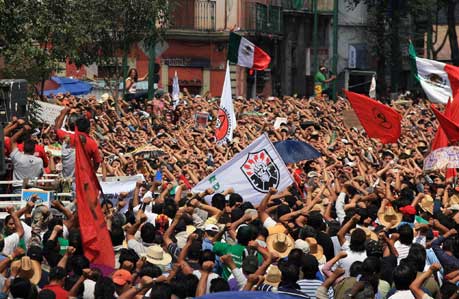
SME workers protest
Mexican Electrical Workers Union members protest the summary firing of 44,000 members. Photo: La Jornada

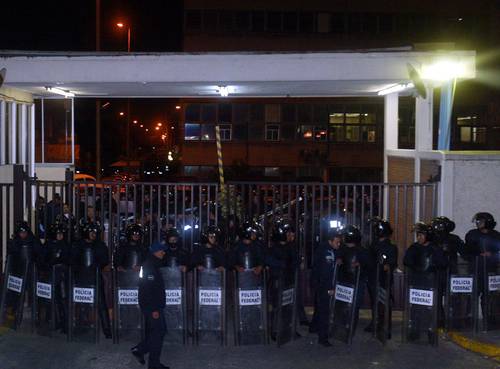
In the middle of the night last Saturday, President Felipe Calderon sent six thousand soldiers and militarized Federal Police to take over state power company Luz y Fuerza installations in Mexico City and the states of Mexico, Puebla, Morelos, and Hidalgo. Immediately following the takeover, Calderon issued an executive order closing Luz y Fuerza. Because no law or decree can go into effect until it is published in the federal government's Official Diary of the Federation, the government published the executive order in a special edition of the Official Diary of the Federation to coincide with the military and police raids that closed Luz y Fuerza.

Mexican legal experts have criticized Calderon's action as illegal, unconstitutional, and "an excessive and abusive use of power" because he by-passed Congress when he decided to close Luz y Fuerza and deploy the military and police against workers.

The government's official justification for closing Luz y Fuerza is that the company's operating expenses exceed those of other state-owned companies. It claims its use of the military and militarized federal police was a pre-emptive strike: it wanted to prevent workers from striking, taking control of the facilities, and cutting off power in protest of the closing of Luz y Fuerza. However, a week prior to the police and military takeover, the union specifically stated in a press release that it had no intentions of striking nor cutting off power to electricity customers.

However, Mexican Labor News & Analysis' Dan La Botz has a different perspective on the government's intentions:

This current threat is the latest in a series of attacks on the union by the government of Felipe Calderón.The Felipe Calderón administration, having spent three years trying to destroy the Mexican Miners and Metal Workers Union (SNTMMRM), has now opened a new front in its war on the working class. In September the government launched a multifaceted attack intended to destroy the Mexican Electrical Workers Union (SME) which has been at the center of resistance to its neoliberal programs.

The government's attack has several elements. First, the government is supporting a small dissident faction within the union, using that as an opportunity to meddle in the union's internal life with the goal of breaking its militant leadership. Second, the government, which is also the employer, has reduced the budget for the state-owned Central Light and Power Company (LFC). Third, the government is also calling for a change in company management and for the complete restructuring of the company.

La Botz also notes that the Mexican government officially refused to recognize the union's president, Martin Esparza Flores, following his recent re-election. According to La Botz,

In practice, these administrative procedures (which are nowhere found in Mexican labor law) are used against independent or democratic unions or against unions opposing government policies, and almost never against government backed, employer controlled or gangster-run unions. Without government approved and recognized officers, the union officials cannot engage in collective bargaining or other union activities, leaving the union officially leaderless.

With Luz y Fuerza officially non-existant, the governmental Federal Electricity Commission (CFE) has announced that it is sending thousands of its employees to run Luz y Fuerza until CFE can absorb Luz y Fuerza's operations entirely. Prior to the takeover, Luz y Fuerza ran electricity operations in central Mexico: in Mexico City and the states of Mexico, Puebla, Morelos, and Hidalgo. The CFE provided electricity to the rest of the country.

La Botz argues that the CFE takeover means that the independent and democratic 44,000-worker SME will be replaced by the government-controlled Sole Union of Mexican Electrical Workers (SUTERM), which represents CFE workers. In Mexico, government-controlled unions are the norm, and independent democratic unions are a rarity.

In an article written just before the military and police takeover of Luz y Fuerza, La Botz wrote:

Calderón's administration has two motives in its attack on the SME. First, it wants to break the SME because it has been the center of so many movements resisting the Calderón government, its neoliberal policies, and particularly its plans to privatize the petroleum and electric power industries. Second, Calderón wants specifically to privatize the electrical industry, including the Central Light and Power Company, and to do so it must break the power of the SME.

NAFTA Armed

While government officials have promised that they won't take advantage of the Luz y Fuerza takeover to privatize the electricity sector, the Calderon administration's political trajectory states otherwise.

The Calderon administration participated whole-heartedly in the Security and Prosperity Partnership (SPP), a private sector strategy to expand and "arm" the North American Free Trade Agreement (NAFTA) without having to obtain domestic legislatures' approval. As of this past summer, the SPP is no longer an active initiative; however, several of the SPP's working groups, comprised of private sector industry leaders, will continue to meet. The North American Energy Working Group (NAEWG), for example, pre-dated the SPP by four years. It met within the SPP framework to develop and advance SPP energy policy and procedures. The NAEWG is likely to continue to operate in some form despite the SPP's official and indefinite "inactivity."

Indeed, despite the tabling of the SPP initiative, North American energy interests met over the summer to develop regional energy corridors that would increase the flow of energy from neighboring countries into the United States.

The SPP's view of energy management is clear. According to the SPP's "Prosperity Agenda," in order to "facilitate business," Canada, Mexico, and the United States must "strengthen North America's energy markets by working together, according to our respective legal frameworks, to increase reliable energy supplies for the region's needs and development." Energy, according to the SPP, rather can being used for human development (providing every citizen with electricity in their homes, for example), must increase the business sector's prosperity. Energy is a market, not a national resource.

The North American Competitiveness Council (NACC), which coordinated the SPP's working groups, stated one of its principle energy concerns in its initial recommendations. The NACC, which was comprised of equal numbers of private sector representatives from Mexico, Canada, and the US, wrote, "The prosperity of the United States relies heavily on a secure supply of imported energy."

What does the North American energy agenda mean for Mexico? In Mexico, a significant sector of the population does not have electricity and other basic utilities in their homes. Entire communities lack electric service. Some of Mexico's poorest indigenous communities pay some of the highest electricity rates on the North American continent.

Even though Mexico's electricity sector has not reached a basic level of functionality at the domestic level (electricity for every citizen), Mexican leaders have decided to enter into regional agreements such as Plan Puebla Panama (now the Mesoamerican Project) and the SPP, which aim to increase energy flows into the United States, not vice-versa.

Mexico's energy sector, as it is currently structured, runs entirely counter to the SPP's Prosperity Agenda. Mexico's energy companies are state-owned. Some energy sector unions, such as the Pemex oil workers union and the SME, have actively opposed the further privatization of the nation's energy resources, which is commonly considered to be an SPP goal in Mexico. La Botz notes that the SME formed the National Front Against Privatization. Pemex, on the other hand, recently (more or less) survived a Calderon initiative to privatize the Mexican oil sector.

Militarizing Mexican Life

Calderon's Saturday night invasion of Luz y Fuerza's facilities in the capital and four states is reminiscent of other recent joint police-military operations against drug cartels. Since Calderon deployed 40,000 soldiers and thousands of militarized Federal Police, one of the campaign's hallmark operations has been the sudden takeover of police stations in towns and cities where drug trafficking organizations are believed to have corrupted entire police forces. In these operations, soldiers and federal police surround a police station, relieve the local police officers of their duties, and occupy the building. When 6,000 soldiers and federal police suddenly invaded Luz y Fuerza's buildings and then occupied them to prevent the workers from retaking the facilities, one would have thought that Luz y Fuerza was a drug cartel's base of operations. But it wasn't.

Mexico is becoming increasingly militarized under the pretext provided by the war on drugs. Mexican citizens are becoming correspondingly desensitized to such blatant displays of state military power in the civilian realm. Mexico's Constitution expressly prohibits the military's use in times of peace; however, this was not Mexicans' principle criticism of the operation against Luz y Fuerza. Mexicans consulted by this reporter complained that the operation was a blow to the country's democratic unions, as well as a step towards privatization of the energy sector. When this reporter commented on the barbarity of deploying the military and riot police against a civilian union--one that wasn't even on strike, as if that were to justify such represion--the response was, "Tienes razon. You're right. I hadn't even considered that."

The use of the military and the Federal Police--who receive military training--against unions is fairly common in Mexico. The military and the Federal Police (formerly known as the Federal Preventive Police or PFP) have been deployed against striking miners and teachers. Likewise, in 2006 federal police violently put down social conflicts in Oaxaca and Atenco, both of which had their roots in labor disputes.

Both the Mexican Military and the Federal Police receive training, equipment, and armament from the United States government under the Merida Initative. The Merida Initiative is designed in part to carry out the Security and Prosperity Partnership's "Security Agenda."

Federal Police occupy a Luz y Fuerza building. Photo: La Jornada

Friday, January 23, 2009

Mexican Armed Forces Will Manage Merida Initiative Planes

The equipment required an investment of $99 million dollars


by Notimex
Translation and notes by Kristin Bricker

Mexico - The Mexican Armed Forces will receive and manage the aircraft that the United States will hand over during the second half of 2009 under the Merida Iniciative.

This second shipment is in addition to another that includes bullet-proof vests, x-ray and Gamma-ray machines[1] to search shipments on the borders, and it will begin to arrive in Mexico in the first four months of this year.

The aircraft that will be delivered "in autumn" will be equipped with non-invasive inspection equipment, which will be regularly used by the Armed Forces, according to the United States ambassador.

Said equipment will be bought with USD$99 million that come from a US Defense Department Defense Security Cooperation Agency fund.

According to the United States embassy in Mexico, the equipment "will provide additional capacity to Mexico's efforts to secure the national territory, both land and water, and detect drug, money, and weapons contraband."

The specifics of the planes that will be delivered to Mexico are confidential for national security reasons (Chapter IV, Article 27, and Articles 13, 14, and 15 of the Federal Transparency and Access to Public Information Law).

The first package signed by both governments last December in the "Letter of Agreement" includes transfers of equipment, technology, and training for USD$197,175,000 and will arrive in Mexico within the first four months of 2009.

That first package is funded by the International Narcotics Control and Law Enforcement Cooperation Fund, which has USD$263,500,000 in funds.

The embassy as well as the Foreign Relations Secretary stated that the funding includes non-intrusive inspection equipment, computer equipment, and applied technology for data-processing and -sharing.

It also includes telecommunication devices, contraband-detection canines, and training programs.

Armored vehicles, bullet-proof vests, safety helmets, communications and equipment, and polygraphs for confidentiality control will also be sent.

The Integrated Ballistics Identification System[2], computer equipment to automate judicial processes, the National Police Registry (with municipal information-sharing), and passport and fingerprint scanners are also part of the shipment.

The non-invasive inspection equipment are "mobile inspection units" equipped with x-ray and gamma-ray equipment, "ion scanners capable of identifying explosives and narcotics," and equipment that "analyzes the molecular composition and measures objects' density."[3]

Instruments of this nature are used, for example, in the El Paso and Nuevo Laredo, Texas, Customs for trailers loaded with merchandise. The inspection is completed in a matter of minutes, whereas before it would have taken days to search each unit.

Translators' notes:


1. Gamma-ray machines are similar to x-ray machines. The are used to scan cargo containers, boxcars, and other large shipping containers.


2. According to Wikipedia, "IBIS [the Integrated Ballistics Identification System] has been adopted as the platform of the National Integrated Ballistic Information Network (NIBIN) Program, which is spearheaded by the United States Bureau of Alcohol, Tobacco, Firearms and Explosives (ATF). The integration of technology into over 200 sites across the US facilitates sharing of information between different law enforcement groups. The rapid dissemination of ballistics information, in turn, allows for tracking of gun-specific information and connection of a particular firearm to multiple crimes irrespective of geographic location." This is part of the ATF's Operation Gunrunner, which AFT agents will be deployed to Mexico to manage. The information-sharing bears the fingerprints of the Security and Prosperity Partnership, which calls for North American security "cooperation" and information-sharing.

3. Narco News has documented repeated abuses of ion scanners in the US and Mexico. Ion scanners produce false positives in approximately 90% of cases because they confuse hand sanitizers, over-the-counter medications, perfumes, and melanin (which is abundantly present in people with dark skin) with contraband. They are meant to provide a quick scan to detect contraband. A negative result means that further inspection is not necessary. A positive result means that further inspection by other means is necessary and DOES NOT in and of itself prove the presence of contraband. Ion scanners are abused in the US prison system, where prison visitors are rejected based solely on positive ion scanner results. Narco News reported claims that ion scanners have been used to justify warrant-less neighborhood-wide military raids in Michoacan, Mexico.

Wednesday, December 24, 2008

“Wall of Violence” on Mexico’s Southern Border

Calderon’s “two-faced” policy combines police, the military, gangs, and Los Zetas to fulfill US mandate to deter Central American migration


by Kristin Bricker

“Humberto” is a Honduran subsistence farmer. He grows his beans and vegetables without pesticides and herbicides. “The chemicals they put in food these days ruin the taste,” he says. Humberto has a patch of land, a house, a wife, and five children—three of whom still live at home.

Like many small farmers, Humberto has a lot of debt. The bank is going to take his home if he doesn’t come up with the approximately USD$17,000 he owes. So Humberto packed some clothes, kissed the wife and kids goodbye, and headed north to the United States. He told them he’d be back as soon as he’d paid off the debt; it wouldn’t take long.

Humberto had planned to take the route most undocumented Central Americans take north: he took busses, combis (vans), and hitched rides towards Mexico’s southern border. He crossed the Suchiate River that divides Guatemala’s Tecún Umán from Ciudad Hidalgo in Chiapas, Mexico. He took the combis north to Arriaga, Chiapas, where he planned to hop on a freight train, perched precariously on its roof as it headed towards Oaxaca. In Oaxaca he’d hop a different train to Veracruz; from Veracruz he’d hop a train to Mexico state, and from there he’d get on a train headed to one of five crossing areas on the Mexico-US border. He’d figure out how to cross into the US when he got there.

But Humberto’s plans were put on hold in Arriaga. As Humberto waited for the train in Arriaga—it leaves every three days—he made friends with some fellow train-hoppers who said they were Guatemalan. They chatted, shared a couple of kilos of tortillas and a can of sardines that Humberto had scared up (“Woo! We ate rich that day,” he remembers), and dozed on the train tracks. At some point—Humberto doesn’t remember exactly when—the Guatemalans disappeared. He looked around, wondering where they went, and saw why they’d fled so fast: a police patrol was headed his way. An unidentified man dressed in plainclothes accompanied them.

Humberto ran. The police and the man ran faster. The man in plainclothes caught Humberto first. He hit Humberto in the ankle with a club. Humberto’s ankle shattered and he crumpled to the ground. Their job done, police and the man started to leave. They had no interest in arresting Humberto.

“Hey!” Humberto shouted. “You guys can’t just break my foot and leave me here! Take me to a hospital!”

The police and the mysterious man heeded Humberto’s cries. They radioed for an ambulance. The plainclothes man—Humberto doesn’t know if he was police or paramilitary—supported Humberto on his right side. A police officer put Humberto’s left arm around his shoulder and together they helped him to the road and waited until the ambulance came to pick him up.

When the hospital discharged Humberto, he went to the Catholic Church’s Casa del Migrante “El Hogar de la Misericordia” (“House of Mercy”), a shelter for migrants that provides them with food and a roof over their heads. Even though migrants are only allowed to stay for three days while they wait for the train to leave, Father Heyman Vazquez and his humanitarian team let migrants stay longer if the need arises. With his leg in a cast and multiple pins in his ankle, Humberto will be incapacitated for months. The Casa del Migrante will let Humberto stay until he recovers. The shelter has an agreement with the local hospital, which treats shelter residents for free.

Humberto says he’ll continue north when he recovers. He has to pay off that debt or he won’t have a house to go home to.

I ponder Humberto’s bravery in the face of such brutality, more of which is certainly awaiting him further north.

“Did you pay a coyote?” I ask him. Coyotes charge a high price for trafficking migrants through Mexico and across the US border. Their financial agreements with government agents (both US and Mexican) provide their clients with a certain degree of security.

“No, I didn’t,” Humberto replies. “I’m on my own.”

Part of the Price

Humberto’s story is repeated throughout El Hogar de la Misericordia and its sister Casas del Migrante in Oaxaca and Veracruz. The actors often change—sometimes the attackers are gang members, or police, or soldiers, or drug cartel members, or immigration agents. Too often, as in Humberto’s case, they seem to be a combination of several of the above. Together they take advantage of the impunity provided by the government to rob and abuse migrants, forming what several immigration activists have referred to as a “Wall of Violence” that discourages migrants from ever wanting to set foot on Mexican soil.

The “Wall of Violence” is fierce: El Hogar de la Misericordia estimates that 80% of all migrants who pass through Chiapas have been assaulted during their travels. Approximately 30% of the women who come to El Hogar de la Misericordia report being sexually assaulted in la Arrocera, Chiapas, which is only one of many stops along the migrants’ route. Fermina Rodriguez of the Fray Matias de Cordova Human Rights Center, which monitors human rights on Mexico’s southern border, says, “When you talk to women, they consider rape to be part of the price they pay to migrate.”

“Two-faced”

The “Wall of Violence” shouldn’t exist in Mexico. In mid-2007, Mexico decriminalized undocumented migrants. It did away with the ten-year prison sentences the law used to allow and now refers to foreigners who enter the country illegally as “administrative irregularities.” Police and soldiers shouldn’t be carrying out operations—be they official or clandestine—against undocumented migrants. But they do.

On October 15, 2008, Mexico’s President Felipe Calderon met with Salvadoran President Elías Antonio Saca to call on the United States government to decriminalize immigrants in the US. Calderon also agreed to reform regulations that apply to undocumented Salvadorans in Mexico. One promised reform will allow undocumented Salvadorans to enter a Mexican program to earn a bachelor’s degree in English. In announcing the pact between the two nations, Calderon stated that it was necessary to “protect the dignity of people who are in Mexican territory, regardless of their migration situation.”
In August 2008, Calderon had a similar meeting with Honduran President Manuel Zelaya. There, the two leaders called immigration “a human right.” Calderon promised his Honduran counterpart that his country would respect migrants’ human rights in Mexico, and he “reiterated our readiness to prevent cases of abuse and human rights violations that can happen on our southern border.”

However, Central American presidents aren’t the only leaders with a vested interest in how Mexico treats migrants passing through its territory.

Mexico is a participant in the Security and Prosperity Partnership (SPP), a North American initiative that aims to pick up where the North American Free Trade Agreement (NAFTA) left off. It aims to “harmonize” laws, regulations, and procedures related to migration, security, energy, health, trade, the environment, and agriculture. Thomas Shannon, Sub-Secretary of Western Hemisphere Affairs for the US State Department, summed up the SPP in one simple sentence: “To a certain extent, we’re armoring NAFTA.”

The SPP is able to succeed where NAFTA fell short because, unlike NAFTA, SPP initiatives do not need to be ratified by Congress. The North American Competitiveness Council (NACC), a group of thirty business leaders from Mexico, Canada, and the US, issues recommendations under the SPP, and the three countries’ executive branches commit to carry out the recommendations. In this sense, while NAFTA is a treaty, the SPP is more of a handshake agreement.

The SPP specifically deals with the nations’ borders. It aims to facilitate the flow of cargo, money, and “legitimate” people across borders. In its “Prosperity Agenda,” the SPP vows to “identify measures to facilitate further the movement of business persons within North America” [emphasis added] by developing a “trusted traveler program.” At the same time, the NACC recommends that leaders “enhance the use of biometrics in screening travelers destined to North America with a view to developing compatible biometric border and immigration systems.” Biometrics utilize unique biological identifiers such as fingerprints and DNA. The NACC also promised the presidents and prime minister, “We will develop standards for lower-cost secure proof of status and nationality documents.”

Globalization’s double standard under the SPP and free trade agreements such as NAFTA isn’t lost on Father Alejandro Solalinde Guerra, the southern coordinator of the Catholic Church’s Human Mobility Mission Migrants program: “The globalized economy has been, above all, machiavellian and immoral. The markets cross borders freely. Money crosses freely. The volatile speculative market, financial capital, even poultry magnates cross freely. But the migrant population isn’t given the same treatment.” While the SPP opens North American borders to capital and capitalists, it’s closing them to capitalism’s victims.

The SPP’s border recommendations are already being implemented through one of the SPP’s hundreds of programs and agreements: the Merida Initiative, aka Plan Mexico. While Plan Mexico’s aim is to combat organized crime, the US government snuck the SPP’s biometric equipment into the aid package for Mexico’s military and police. This past November 17, US Ambassador to Mexico Antonio Garza helped the Mexican government inaugurate the first of its sixty Plan Mexico-funded laboratories designed to determine the authenticity of immigration documents. While the head of Mexico’s National Migration Institute, Cecilia Romero, says the labs will combat human, drug, and arms trafficking, it’s unclear how they will fulfill all but the first goal. After all, illegal drugs and guns don’t carry immigration papers, and, as the Burro Hall blog points out, “On the list of antisocial activities committed by the cartels, sneaking into the country on false papers is pretty far down the list.”

Calderon’s desire to pander to both his Central American counterparts and the US government leaves Mexico with what a Contralinea editorial cartoon referred to as a “two-faced” immigration policy on the southern border: one on paper and another completely different one in reality. Solalinde argues, “If the Mexican government really wants to demonstrate that it respects human rights, it can’t just sign documents. It has to be consistent in all of its actions through all of its institutions and personnel in order to respect human rights. If it doesn’t do that, it leaves the impression that everything that’s happening on the southern border is state policy. The Mexican government doesn’t have the guts to put up a wall on the southern border. But in a lot of ways it’s putting up a de facto wall, because it’s causing a lot of people to die; it’s making a lot of people turn around and go back. There’s the suspicion that this is a state policy that’s coordinated with and financed by the United States so that migrants aren’t allowed to cross.”

Wall of Violence

“Migrants don’t have rights in Mexico,” says Father Heyman Vazquez Medina, founder of El Hogar de la Misericordia. “It’s ok to beat them, extort money from them, rob them, sexually abuse them, murder them, and nothing happens. Central American migrants’ legal security guarantees appear to be repeatedly and permanently violated by individuals and groups of people who rely on the protection, consent, tolerance, or acquiescence of the State and who have the power of weapons, money, police protection, corruption, and impunity. They have put a price on the head of each migrant.”

Migrant shelter staffers say those who abuse migrants operate with absolute impunity. Most migrants don’t report crimes because they don’t have the time or resources to stay in the town where the crime occurred in order to work on their cases. Others are so traumatized by their experiences that they just want to leave Mexico as soon as possible. Solalinde recalls one case where a woman was kidnapped from one of the shelters he oversees. Solalinde remained in contact with her family throughout the ordeal. When she finally turned up in the United States, she said that the group that kidnapped her forced her to make several pornographies. When they finally brought her to the US-Mexico border, they made her family pay thousands of dollars in ransom. Solalinde offered to fly her back south and pay all of her expenses if she filed a complaint with the government. The woman refused, saying she never wanted to set foot in Mexico ever again.

Even when migrants or human rights organizations do file complaints, they almost never result in arrests or convictions. Solalinde says that almost every time he calls the police because migrants have identified and located their attackers, he can’t find a police force that will arrest the suspects. They all say they don’t have jurisdiction in immigration affairs.

Vazquez says El Hogar de la Misericordia no longer bothers to file complains with Mexico’s official National Human Rights Commission (CNDH in its Spanish initials) when Mexican security forces abuse migrants. Even though he has provided the CNDH with photographic evidence and eyewitness testimony to police and military abuses, the CNDH generally says there is not enough evidence to issue a non-binding recommendation (the only “power” it has).

Migrants’ exploitation in Mexico begins the moment they attempt to cross the Guatemala-Mexico border. Mercedes Osuna of La Semilla del Sur, a Chiapas-based organization that works primarily on indigenous issues, recently followed the migration route from Guatemala to southern Mexico. She explains that a Guatemalan-Mexican “union” of raft owners traffics people and goods across the Suchiate River between Tecún Umán, Guatemala, and Ciudad Hidalgo, Chiapas, in full view of an immigration office located next to the river. The rafts that ferry cheaper Mexican goods to Guatemala cost MX$10 (about 75 cents) per ride. Slightly further down the river, the same “union” uses the same rafts to ferry migrants from Guatemala to Mexico. Migrants pay USD$300. Faced with this steep price and barred from the 10-peso rafts, many migrants choose to wade or swim across. “The river is filthy and it stinks,” Osuna says.
After crossing the river into Ciudad Hidalgo, migrants walk or catch combis north to Arriaga. However, on the route between Ciudad Hidalgo and Arriaga, there is a Mexican immigration office. Osuna explains that to avoid passing this office, undocumented migrants must walk a roundabout route through an area called la Arrocera. La Arrocera is teeming with violent criminals who mug migrants as they pass through. Osuna spoke with some migrants who recently passed through la Arrocera. They told her that in la Arrocera they saw uniformed Chiapas state police in marked vehicles pick up and drop off people who mugged migrants. In la Arrocera, the muggers are painfully thorough: migrants complained to Osuna of being stripped searched. The assailants even checked their victims’ anuses and vaginas for hidden valuables.

Police don’t just offer rides to assailants; they often are the assailants. While immigration violations do not fall within the jurisdiction of the state police, police use migrants’ fear to their own advantage. Osuna explains that while police can’t legally ask migrants for identification (only immigration police can), they do so anyway in order to extort money from them.

Bricks in the Wall

There is, of course, a slightly safer way to migrate: pay a coyote, also known as a pollero. Coyotes charge migrants a hefty fee to shuttle them through unknown lands. Carlos Solis, coordinator of Arriaga’s El Hogar de la Misericordia, says that the coyotes’ price for passage between Arriaga and Ixtepec, Oaxaca, is a thousand pesos (about USD$75).

In Chiapas, the coyotes pay the train machinists to guarantee their clients’ passage. Osuna says that at some popular hop-on points, machinists will slow down the train if coyotes pay them to. On the other hand, if the train is approaching a group of migrants waiting to hop on, but a coyote hasn’t paid, the machinist will speed up the train, increasing the likeliness of injury as desperate immigrants attempt to jump on.

Coyotes also pay machinists for information on when the next train will leave. Osuna witnessed obvious machinist-coyote complicity in Arriaga during her visit there. On the day a freight train was rumored to leave, about 150-200 migrants waited by the train tracks. A train with only four cars began to move, but most of the migrants believed that the train wouldn’t leave with so few cars—engines move around the train yard to pick up cargo and cars, but the trains don’t leave the yard for good until dozens of cars are attached to the engine.

That day, however, the train left the Arriaga station with only four cars. Ten migrants who were accompanied by their pollero knew that the train was leaving and were able to get on. When other migrants saw the pollero’s clients get on, they realized what was happening and chased the train. About thirty of them managed to get on, but over 100 would have to wait three more days for the next train.
Gangs and Los Zetas also enforce the coyote system. Father Solalinde says that a few months ago in Veracruz, a group of people allegedly working for Los Zetas boarded a train full of migrants. The men had lists of the names of migrants who had paid coyotes. They asked each migrant for his or her name and checked the name against the list. If the migrant’s name did not appear on the list, the man with the list told him or her, “You haven’t paid your pollero.” Solalinde recounts, “And if the migrant refused to pay, he was thrown from the train. Several migrants lost limbs that way. And the pollero who doesn’t pay Los Zetas gets it even worse.”

The gangs and Los Zetas have financial incentive to make sure the migrants pay their polleros: Los Zetas, former Mexican soldiers from an elite US-trained Special Forces team who deserted to work in the more lucrative drug trade, charge coyotes a fee to operate in their territory.

Los Zetas don’t stop at taking money from migrants through their coyotes; they also rob and kidnap migrants. This past October, 32 Central American migrants escaped from Los Zetas’ custody in the Mexican state of Puebla. Los Zetas and municipal police had kidnapped the Central Americans and demanded USD$2,500 from each migrant’s family in the United States. Father Vazquez says mass kidnappings of migrants, even women and children, are common.

Solis says that a Chiapas state police commander told him that Los Zetas are also infiltrating El Hogar de la Misericordia. About five or six months ago, Los Zetas were first detected in and around Arriaga. They pose as migrants and enter El Hogar de la Misericordia to gather intelligence on the residents. The Zetas find out who doesn’t have a coyote, which migrants have money, and who is planning to receive wire transfers. They report this information to their colleagues, who later rob the migrants.

Zetas have also been seen photographing migrants on trains. Solis says they even take his picture sometimes.

Criminal Organizations Unite Across Borders

While Los Zetas started out as the Gulf cartel’s private army, they appear to be diversifying their operations. The DEA reported this year that it believes Los Zetas are attempting to break free from the Gulf cartel to form their own cartel. Furthermore, Los Zetas are reportedly purchasing land along the Guatemala-Mexico border to store and traffic drugs. The News’ Malcolm Beith reports that Zetas kill bus drivers and business owners in Tecún Umán if they don’t pay the fees the criminal organization demands.

Los Zetas have entered the immigration industry in southern Mexico with relative ease and little resistance from other more established Mexican cartels. Solis says this is due to their links with other southern criminal organizations.

This month FBI director Robert Mueller reported that Los Zetas have “periodic contact” with the notorious M-18 and MS-13 (Mara Salvatrucha) gangs in El Salvador, the birthplace and stronghold of Central American gangs. Solis says these gangs work together with Los Zetas in Honduras, as well.
Further north, Los Zetas have found natural allies in a Guatemalan group called kaibiles. Kaibiles, much like Los Zetas, were Guatemalan Special Forces soldiers trained by the US during Guatemala’s dirty war. They committed some of the worst atrocities during that country’s brutal civil war, and then they deserted to work in drug trafficking. The working relationship between Los Zetas and the kaibiles dates back to at least 2005, when the US Department of Homeland Security notified the Border Patrol that kaibiles were training Los Zetas in a McAllen, Texas, ranch.

“Did you pay your coyote?”

Carlos is on his twelfth attempt to reach the United States. He says there’s just too much poverty in his native Honduras.

Carlos arranged for his sister to wire him money along the way so that he didn’t have to travel with a lot of cash. When he reached Arriaga, she wired him USD$300. On his way back to El Hogar de la Misericordia, a group of men jumped him. Some of them were Mexican, and some were Central American. They stole his $300 and everything else he was carrying. Then they brutally beat him. Carlos has a concussion, lost hearing in his left ear, and has bruises and wounds all over his body. He can barely walk and suffers excruciating headaches. Even though the attack happened days ago, Carlos still has blood all over his shirt.

“Are you going to file a complaint?” I ask.

“No, they don’t do anything,” Carlos replies.

“Did you pay a coyote?”

“No, I’m on my own.”

Tuesday, December 23, 2008

"Wall of Violence" on Mexico's Southern Border

Calderon’s “two-faced” policy combines police, the military, gangs, and Los Zetas to fulfill US mandate to deter Central American migration

“Humberto” is a Honduran subsistence farmer. He grows his beans and vegetables without pesticides and herbicides. “The chemicals they put in food these days ruin the taste,” he says. Humberto has a patch of land, a house, a wife, and five children—three of whom still live at home.

Like many small farmers, Humberto has a lot of debt. The bank is going to take his home if he doesn’t come up with the approximately USD$17,000 he owes. So Humberto packed some clothes, kissed the wife and kids goodbye, and headed north to the United States. He told them he’d be back as soon as he’d paid off the debt; it wouldn’t take long.

Humberto had planned to take the route most undocumented Central Americans take north: he took buses, combis (vans), and hitched rides towards Mexico’s southern border. He crossed the Suchiate River that divides Guatemala’s Tecún Umán from Ciudad Hidalgo in Chiapas, Mexico. He took the combis north to Arriaga, Chiapas, where he planned to hop on a freight train, perched precariously on its roof as it headed towards Oaxaca. In Oaxaca he’d hop a different train to Veracruz; from Veracruz he’d hop a train to Mexico state, and from there he’d get on a train headed to one of five crossing areas on the Mexico-US border. He’d figure out how to cross into the US when he got there.

But Humberto’s plans were put on hold in Arriaga. As Humberto waited for the train in Arriaga—it leaves every three days—he made friends with some fellow train-hoppers who said they were Guatemalan. They chatted, shared a couple of kilos of tortillas and a can of sardines that Humberto had scared up (“Woo! We ate rich that day,” he remembers), and dozed on the train tracks. At some point—Humberto doesn’t remember exactly when—the Guatemalans disappeared. He looked around, wondering where they went, and saw why they’d fled so fast: a police patrol was headed his way. An unidentified man dressed in plainclothes accompanied them.

Humberto ran. The police and the man ran faster. The man in plainclothes caught Humberto first. He hit Humberto in the ankle with a club. Humberto’s ankle shattered and he crumpled to the ground. Their job done, police and the man started to leave. They had no interest in arresting Humberto.

“Hey!” Humberto shouted. “You guys can’t just break my foot and leave me here! Take me to a hospital!”

The police and the mysterious man heeded Humberto’s cries. They radioed for an ambulance. The plainclothes man—Humberto doesn’t know if he was police or paramilitary—supported Humberto on his right side. A police officer put Humberto’s left arm around his shoulder and together they helped him to the road and waited until the ambulance came to pick him up.

When the hospital discharged Humberto, he went to the Catholic Church’s Casa del Migrante “El Hogar de la Misericordia” (“House of Mercy”), a shelter for migrants that provides them with food and a roof over their heads. Even though migrants are only allowed to stay for three days while they wait for the train to leave, Father Heyman Vazquez and his humanitarian team let migrants stay longer if the need arises. With his leg in a cast and multiple pins in his ankle, Humberto will be incapacitated for months. The Casa del Migrante will let Humberto stay until he recovers. The shelter has an agreement with the local hospital, which treats shelter residents for free.

Humberto says he’ll continue north when he recovers. He has to pay off that debt or he won’t have a house to go home to.

I ponder Humberto’s bravery in the face of such brutality, more of which is certainly awaiting him further north.

“Did you pay a coyote?” I ask him. Coyotes charge a high price for trafficking migrants through Mexico and across the US border. Their financial agreements with government agents (both US and Mexican) provide their clients with a certain degree of security.

“No, I didn’t,” Humberto replies. “I’m on my own.”

Part of the Price

Humberto’s story is repeated throughout El Hogar de la Misericordia and its sister Casas del Migrante in Oaxaca and Veracruz. The actors often change—sometimes the attackers are gang members, or police, or soldiers, or drug cartel members, or immigration agents. Too often, as in Humberto’s case, they seem to be a combination of several of the above. Together they take advantage of the impunity provided by the government to rob and abuse migrants, forming what several immigration activists have referred to as a “Wall of Violence” that discourages migrants from ever wanting to set foot on Mexican soil.

The “Wall of Violence” is fierce: El Hogar de la Misericordia estimates that 80% of all migrants who pass through Chiapas have been assaulted during their travels. Approximately 30% of the women who come to El Hogar de la Misericordia report being sexually assaulted in la Arrocera, Chiapas, which is only one of many stops along the migrants’ route. Fermina Rodriguez of the Fray Matias de Cordova Human Rights Center, which monitors human rights on Mexico’s southern border, says, “When you talk to women, they consider rape to be part of the price they pay to migrate.”


“Two-faced”

The “Wall of Violence” shouldn’t exist in Mexico. In mid-2007, Mexico decriminalized undocumented migrants. It did away with the ten-year prison sentences the law used to allow and now refers to foreigners who enter the country illegally as “administrative irregularities.” Police and soldiers shouldn’t be carrying out operations—be they official or clandestine—against undocumented migrants. But they do.

On October 15, 2008, Mexico’s President Felipe Calderon met with Salvadoran President Elías Antonio Saca to call on the United States government to decriminalize immigrants in the US. Calderon also agreed to reform regulations that apply to undocumented Salvadorans in Mexico. One promised reform will allow undocumented Salvadorans to enter a Mexican program to earn a bachelor’s degree in English. In announcing the pact between the two nations, Calderon stated that it was necessary to “protect the dignity of people who are in Mexican territory, regardless of their migration situation.”

In August 2008, Calderon had a similar meeting with Honduran President Manuel Zelaya. There, the two leaders called immigration “a human right.” Calderon promised his Honduran counterpart that his country would respect migrants’ human rights in Mexico, and he “reiterated our readiness to prevent cases of abuse and human rights violations that can happen on our southern border.”

However, Central American presidents aren’t the only leaders with a vested interest in how Mexico treats migrants passing through its territory.

Mexico is a participant in the Security and Prosperity Partnership (SPP), a North American initiative that aims to pick up where the North American Free Trade Agreement (NAFTA) left off. It aims to “harmonize” laws, regulations, and procedures related to migration, security, energy, health, trade, the environment, and agriculture. Thomas Shannon, Sub-Secretary of Western Hemisphere Affairs for the US State Department, summed up the SPP in one simple sentence: “To a certain extent, we’re armoring NAFTA.”

The SPP is able to succeed where NAFTA fell short because, unlike NAFTA, SPP initiatives do not need to be ratified by Congress. The North American Competitiveness Council (NACC), a group of thirty business leaders from Mexico, Canada, and the US, issues recommendations under the SPP, and the three countries’ executive branches commit to carry out the recommendations. In this sense, while NAFTA is a treaty, the SPP is more of a handshake agreement.

The SPP specifically deals with the nations’ borders. It aims to facilitate the flow of cargo, money, and “legitimate” people across borders. In its “Prosperity Agenda,” the SPP vows to “identify measures to facilitate further the movement of business persons within North America” [emphasis added] by developing a “trusted traveler program.” At the same time, the NACC recommends that leaders “enhance the use of biometrics in screening travelers destined to North America with a view to developing compatible biometric border and immigration systems.” Biometrics utilize unique biological identifiers such as fingerprints and DNA. The NACC also promised the presidents and prime minister, “We will develop standards for lower-cost secure proof of status and nationality documents.”

Globalization’s double standard under the SPP and free trade agreements such as NAFTA isn’t lost on Father Alejandro Solalinde Guerra, the southern coordinator of the Catholic Church’s Human Mobility Mission Migrants program: “The globalized economy has been, above all, machiavellian and immoral. The markets cross borders freely. Money crosses freely. The volatile speculative market, financial capital, even poultry magnates cross freely. But the migrant population isn’t given the same treatment.” While the SPP opens North American borders to capital and capitalists, it’s closing them to capitalism’s victims.

The SPP’s border recommendations are already being implemented through one of the SPP’s hundreds of programs and agreements: the Merida Initiative, aka Plan Mexico. While Plan Mexico’s aim is to combat organized crime, the US government snuck the SPP’s biometric equipment into the aid package for Mexico’s military and police. This past November 17, US Ambassador to Mexico Antonio Garza helped the Mexican government inaugurate the first of its sixty Plan Mexico-funded laboratories designed to determine the authenticity of immigration documents. While the head of Mexico’s National Migration Institute, Cecilia Romero, says the labs will combat human, drug, and arms trafficking, it’s unclear how they will fulfill all but the first goal. After all, illegal drugs and guns don’t carry immigration papers, and, as the Burro Hall blog points out, “On the list of antisocial activities committed by the cartels, sneaking into the country on false papers is pretty far down the list.”

Calderon’s desire to pander to both his Central American counterparts and the US government leaves Mexico with what a Contralinea editorial cartoon referred to as a “two-faced” immigration policy on the southern border: one on paper and another completely different one in reality. Solalinde argues, “If the Mexican government really wants to demonstrate that it respects human rights, it can’t just sign documents. It has to be consistent in all of its actions through all of its institutions and personnel in order to respect human rights. If it doesn’t do that, it leaves the impression that everything that’s happening on the southern border is state policy. The Mexican government doesn’t have the guts to put up a wall on the southern border. But in a lot of ways it’s putting up a de facto wall, because it’s causing a lot of people to die; it’s making a lot of people turn around and go back. There’s the suspicion that this is a state policy that’s coordinated with and financed by the United States so that migrants aren’t allowed to cross.”


Wall of Violence

“Migrants don’t have rights in Mexico,” says Father Heyman Vazquez Medina, founder of El Hogar de la Misericordia. “It’s ok to beat them, extort money from them, rob them, sexually abuse them, murder them, and nothing happens. Central American migrants’ legal security guarantees appear to be repeatedly and permanently violated by individuals and groups of people who rely on the protection, consent, tolerance, or acquiescence of the State and who have the power of weapons, money, police protection, corruption, and impunity. They have put a price on the head of each migrant.”

Migrant shelter staffers say those who abuse migrants operate with absolute impunity. Most migrants don’t report crimes because they don’t have the time or resources to stay in the town where the crime occurred in order to work on their cases. Others are so traumatized by their experiences that they just want to leave Mexico as soon as possible. Solalinde recalls one case where a woman was kidnapped from one of the shelters he oversees. Solalinde remained in contact with her family throughout the ordeal. When she finally turned up in the United States, she said that the group that kidnapped her forced her to make several pornographies. When they finally brought her to the US-Mexico border, they made her family pay thousands of dollars in ransom. Solalinde offered to fly her back south and pay all of her expenses if she filed a complaint with the government. The woman refused, saying she never wanted to set foot in Mexico ever again.

Even when migrants or human rights organizations do file complaints, they almost never result in arrests or convictions. Solalinde says that almost every time he calls the police because migrants have identified and located their attackers, he can’t find a police force that will arrest the suspects. They all say they don’t have jurisdiction in immigration affairs.

Vazquez says El Hogar de la Misericordia no longer bothers to file complains with Mexico’s official National Human Rights Commission (CNDH in its Spanish initials) when Mexican security forces abuse migrants. Even though he has provided the CNDH with photographic evidence and eyewitness testimony to police and military abuses, the CNDH generally says there is not enough evidence to issue a non-binding recommendation (the only “power” it has).

Migrants’ exploitation in Mexico begins the moment they attempt to cross the Guatemala-Mexico border. Mercedes Osuna of La Semilla del Sur, a Chiapas-based organization that works primarily on indigenous issues, recently followed the migration route from Guatemala to southern Mexico. She explains that a Guatemalan-Mexican “union” of raft owners traffics people and goods across the Suchiate River between Tecún Umán, Guatemala, and Ciudad Hidalgo, Chiapas, in full view of an immigration office located next to the river. The rafts that ferry cheaper Mexican goods to Guatemala cost MX$10 (about 75 cents) per ride. Slightly further down the river, the same “union” uses the same rafts to ferry migrants from Guatemala to Mexico. Migrants pay USD$300. Faced with this steep price and barred from the 10-peso rafts, many migrants choose to wade or swim across. “The river is filthy and it stinks,” Osuna says.

After crossing the river into Ciudad Hidalgo, migrants walk or catch combis north to Arriaga. However, on the route between Ciudad Hidalgo and Arriaga, there is a Mexican immigration office. Osuna explains that to avoid passing this office, undocumented migrants must walk a roundabout route through an area called la Arrocera. La Arrocera is teeming with violent criminals who mug migrants as they pass through. Osuna spoke with some migrants who recently passed through la Arrocera. They told her that in la Arrocera they saw uniformed Chiapas state police in marked vehicles pick up and drop off people who mugged migrants. In la Arrocera, the muggers are painfully thorough: migrants complained to Osuna of being stripped searched. The assailants even checked their victims’ anuses and vaginas for hidden valuables.

Police don’t just offer rides to assailants; they often are the assailants. While immigration violations do not fall within the jurisdiction of the state police, police use migrants’ fear to their own advantage. Osuna explains that while police can’t legally ask migrants for identification (only immigration police can), they do so anyway in order to extort money from them.

Bricks in the Wall

There is, of course, a slightly safer way to migrate: pay a coyote, also known as a pollero. Coyotes charge migrants a hefty fee to shuttle them through unknown lands. Carlos Solis, coordinator of Arriaga’s El Hogar de la Misericordia, says that the coyotes’ price for passage between Arriaga and Ixtepec, Oaxaca, is a thousand pesos (about USD$75).

In Chiapas, the coyotes pay the train machinists to guarantee their clients’ passage. Osuna says that at some popular hop-on points, machinists will slow down the train if coyotes pay them to. On the other hand, if the train is approaching a group of migrants waiting to hop on, but a coyote hasn’t paid, the machinist will speed up the train, increasing the likeliness of injury as desperate immigrants attempt to jump on.

Coyotes also pay machinists for information on when the next train will leave. Osuna witnessed obvious machinist-coyote complicity in Arriaga during her visit there. On the day a freight train was rumored to leave, about 150-200 migrants waited by the train tracks. A train with only four cars began to move, but most of the migrants believed that the train wouldn’t leave with so few cars—engines move around the train yard to pick up cargo and cars, but the trains don’t leave the yard for good until dozens of cars are attached to the engine.

That day, however, the train left the Arriaga station with only four cars. Ten migrants who were accompanied by their pollero knew that the train was leaving and were able to get on. When other migrants saw the pollero’s clients get on, they realized what was happening and chased the train. About thirty of them managed to get on, but over 100 would have to wait three more days for the next train.

Gangs and Los Zetas also enforce the coyote system. Father Solalinde says that a few months ago in Veracruz, a group of people allegedly working for Los Zetas boarded a train full of migrants. The men had lists of the names of migrants who had paid coyotes. They asked each migrant for his or her name and checked the name against the list. If the migrant’s name did not appear on the list, the man with the list told him or her, “You haven’t paid your pollero.” Solalinde recounts, “And if the migrant refused to pay, he was thrown from the train. Several migrants lost limbs that way. And the pollero who doesn’t pay Los Zetas gets it even worse.”

The gangs and Los Zetas have financial incentive to make sure the migrants pay their polleros: Los Zetas, former Mexican soldiers from an elite US-trained Special Forces team who deserted to work in the more lucrative drug trade, charge coyotes a fee to operate in their territory.

Los Zetas don’t stop at taking money from migrants through their coyotes; they also rob and kidnap migrants. This past October, 32 Central American migrants escaped from Los Zetas’ custody in the Mexican state of Puebla. Los Zetas and municipal police had kidnapped the Central Americans and demanded USD$2,500 from each migrant’s family in the United States. Father Vazquez says mass kidnappings of migrants, even women and children, are common.

Solis says that a Chiapas state police commander told him that Los Zetas are also infiltrating El Hogar de la Misericordia. About five or six months ago, Los Zetas were first detected in and around Arriaga. They pose as migrants and enter El Hogar de la Misericordia to gather intelligence on the residents. The Zetas find out who doesn’t have a coyote, which migrants have money, and who is planning to receive wire transfers. They report this information to their colleagues, who later rob the migrants.

Zetas have also been seen photographing migrants on trains. Solis says they even take his picture sometimes.

Criminal Organizations Unite Across Borders

While Los Zetas started out as the Gulf cartel’s private army, they appear to be diversifying their operations. The DEA reported this year that it believes Los Zetas are attempting to break free from the Gulf cartel to form their own cartel. Furthermore, Los Zetas are reportedly purchasing land along the Guatemala-Mexico border to store and traffic drugs. The News’ Malcolm Beith reports that Zetas kill bus drivers and business owners in Tecún Umán if they don’t pay the fees the criminal organization demands.

Los Zetas have entered the immigration industry in southern Mexico with relative ease and little resistance from other more established Mexican cartels. Solis says this is due to their links with other southern criminal organizations.

This month FBI director Robert Mueller reported that Los Zetas have “periodic contact” with the notorious M-18 and MS-13 (Mara Salvatrucha) gangs in El Salvador, the birthplace and stronghold of Central American gangs. Solis says these gangs work together with Los Zetas in Honduras, as well.

Further north, Los Zetas have found natural allies in a Guatemalan group called kaibiles. Kaibiles, much like Los Zetas, were Guatemalan Special Forces soldiers trained by the US during Guatemala’s dirty war. They committed some of the worst atrocities during that country’s brutal civil war, and then they deserted to work in drug trafficking. The working relationship between Los Zetas and the kaibiles dates back to at least 2005, when the US Department of Homeland Security notified the Border Patrol that kaibiles were training Los Zetas in a McAllen, Texas, ranch.


“Did you pay your coyote?”

Carlos is on his twelfth attempt to reach the United States. He says there’s just too much poverty in his native Honduras.

Carlos arranged for his sister to wire him money along the way so that he didn’t have to travel with a lot of cash. When he reached Arriaga, she wired him USD$300. On his way back to El Hogar de la Misericordia, a group of men jumped him. Some of them were Mexican, and some were Central American. They stole his $300 and everything else he was carrying. Then they brutally beat him. Carlos has a concussion, lost hearing in his left ear, and has bruises and wounds all over his body. He can barely walk and suffers excruciating headaches. Even though the attack happened days ago, Carlos still has blood all over his shirt.

“Are you going to file a complaint?” I ask.

“No, they don’t do anything,” Carlos replies.

“Did you pay a coyote?”

“No, I’m on my own.”


This article originally appeared in Narco News.

Tuesday, November 4, 2008

The Battle for Pemex: a Mexican Oil Worker Explains Energy Reform

Mexican Congress approves light reforms for the state oil company; legislators vow to continue the campaign to privatize Pemex
by Kristin Bricker
Mexican Congress approved light reforms to the state-owned oil monopoly Pemex at the end of October 2008. While the details of the reforms have still not been published in the government’s Official Diary of the Federation, details are trickling out through the media.
The biggest reform reported so far assigns specific blocks of the Gulf of Mexico to private companies to drill and explore. Private companies have been allowed to explore and drill in the Gulf of Mexico for years, but this is the first time they’ll have exclusive rights to specific blocks. This was one of the more contentious parts of the new laws, with opposition leader Andres Manuel Lopez Obrador calling for language specifically barring the government from assigning exclusive blocks to private companies. He sees this practice as an initial step towards further privatization of Mexico’s oil industry. However, Energy Secretary Georgina Kessel argued, "If we're drilling a well in one particular area, we can't allow somebody else to come along and do drilling in the same area."

Other significant reforms are the addition of 4 independent members to the company's board of directors and bonuses for companies that finish projects ahead of schedule or pass on technology to Pemex.

The reforms provoked tepid responses from the international private petroleum industry, which was hoping for sweeping changes to Mexico’s energy sector.

The new laws are a minor setback for President Felipe Calderon and his National Action Party (PAN), which called for the privatization of Pemex in April. Calderon wanted to allow private companies to build and own refineries and transport oil. The Institutional Revolution Party (PRI) supported the PAN's efforts but refused to call the proposed reform "privatization" during an election season.

Despite the setback, lawmakers vow to continue the campaign to privatize Pemex, which would require constitutional changes. Sen. Carlos Lozano of the PRI told Reuters, "Constitutional changes are not on our agenda right now. It is a three-year agenda."

The business community seems to agree that while the new laws don’t change much, the fight to privatize Pemex is not over. "What they've passed is just an affirmation of the status quo," said energy analyst George Baker. "They're a place-holder for real market-oriented reforms."

The one thing the entire country agrees upon is that Pemex is in dire need of reform; the question is what kind of reform. Pemex's infrastructure is on average 25 years old. Pemex's refining capacity is severely insufficient. Overall production has fallen at least 10% over the past year.

Laura Carlsen of the Center for International Policy's Americas Program argues that government officials have sabotaged Pemex in order to pave the way for privatization:
Ironically the politicians calling for handing over refining and other Pemex operations to foreign companies are the same ones responsible at least in part for the company's current incapacity.... [M]uch of the deterioration of Pemex occurred under the watch of the same political party that now argues that the only way to save the company is to contract out to the private sector. Calderon served as Secretary of Energy in the Fox administration from 2003-2004. PAN governments have held power for nearly eight years, during which time Pemex had record sales due to high international oil prices. Why wasn't that money reinvested in the oil company to avoid the current crisis?
The bleeding of Pemex was a conscious administrative and political decision, for two reasons. First, the funds siphoned out of the petroleum behemoth masked the real state of the Mexican economy. The Treasury Ministry used Pemex income, and especially the windfall profits of the past few years that are not earmarked in the congressionally approved budget, as a petty cash box. Much of this money went to pay off foreign debt. Some of it disappeared into corruption such as the "Pemexgate" case that diverted funds to support the PRI presidential candidacy. And much of the rest ended up in presidential pet projects. Successive administrations bled Pemex for political aims and with little or no accountability to Congress or the Mexican people.
Second, neoliberal administrators intentionally sought to create a dismal outlook for the state-owned enterprise to strengthen their difficult case for privatization. Only by presenting a doomsday scenario could they hope to pass the key legislative reforms regarding the oil industry that would finally fulfill the objectives for structural reform envisioned by the World Bank, the U.S. government, and Mexico's neoliberal leaders.
The battle for Pemex is far from over. Energy is a central component of the Security and Prosperity Partnership (SPP), which is led by a group of thirty corporations—including Chevron Texaco, Sunoco, and ExxonMobil. The SPP calls for North American energy integration. Other corporations behind the SPP include several transport companies who have undoubtedly been salivating over the prospect of opening oil transport in Mexico to the private sector through Calderon's energy reform.
These corporate and neoliberal actors will not let up their pressure to privatize Mexico's oil, and neither will conservative forces in Mexico. The political parties' rhetoric about energy reform has been intentionally confusing as different actors clamor for financial and political benefits. Just before Mexican Congress considered the new reforms, journalist Kristin Bricker sat down with Eduardo Gomezcaña Morales, former Pemex worker and current economist for the National Union of Trustworthy Petroleum Industry Workers, a Pemex workers' union, to understand what is really at stake in the continuing debate over the future of Mexico's oil reserves.

Bricker: Can you explain PEMEX's current situation? What parts of Mexico’s petroleum industry have already been privatized and what's still public domain?
 

Gomezcaña Morales: There's been a lot of debate over what exactly is "privatization." So let's look at a dictionary. Privatization is converting something that used to be monopolized by the government—what we know as "public"—into a private entity.

Since 1974, they've been going about privatizing some substantive parts of the petroleum industry. In that year Mexico began to export crude oil. Before 1974 Mexico produced petroleum for domestic benefit, for domestic consumption. Because the United States was no longer receiving petroleum from the Arabs, and because US oil production peaked in 1970, the United States thought it necessary to bully the small countries, the underdeveloped countries, countries in the Global South, with the goal of attracting petroleum and the production of that product. So, in 1974 Mexico began overproducing petroleum in order to sell it to the United States. With strategic and financial objectives, this set off the process of privatization.

In subsequent years came the process of privatizing substantive activities like petrochemicals. Petrochemicals were the spearhead for privatization.

Beginning with [former president] Carlos Salinas de Gotari, the neoliberal governments broke down the classification of petrochemicals into primary and secondary products, which is a degradation because these classifications don't exist in reality. So with this new classification, in 1985 sixteen petrochemicals were classified as secondaries with the objective of evading the Mexican Constitution. The Constitution said that the State was responsible for regulating the primary products derived from petroleum. So they converted them into secondary products so that private interests could begin to produce them. The next year they reclassified 32 more as secondaries.

This caused a resistance movement in the 1980’s that managed to halt this process, and they returned the petrochemical-producing activities to Pemex, but without any restructuring. They bought a couple of refineries which are now obsolete, and others which still haven't been used to date. They remained intact after they were installed. They haven't maintained them, they haven't monitored them—they haven't even used them. So what the neoliberal government did was [through neglect] provoke a situation in which Mexico was converted into a country which imports petrochemicals [due to a lack of refining capacity].

After this came the process of the privatization of natural gas. During the first phase, gas was classified by Pemex as a basic [or primary] petrochemical. The transportation of gas through pipelines was granted to private companies. As oil workers all over the world know, pipelines require rigorous protection. For example, they require maintenance, they require pigging [specialized inspection and removal of residue from the interior of the pipeline]—activities which the private companies who received the concessions are not doing. So these companies charge for delivering the product, but they don't maintain the pipelines. Because Pemex maintains the other pipelines that accompany the natural gas pipelines, we have to maintain the natural gas pipelines, too. So really it's a gift to the private companies.

Next comes the concession of the right to supply homes with natural gas to French and Spanish companies, first in Mexico City and then in other cities like Guadalajara and Monterey, and they're gradually moving on to others.

So in this way they went about modifying Article 27 of the constitution so that private companies could market natural gas. But administrations like [former President Vicente] Fox's are more cynical. They began to create activities that transnational companies could carry out. So now we're not just talking about Mexican private companies, but also international ones. In 2000 Fox launched public bidding for the exploration, production, and marketing of the country's natural gas, specifically in the Burgos Basin. In the Burgos Basin case we've brought suit against Repsol and the other four contractors involved, because this is clearly privatization. They want to fool the nation and the world by saying that this is not a case of production, but they're the ones who take the gas out of the ground. They don't call it "production;" they call it "development." They're the ones who are marketing the gas. There's a contract that was just publicly announced where Repsol wants to sell natural gas from our Burgos Basin to Peru.

So it's pretty obvious that the process of privatizing the petroleum industry has been going on for a while now. Now Calderon is following this pattern. Calderon is promoting privatization in order to justify all of the irregularities that previous administrations committed, in order to legalize this whole process that I've discussed, in order to erase the wrongdoing. But [the privatization] is already done.
On the labor front, Calderon is also trying to lay off 30,000 workers with a project he's launching that's just coming to light now called the SUMA Project[1]. Right now we're a workforce of 140,000 petroleum workers.

Bricker: Can you explain the center-left Democratic Revolution Party's role in the debate?

Gomezcaña Morales: The problem in our country is that the PAN and the PRI (which controlled the country before the PAN) have a majority in the Chamber of Deputies [Mexico's lower house]. So we're depending on the PRI to accept or not accept Calderon's proposal.

The PRD [Democratic Revolution Party] has a nationalist proposal. There's a big problem within the party right now. The PRD is very divided. Because it wants to co-opt the government, there was a fear that the PRD members of congress would vote for privatization.

Within the PRD there is a nationalist block. The PRD's Andres Manuel Lopez Obrador is the leader of the movement to defend the petroleum industry. Independent of the political bubble that Lopez Obrador is operating out of, he's the only one who's had the good sense to lead a social movement—which is the strongest social movement in our country—in defense of the nationalization of petroleum.

He's doing this in the margins of the PRD. The PRD supposedly has a project together with the FAP [Broad Progressive Front, a coalition of center-left parties], but Lopez Obrador is out there on his own, with the followers he has. But it's the only resistance there is right now.

Lopez Obrador has a good proposal, but it's really his proposal, and not the PRD's. The PRD's proposal together with the rest of the FAP parties—Convergencia and the Worker's Party—isn’t as good as Lopez Obrador's. We support Lopez Obrador's proposal as the only form of defense. The Mexican people support that proposal, and we're hoping it can stop the privatization.

We collaborated on Lopez Obrador's proposal. Even though we're not affiliated with a political party, we did send them a couple of proposals. The proposal is that everything belongs to the state, and that the industry be divided up into strategic areas, and not into service areas or potentially marketable areas. Energy should be what guarantees our country's development. Energy should be part of a national strategic purpose. We don't have to treat it like a resource we can sell. It's a resource for our own nation.

In all of the proposals that have been made, they discuss primary production, exploration, and marketing. All of the proposals are along those lines. There's no need for private companies to get involved in those areas. There's nothing in those about bringing petrochemicals back under national domain, that there be resources for exploration, that maintenance has a sufficient budget so that it can actually be carried out, that refining be increased...

There's a trick going on in our country. The government is using television to make a strong attack. Their ads say, "We want refineries." We do, too! They're appropriating our strategies and slogans, using the same words we use. We want refineries, but we want Mexican refineries. We don't want another Telcel[2]. We don't want Mexico to get sacked again.

If we observe the gas stations that are in Guatemala, El Salvador, and in Honduras, they don't have the minimum security standards that we have in our gas stations in Mexico. And why is that? Because this resource is under the State's control here.

Some of the security standards that we have that don’t exist in Central American countries are, for example, gas pump vapor recovery systems which recover gas vapors so that they don’t pollute the air. This system does not exist anywhere in Central America. The distance between the tank where the gas is stored in the station and the pump is very far. This leads to pollution. In Central America they also don’t have concrete or metal posts to protect the pump if a car loses control and crashes into the station. There’s gas all over the ground in all the gas stations there; in Mexico they get fined if they leave gas on the ground. They’re security measures that they’re not taking. Why? Because Texaco doesn’t let them, Shell doesn’t let them, because Exxon doesn’t let them. All of these companies operate in the margins of the law in these countries. They’re companies that have the power of transnationals, the power of the United States, the power of the great super powers. Given the circumstances, we wouldn’t be able to force them to abide by our laws.

Bricker: How is the privatization of Pemex linked to Plan Puebla Panama, now known as the Mesoamerica Project, and US hegemony?

Gomezcaña Morales: I think Mexico is a laboratory. It’s a neoliberal strategy that goes beyond Plan Puebla Panama, aka the Mesoamerica Project. Mexico isn’t just Puebla and what’s south of that state. In all of the Mexican states there’s privatization, which they want to use as an example for what they’re going to apply in the rest of the world. If they manage to advance in the area of petrochemicals here in Mexico then they’re going to be able to advance petrochemical projects in Costa Rica[3]. If they manage to privatize the refineries in Mexico, then they’re going to be able to start the process of privatizing Costa Rica’s refinery. It’s every clear that they’re carrying out experiments.

In the United States there’s a refinery called Deer Park. Pemex supposedly has a 50-50 stake in the refinery along with Shell Oil. According the Pemex annual reports, to date we haven’t received a single dollar, not a single Mexican cent, for this investment.

I imagine that if Shell were to come to Mexico to build refineries, that Mexico would hand over our petroleum to Shell in our very own country, and that it would sell us the finished product at a very high price, at a price on par with the international market.

This is the experiment that they want to apply all over Latin America. This is why Fox insisted so hard on investing in a refinery in Costa Rica, because it’s part of Plan Puebla Panama. They want to be able to replicate experiments like that all over.

Bricker: How do you respond to politicians’ statements in the media that Mexico is running out of petroleum, so Pemex needs to be privatized before this happens?

Gomezcaña Morales: Peak oil is a reality. Peak oil is petroleum’s downfall. This year we’ve hit peak oil at a global level—we’ve reached the zenith, and now comes the drop in petroleum reserves. We’re seeing this in Mexico. Mexico will stop producing petroleum. We’re not finding new oilfields. We’re already experiencing a strong decrease in petroleum reserves globally.

The problem is that there aren’t alternative projects. The few projects that exist that are searching for alternative energy sources are redundant. Foreigners are carrying out these projects. It’s written into Plan Puebla Panama that in the case of Mexico's wind power, instead of the [state-owned] electric company[4] having the responsibility to invest in wind power projects, they grant the right to install windmills in this zone to foreign private companies like Spain’s Repsol. It’s our wind, even though that sounds a little abstract. The profits won’t be for Mexico. The profits are for the foreign companies. Repsol doesn’t even have the infrastructure to carry out these types of projects. Repsol subcontracts the work to other foreign companies, just like Halliburton does. And they keep granting these projects to Repsol and Halliburton because the neoliberal governments—like Mexico’s—allow it.

Something else very important is going on in Mexico. No other country would permit the conflict of interests that exists in the Mexican Ministry of the Interior (Segob in its Spanish initials). Felipe Calderon’s little pet Juan Camilo Mouriño [the current Secretary of the Interior] has a conflict of interest in our country’s energy sector.[5] He’s Spanish. So he’s promoting Spanish investment in our country. They have vested interests here.

To sum it up, there are two completely different projects here: the Global South’s project and the North’s project. Those of us from below, and the powerful. Those of us who defend all of our resources—one of them being petroleum—from projects like Plan Puebla Panama, and those who want what’s ours.

Footnotes:

[1] Project SUMA is a plan hatched by the United States and Mexico to “synergize” Pemex’s operations. The National Union of At-Will Petroleum Industry Workers says it would lay off workers and reduce Pemex to a company that merely manages contracts and investment portfolios in the Mexican petroleum industry. It would also do away with Pemex’s Corporate Office for Engineering and Project Development, ostensibly to hand over control of project engineering and development to the private sector. The union estimates that between 30,000 and 60,000 workers would be laid off under the project.
[2] When the Mexican government privatized the national telephone company, Telmex, it sold the monopoly to Carlos Slim, who, thanks to the benefits he received from privatization, went on to become the richest man in the world.
[3] Costa Rica also has a state-owned oil company, Recope.
[4] Electricity is also nationalized in Mexico under the government’s Federal Electricity Commission (CFE in its Spanish initials).
[5] In 2002 and 20003, while working as an aid to then-Secretary of Energy Felipe Calderon, Mouriño signed at least three energy contracts as an official representative of his father’s Mexican transportation company Transportes Especializados Ivancar. The contracts were for services provided to Pemex. Andres Manuel Lopez Obrador, who presented the contracts to the media, said, “He obtained million-peso contracts by directly awarding them in order to benefit his family business.”

Wednesday, October 29, 2008

Rice Refuses to Rule Out Deployment of Armed US Agents under Plan Mexico

During a recent visit to Mexico, the US Secretary of State discusses Plan Mexico, security cooperation, and the war on drugs

US Secretary of State Condoleezza Rice refused to rule out the deployment of armed US agents to Mexico under Plan Mexico during a recent visit to Mexico. While US and Mexican officials have been adamant that US military forces will not be deployed to Mexico, agents from the Bureau of Alcohol, Tobacco, and Firearms (ATF) and Federal Bureau of Investigation (FBI) will be deployed to Mexico, Central America, and the Caribbean as part of the initiative. Now the big question on everyone's mind is, "What other US agents will be deployed, and will they come armed?"

Reporters questioned Rice about the possibility of armed US agents on Mexican soil on at least three separate occasions during her visit to Mexico. Each time she avoided answering definitively.

In an October 23 interview, Rice told Televisa's Leonardo Kourchenko that some aspects of the Merida Initiative, also known as Plan Mexico, can already go forward. Kourchenko responded, "Armed agents, for instance."

Rice replied: "Yes. And so we think that this is--" Then she corrects herself: "Armed agents? No. We're going to respect Mexican law, and the Mexican Government is in control on this issue."

Kourchenko pushes for a more concrete answer. "There won't be American agents armed in the Mexican territory?"

Rice stumbles to avoid a yes-or-no answer yet again: "We will--the Mexican Government has complete control over how this is carried out. But this is to make Mexican security forces more capable, not to impose American security forces on Mexico."

Later, in a press conference with Mexico's Foreign Relations Secretary Patricia Espinosa, reporters pose the armed agents question to Rice again: "With regards to the arrival of the United States companies and the Merida Initiative, what relationship will the Mexican Government have with the private contractors from the United States? And I would like to ask you, in particular, will we allow armed personnel to be here in Mexico?"

This is a very important question. The day after George Bush signed Plan Mexico into law, leaked videos appeared in the press that depicted US-based private contractors teaching torture tactics to Leon, Guanajuato, police as part of the war on organized crime. Government officials from Calderon's PAN party paid for the training and publicly defended its legality and usefulness after the tapes hit the international press. And while both Mexican and US officials have publicly stated that no US soldiers will be deployed to Mexico under Plan Mexico, Mexican critics have argued that the US Defense Department is skilled at using private contractors to fulfill military functions, often with disastrous consequences. So how does Rice respond the third time reporters ask her if the US government will deploy armed agents to Mexico?

"Well... on the matter of migration and [inaudible] policies. The problem--we all have problems with migration. We and Mexico have discussed this issue. In fact, the President has been a major proponent of comprehensive immigration reform in the United States.... I sincerely hope that comprehensive immigration reform will come in the United States in the next administration. It really needs to."

Rice goes on to rail against Cuba, and then wraps up her answer by declaring how proud she is that Mexico and the United States are friends.

Secretary Espinosa then steps up in an attempt to answer the question without really answering it: "In no way will there be any North American agents armed in our country that will be performing activities that are limited by our law for the Mexican Government officials."

The big question, then, is: what activities are limited by Mexican law, and--perhaps more importantly--which ones are not?

One of the stated purposes of the Security and Prosperity Partnership (SPP)--of which Plan Mexico is a significant component--is increased cooperation between various militaries and law enforcement agencies. As a result of the SPP, Canada and the US signed an agreement on February 14, 2008, that allows both countries' troops to cross into the other's territory in the event of an emergency.

Secretary Rice's trip to Mexico included work on a similar cooperation agreement between Mexico and the United States for emergency management in the case of natural disasters and accidents. The details of the agreement have not been released, and it is unknown if the new agreement would permit US troops to cross into Mexican soil in the case of an "emergency."

However, Mexican troops have already been deployed to the United States in response to a national disaster. Following Hurricane Katrina, 196 uniformed Mexican soldiers helped out with relief operations in San Antonio, Texas.

"No Other Way"

During her visit, Rice shed some light on the Bush administration's priorities in the war on drugs in Mexico. Despite numerous criticisms that law enforcement strategies for dealing with the drug trade are bound to fail if the demand for drugs is not addressed, the Bush administration did not prioritize treatment in Plan Mexico. Bush's original proposal contained no money for drug treatment in Mexico, and Congress added only a nominal amount for drug treatment in its plan. Plan Mexico has not been met with a corresponding increase in funds for drug treatment in the US, which is the primary market for drugs that pass through the Central America-Mexico corridor.

When asked if a military/law enforcement strategy is "the proper and right strategy" to combat the drug trade, Rice responded, "I see no other way than to be very tough on organized crime, to be capable of dealing with these very violent people who are trying to terrorize the population, who are trying to carry out their criminal activities. I see no other way."

Dr. Rice has obviously not read studies that show that drug treatment is much more cost effective than law enforcement strategies.

Rewriting History

Rice also rewrote Mexican history during her interview with Televisa in order to justify President Felipe Calderon's highly controversial use of the military to combat drug cartels and perform police duties in the war on organized crime. When asked for her opinion on Calderon's military strategy, Rice told Televisa, "Mexico is a democratic country with a democratically elected president who has gone to his people, gone to his legislative branch, and developed this strategy."

There are several factual errors in Rice's statement. The first is regarding Calderon's status as a "democratically elected president." Calderon took the presidency thanks to massive voter fraud in 2006. Urns stuffed full of uncounted votes turned up in dumpsters in zones that overwhelmingly supported opposition candidate Andres Manuel Lopez Obrador. Vote tallies were padded in favor of Calderon. Entire pro-Calderon precincts were counted twice in the final tally. Ballot boxes were found stuffed full of illegal votes. In some polling places, there were more illegal votes than actual voters. Narco News has demonstrated that these fraudulent practices combined clearly tipped the election in Calderon's favor.

Rice is also incorrect when she states that Calderon went to the legislative branch to develop his military strategy. Far from being a plan developed along with the legislative branch, Calderon deployed the troops without seeking Congress' approval first. Calderon's strategy of utilizing the military for policing functions is highly controversial, to the point where some members of Congress have considered revoking Calderon's authority to deploy troops without congressional approval. It's not even clear if Calderon's use of the troops is legal: Gen. Jose Francisco Gallardo notes that the use of the military in civilian police jurisdictions violates Article 21 of the Mexican constitution.